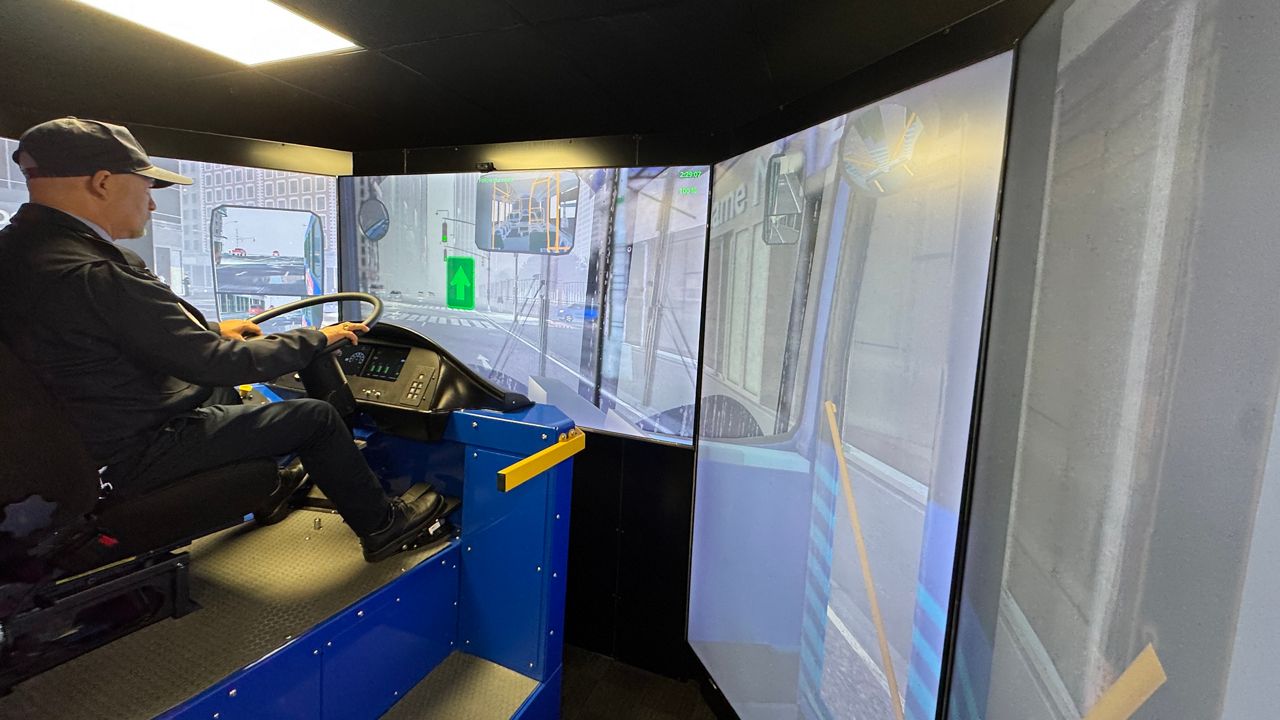
Veteran MTA bus operator Edison Obando knows the challenges of navigating New York City streets behind the wheel of a bus.
So when he climbed into one of the MTA’s new driving simulators, he said the experience felt strikingly familiar.
“It’s like driving a bus you feel like you are driving it, when you hit the brakes it stops, hit the gas it moves, pretty real,” said Obando, who has spent 20 years driving buses and currently operates a route in Flushing.
What You Need To Know
- The MTA has new simulators to help train new bus operators
- There are three simulators in the Bronx and one in Brooklyn
- The state-of-the-art simulators allow for operators to experience all types of road and weather conditions before beginning training in an actual bus
The MTA recently introduced four state-of-the-art simulators designed to help train new bus operators before they begin driving actual buses on city streets. Three simulators are located at the Zerega Training Center in the Bronx, while a fourth is based at the Spring Creek Depot in Brooklyn.
The technology allows trainees to experience a wide range of road and weather conditions in a controlled environment.
“They can experience heavy traffic, heavy pedestrian traffic, bicyclists, all types of stuff on the road before we actually put them on the road so they can operate the bus in the snow. We can throw all types of weather conditions for them: snow, rain, wind,” said Alvaro Brandon, a former bus operator who now serves as assistant chief training officer for New York City Transit buses.
The simulators recreate the challenges operators may face across the five boroughs, helping trainees build skills and confidence before driving passengers.
NY1’s Roger Clark also tested the simulator and quickly discovered how realistic it can feel, colliding with a utility pole and narrowly missing bollards and another vehicle during the session.
At the end of each simulation, operators receive a performance report card that evaluates their driving.
Brandon said the new technology will play an important role in improving safety for both operators and the public.
“This is an incredible tool. I’m glad we have it; this is going to reduce accidents; it’s going to save lives. What we can simulate on this translates to safety on the road,” Brandon said.
The MTA expects more than 4,300 bus operators to train on the simulators each year.