NEED TO KNOW
-
A 68-year-old woman developed blue-gray skin discoloration after taking minocycline for rosacea for just two weeks
-
Minocycline-induced hyperpigmentation is a known side effect but typically occurs after months of treatment, not weeks
-
Doctors advised stopping the medication as the discoloration may persist and require laser or other treatments to fade
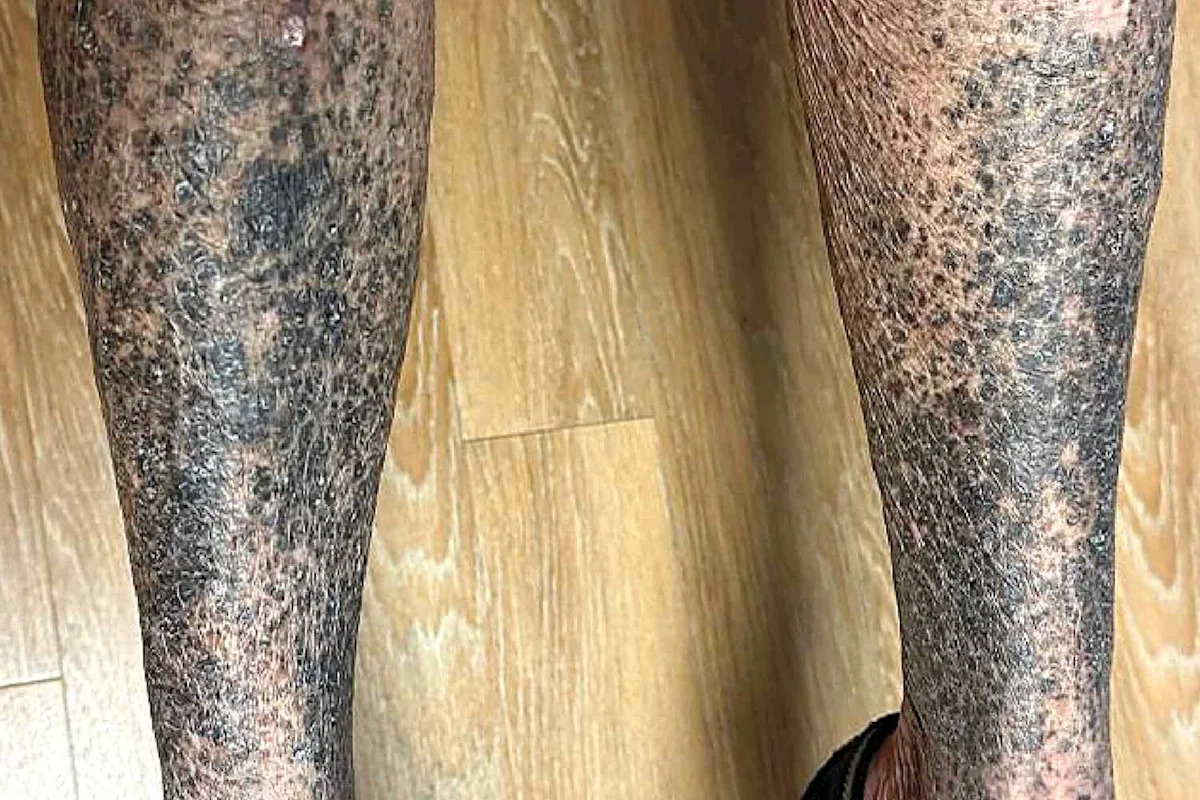
A woman developed “blue-gray hyperpigmentation” on her arms and legs after taking medication to treat her rosacea.
The 68-year-old patient sought medical care after struggling with a “6-week history of dark patches on the skin of her arms and legs,” according to a report in the New England Journal of Medicine. Two weeks before the dark patches began to appear, she’d begun taking 100 mg daily of oral minocycline to treat rosacea, a chronic skin condition that often develops after age 30, and may begin as flushing or redness on the cheeks, nose, chin and forehead. But as the National Rosacea Society explains, “bumps and pimples” may develop.

After 6 months, the patient still had discolored spots on her skin
Credit: The New England Journal of Medicine ©2026
It’s those “inflammatory lesions” that can be treated by minocycline, per Mayo Clinic.
The dark patches, which first appeared on her legs, were “asymptomatic,” but “blue-gray hyperpigmentation” eventually developed on her forearms and the sides of her tongue. Doctors diagnosed her with “minocycline-induced hyperpigmentation,” explaining that it’s a “well-recognized adverse effect of minocycline.”
Never miss a story — sign up for PEOPLE’s free daily newsletter to stay up-to-date on the best of what PEOPLE has to offer, from celebrity news to compelling human interest stories.
Although it’s a known side effect, it generally develops after “months of treatment” — not two weeks, as in this patient’s case. She was diagnosed with Type II hyperpigmentation (blue-gray discoloration of normal skin), but patients may develop Type 1 (blue-black spots in scar tissue), Type III (“muddy-brown” spots on areas exposed to sun), and Type IV (which is like Type III, but in scar tissue), per the National Library of Medicine.
She was advised to stop taking the minocycline and steer clear of sun exposure. Six months after she was seen, the “hyperpigmentation had abated somewhat” — but hadn’t disappeared entirely, according to the journal.
Patients who take minocycline should be warned of the risks, as skin changes may persist — requiring deeper treatment with lasers and other therapeutic options to remove the dark patches.
Read the original article on People