
The San Diego Community College District will use the next six months to study the costs and complications associated with bulldozing San Diego’s aging Golden Hall event venue and building in its place a museum and educational building potentially complemented by student housing.
The evaluation period is made possible by the memorandum of understanding, or MOU, signed Monday by San Diego Mayor Todd Gloria and San Diego Community College District Chancellor Gregory Smith.
The agreement gives the community college district access to the property to assess whether the educational center is physically possible and financially feasible. It also prohibits the city from shopping the Golden Hall site around to other parties during the six-month period.
The MOU marks an incremental step forward in the renewed push to remake the city’s deteriorating Civic Center complex in the heart of downtown San Diego — starting with Golden Hall.
The San Diego Community College District redevelopment proposal, which first materialized in January, centers around creating a more distinguished home for the institution’s growing collection of African art, currently housed in the library at Mesa College. The agencies initially planned to enter into a formal negotiation period, but have since agreed to let the district conduct due diligence on the site before graduating to more serious talks.
The six-month MOU period will either cement the relationship or end in a parting of ways.
“The mission of our district is to serve the community and to be able to bring resources into the community, like the World Art Collection,” Smith told the Union-Tribune. “This MOU allows us to move into the next step of really understanding if this is something we can do and how we can do it, and then being able to say, with some certainty, we believe we can get this done and we can bring this resource to San Diego. So it’s a very exciting step forward in this conversation.”
Gloria characterized the agreement as a smart way to look at repurposing the city’s real estate assets.
“This is about putting a major civic site to better use for San Diegans,” Gloria said in a statement. “Golden Hall has served our city for nearly 70 years, and now we have an opportunity to transform it — making sure it delivers more value through education, arts and community use.”
Built in 1964, Golden Hall takes up roughly one block of San Diego’s Civic Center complex, bounded by A Street and C Street to the north and south, and First Avenue and Third Avenue to the east and west. The municipal quad also includes the City Administration Building (aka City Hall), the Civic Center Plaza office tower, the Evan V. Jones Parkade parking garage and the Civic Theatre.
For most of its history, Golden Hall served as a convention, event and concert venue, although it was used as a homeless shelter in more recent years. The facility has since fallen into disrepair. The city offered the property for sale or lease in 2023 alongside the other Civic Center assets, with Gloria’s idea at the time to generate proceeds to fund the construction or purchase of a new City Hall. But the solicitation failed to attract developer interest.
The community college district’s recent interest in the Golden Hall site was facilitated, in part, by San Diego’s Prebys Foundation. The philanthropic organization is the benefactor behind a new vision — drafted by urban planning firm U3 Advisors with stewardship from the Downtown San Diego Partnership — for the entire concourse.
The museum proposal is viewed as the first step in bringing to life the bigger vision, which seeks to redefine the civic core as a dynamic arts and education hub with world-class public space and thousands of apartments.
Design Distill
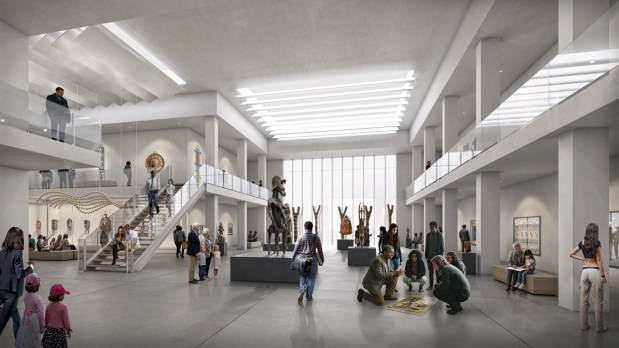
An illustrative view of the vision for San Diego Community College District’s World Art Collection Gallery. (Design Distill)
On the Golden Hall site, the community college district is looking to build a 50,000-square-foot facility that features a 20,000-square-foot gallery space for the World Art Collection. The collection includes more than 1,300 pieces from Africa, the Pacific Islands, Mesoamerica and the continent of Asia. The five-story building would also have classrooms for visiting faculty and students, an auditorium for lectures and collection-related performances, a retail and cafe venue, and storage space.
In addition, the community college district wants to look at erecting hundreds of residential units for students alongside the arts-and-education building, although the housing portion of the proposal is not yet defined, Smith said. The district is also in early talks with San Diego State University, the San Diego Unified School District and other academic institutions about participating in the project.
The project, however, introduces a host of challenges, starting with the demolition of Golden Hall.
The basement of Golden Hall, which occupies roughly 60% of the building’s footprint and extends into the plaza, houses the central power plant that serves all buildings in the Civic Center complex. Demolition of the event center would not only sever the connection between the power plant and the other buildings but could jeopardize the complex’s structural integrity, according to a preliminary review.
And there are other unknowns.
“The environmental part of it will be, probably, the biggest question mark and the scariest piece of it,” Smith said. “If there’s any remediation that needs to be done that can add multiples of cost.”
The MOU is structured to let the community college district complete a feasibility analysis before negotiating with the city more specifically on a real estate transaction. The analysis will review existing site conditions, identify environmental or hazardous materials conditions, determine permitting requirements, locate the best placement for the project and better estimate costs.
“(The due diligence) will give us far more concrete estimates of what the cost will be and what the scope of the work will be. And that’s ultimately going to determine whether or not we can move forward,” Smith said. “If it’s overly costly or complicated, then we may not be able to do it. And we’ll know that at the end of this, or we’ll know that we can move forward. That’s the stage we need to get to. I need to have much more precise information to present to my board.”
If the community college district opts to move forward, the city and the district will then need to hammer out the terms of an exclusive negotiating agreement. The formal contract will require City Council approval.
This story is developing.