
(Disclaimer note: I, Streetsblog Editor Joe Linton, do not claim to be a neutral observer here. Outside of my Streetsblog reporting, I have repeatedly challenged the city’s Measure HLA inaction – including city use of loopholes including “large asphalt repair” – in court and at the Board of Public Works. I don’t have a financial stake in this, but I am an interested party in Measure HLA matters.)
The L.A. City Public Works Department Bureau of Street Services (StreetsLA) quietly resumed street resurfacing after an eight month hiatus. StreetsLA resurfacing project information only appeared on the bureau’s website in the last week or so. StreetsLA appears to be continuing practices that avoid triggering upgrades to accessibility and multi-modal mobility.
Starting July 1 2026, StreetsLA went all in on “large asphalt repair” (LAR). Instead of fully resurfacing from curb to curb, the city would leave a small strip of old cracked asphalt next to a large section of new asphalt. This short SBLA video shows what that LAR practice looks like.
The city has not made any public statement acknowledging that it did shift to LAR, nor why it shifted to LAR. But LAR appears to be a questionable ploy to avoid complying with federal disability law (Americans With Disabilities Act – ADA) and city multimodal law (Healthy Streets L.A. – Measure HLA).
ADA requires the city to ensure sidewalks/crosswalks/curbs are accessible to people moving by wheelchair. New federal ADA requirements, called PROWAG (Public Accessibility Right-of-Way Guidelines), went into effect in early 2025. PROWAG firms up a longstanding requirement that cities add curb ramps (and more) during resurfacing. HLA requires L.A. City to add planned bus/bike/walk/access facilities during resurfacing.
It appears that terming a resurfacing as a “repair” arguably makes it somewhat plausible for the city to claim resurfacing projects are more like “repairing/maintaining,” and not “altering” (triggering ADA) nor “paving/modifying/improving” (triggering HLA).
Recent Streets for All (SFA) data analysis concluded that the city’s LAR practice is not working to maintain city streets in good repair. SFA found that LAR costs the city significantly more than resurfacing. Per square foot, LAR costs $6.80, while regular repaving cost $3.30.
The StreetsLA current statistics and data webpage includes spreadsheets that list and quantify StreetsLA resurfacing output. The site lists the date and location of completed repaving, including separate spreadsheets for Resurfacing and Large Asphalt Repairs.
In late 2025, based on street conditions and StreetsLA spreadsheets, The Future Is L.A. and Streetsblog reported that StreetsLA stopped resurfacing streets on July 1, 2025.
StreetsLA told the L.A. Times (in January) and Streetsblog (in February) that non-LAR full resurfacing would resume during the current fiscal year (which ends June 30). But StreetsLA would not state where or when resurfacing was anticipated to take place. As of late April, StreetsLA spreadsheets showed that the bureau had completed no resurfacing projects since July 1, 2025.
Then, last week, StreetsLA’s Resurfacing spreadsheet showed where and when the city has resumed resurfacing.
 StreetsLA resurfacing spreadsheet (screenshot taken today) showing that resurfacing resumed in mid-March after an eight month hiatus – detail below
 Detail mark-up of above StreetsLA Resurfacing output showing eight month gap. StreetsLA is reporting no completed resurfacing between June 30, 2025 and March 15, 2026.
There is a lag in the data StreetsLA shares with the public; these resurfacing spreadsheets are not continuously updated, but updated sporadically. So, as of today, StreetsLA data shows that there was an eight and a half month resurfacing hiatus; no resurfacing projects were completed after June 30, 2025 until March 15, 2026.
Should the public rejoice that the city is repaving streets again?
The data just appeared last week, so too soon to tell conclusively, but preliminarily: No.
It appears that StreetsLA has reverted to April 2024 anti-HLA strategy of quietly pausing essentially all resurfacing projects that would trigger HLA. HLA triggers upgrades on Mobility Plan network streets designated for bus, walk, and bike facilities; these are located primarily on larger streets. Further, HLA triggers upgrades on paving projects 1/8th mile or longer; so StreetsLA appears to be avoiding longer repaving projects on arterials. This means that a lot of city resurfacing favors smaller streets. Many people moving through L.A. are well aware that this approach has resulted in degraded pavement on many larger streets. (See HLA timeline.)
Regarding ADA, the city has been coordinating some new curb/sidewalk work to precede some street resurfacing (a needed positive practice that the city should probably do a lot more often). But it appears the the city is also cherry-picking street segments that do not need additional ADA work. In some places, this can mean resurfacing up to the crosswalk, but not resurfacing the crosswalk. That practice is hostile to pedestrians and wheelchair users. It also makes the city vulnerable to ADA lawsuits. Federal ADA law guidance notes that “resurfacing only between crosswalks may be regarded as an attempt to circumvent a public entity’s obligation under the ADA, and potentially could result in legal challenges.”
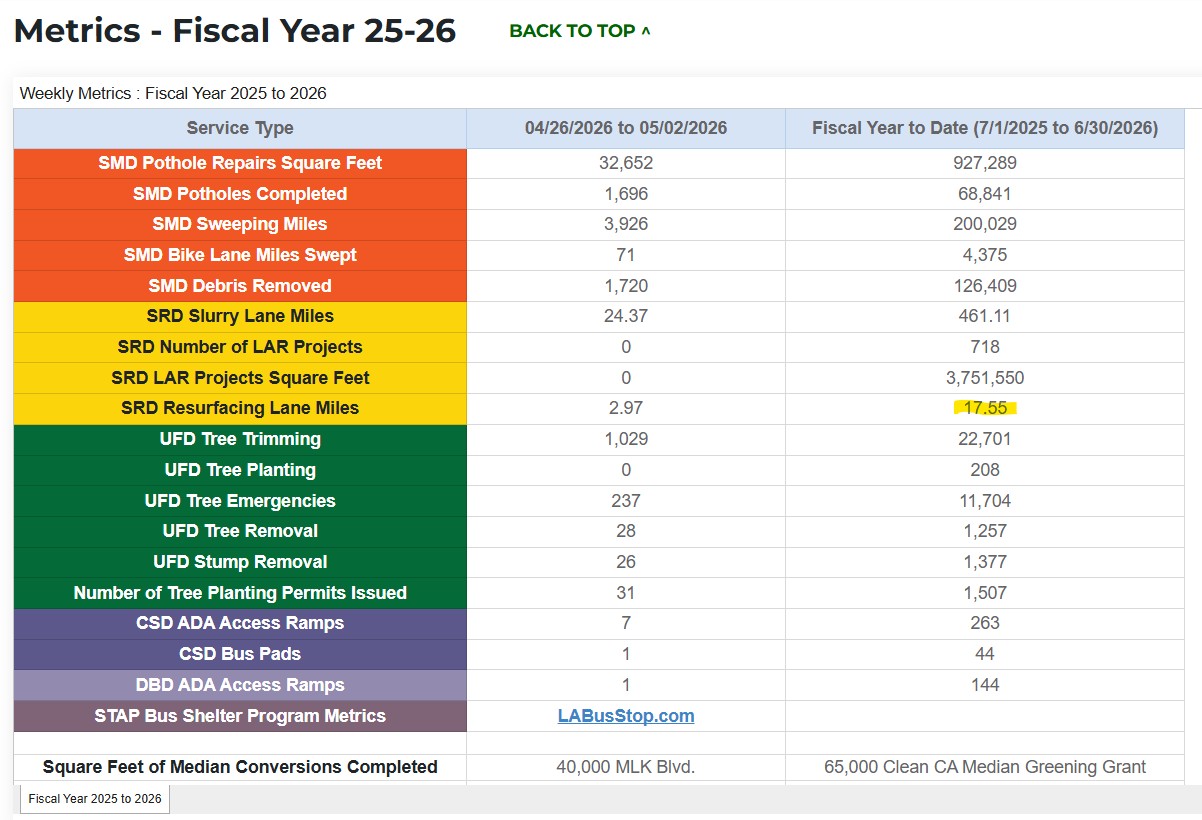 Today the city dashboard shows StreetsLA has completed 17.55 Lane Miles of resurfacing this year
As of today, the StreetsLA dashboard (updated weekly) reports that the bureau has completed 17.55 lane miles of resurfacing this fiscal year.
Last fiscal year (July 2024 to June 2025), StreetsLA resurfaced 312 lane miles. This fiscal year, the City Council and Mayor had approved StreetsLA’s budget to include approximately 280 lane miles. Depending on how it is measured (if LAR is included in resurfacing or not) StreetsLA appears to be on track to complete ~60-160 lane miles of resufacing this fiscal year – less than half of last year’s output.
Unless StreetsLA changes its current processes, it looks like Angelenos will have a bumpy road ahead.