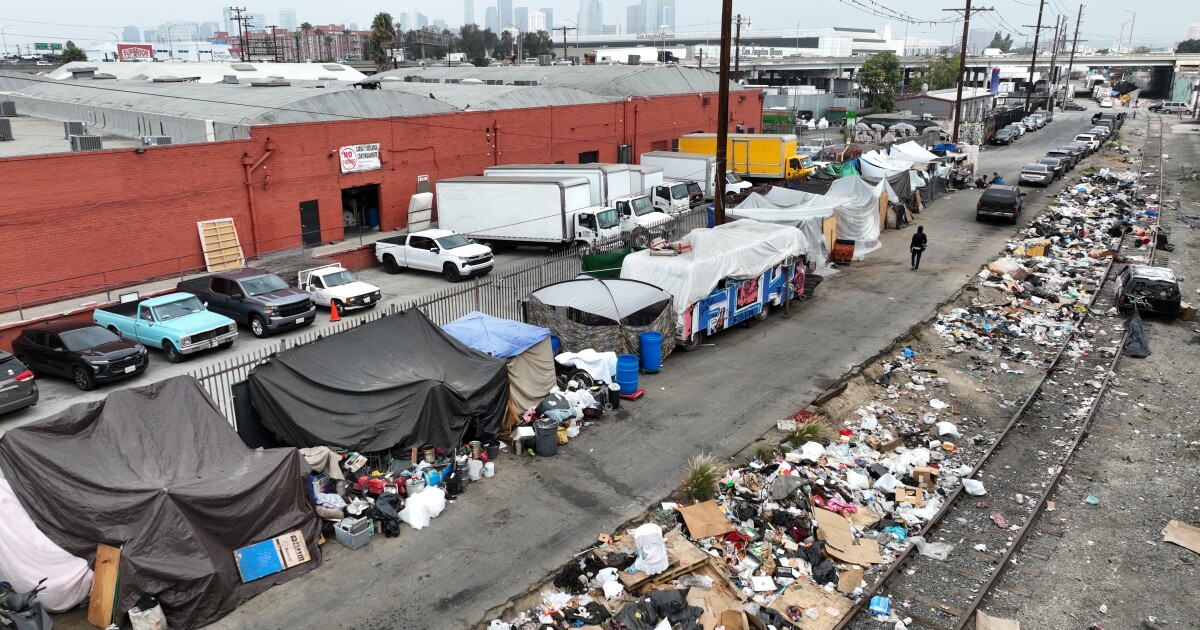
Three candidates for the job of leading Los Angeles laid out competing visions this week for how they would handle the city’s homelessness crisis and disagreed about Inside Safe — Mayor Karen Bass’ program for moving people off the streets.
During part of a two-day forum Monday, Bass defended her signature program, which clears tent encampments by offering motels rooms and other temporary shelter, as well as her administration’s record on homelessness.
She promised, if she won a second term, to build a larger temporary shelter system and to fix problems that have slowed payments from the city to nonprofit organizations.
“L.A. has decreased street homelessness two years in a row, 17.5%,” Bass said, speaking to a gathering of homeless-service providers. “The only reason that happened is because of everybody in this room.”
Learn the ins and outs behind L.A.’s housing crisis.
Sign up for Building Your Block, a seven-issue newsletter course from LAist that explains the obstacles around housing development in L.A. and what you can do to make things better.
A day later, Councilmember Nithya Raman and tech entrepreneur Adam Miller suggested alternatives to Inside Safe, noting its cost.
Raman said she would scale up a different city program — Time Limited Subsidies, sometimes referred to as rapid rehousing. The program provides temporary rental assistance at about one-third the cost of Inside Safe, according to the city administrative officer.
Miller said he would phase out Inside Safe entirely and replace it with tiny-home villages at a fraction of the price of Bass’ program.
Homelessness is a major issue for voters in the June primary. More than 43,000 people remain unhoused in the city of L.A. despite years of record city spending — about $1 billion annually in recent years, according to the City Controller’s Office.
Fourteen candidates are running for L.A. mayor. The top five leading contenders were invited to the forum held in downtown L.A. and hosted by homeless shelter operator Hope the Mission.
Candidates Spencer Pratt and the Rev. Rae Huang declined to participate.

Mayor Karen Bass spoke Monday at the Original Pantry Cafe in downtown L.A. at at event hosted by homeless shelter Hope The Mission.
Housing First?
The candidates disagreed on “housing first,” an approach to homelessness assistance that prioritizes getting unhoused people into permanent housing without first requiring them to be sober, employed or meet other conditions.
Bass said she believes in the policy but argued the city has applied it too rigidly for decades, leaving people unsheltered while they wait years for permanent housing to be built.
“I agree with the notion of housing first, but I don’t think people should be on the street waiting for you to build something,” Bass said.
Raman, an L.A. City Council member since December 2020, said the question isn’t what comes first but what each person needs. The biggest gap right now is mental health resources, she said.
“When I see someone who’s on the street who has deep mental health challenges, I can’t get any help for them,” Raman said. “I can’t get somebody out there to help them.”
Miller, who is CEO of homelessness nonprofit Better Angels, said L.A. needs to move away from housing-first policies in favor of more temporary shelters coupled with treatment and other support.
“Housing first doesn’t work,” Miller said. “We have to stabilize them in interim housing first with services and then move them to permanent housing.
“That’s the only way we’re gonna keep people off the street.”

L.A. City Council member Nithya Raman spoke Tuesday at the Original Pantry Cafe downtown.
Inside Safe
Since late 2022, the city has spent more than $390 million on Inside Safe to clear 121 homeless encampments and place about 5,800 people into interim housing, according to the regional Los Angeles Homeless Services Authority, known as LAHSA.
About 25% of those people are currently living in permanent housing, according to LAHSA. About 30% of them reside in temporary shelters. About 40% have returned to homelessness.
According to a February report by Los Angeles’ city administrative officer, the average nightly cost of an Inside Safe motel room is about $225.81, or roughly $82,420 a year. That’s compared to $86.37 per night for other shelter options.
Bass defended the program but said it needs to bring down costs. She said she’s exploring the possibility of building and operating shelter sites on city-owned land to reduce leasing costs.
Raman said people are staying in temporary shelter for more than a year — comparing it to being left in an emergency room.
“I believe in encampment resolution,” she said. “What I don’t believe in is bringing people indoors and then just leaving them there with no support and no resources.”
Miller said he would try a different approach, tiny-home villages, but acknowledged that ending Inside Safe would take time.
“You can’t turn it off Day 1 because we’d have too many people that are back on the street,” he said.
The average construction cost of a tiny-home village is about $42,000 per unit, according to the nonprofit A-Mark Foundation.

Adam Miller, CEO of homelessness nonprofit Better Angels, argues L.A. needs a political outsider to get the homelessness crisis under control.
Ending homelessness
Each of the candidates expressed a desire to make big reductions in the city’s unhoused population over the next few years, and perhaps eliminate it entirely.
Bass pointed to a 17.5% reduction in street homelessness over two years and said her goal for a second term is to end unsheltered homelessness — meaning those living on the streets — not just manage it.
“There’s no reason for us to have street homelessness by the end of the next four years,” she said. “There just really isn’t.”
Raman said she shares that ambition. She had already pledged to reduce street homelessness by at least 50% before the 2028 Olympics and “eliminate long-term encampments.”
“I think we can end street homelessness in this city,” she said, “but we cannot just pay lip service to it.”
Miller’s campaign platform includes a goal to reduce street homelessness by 60% and reduce homeless encampments by 80%. Miller has not previously held an elected government office, but he argued the city needs fresh leadership more than it needs political experience.
“L.A. has lost hope,” he said. “We need to have the belief that this is a problem that can and should be solved.”
The primary is June 2. If no candidate receives more than 50% of the vote, the top two vote-getters will advance to face each other in a November runoff.