
Note: Aliases have been used in place of the names of the following sources due to safety concerns.
The Aspiring Scholar and her older brother split the cost of an Apple AirTag and secretly stuffed it into the bottom of their mother’s purse to track her location.
The recently-certified Scientist appoints herself the responsibility of picking up her brother from school, since their father’s car—an old, “beat up” sedan with chipped paint that makes rattling noises—would draw attention.
When The Aspiring Filmmaker isn’t accumulating sweat at cramped warehouse raves until the sun rises, or geeking out over silent films with friends in his family’s living room, he sits alone, wrestling with the decision to self-deport with his parents and two younger sisters, or to stay back in the U.S. and survive on his own.
Different roots; different lifestyles; different stories that have each taken an unwarranted turn amid the government’s mass deportations.
Whether they are U.S. citizens or undocumented immigrants themselves, the children of undocumented parents are facing a new reality that forces them to reverse roles with their parents and take initiative. As they begin their climb up the mountain of life’s endeavors, the weight of re-invented immigration policies meets them at its peak.
ICE hasn’t stopped roaming the streets of Los Angeles. Despite a decrease in media coverage since the height of the raids in early 2025, people are still being kidnapped off sidewalks and out of parking lots, and families continue to be torn apart.
Twenty-three years after its creation, ICE has surpassed an unprecedented level of aggression in the past year.
Each day, the sons and daughters of undocumented parents engage their sixth senses for spotting suspicious-looking vehicles shielded by tinted windows, cones that could lead to a DUI checkpoint, which may subject them to revealing their immigration status, and men dressed in uniform.
Their own fears become outweighed by their parents’ need for protection. They pray their youth saves them from ICE interference. They’re conscious of the ageism that may spare their safety, but not their mothers and fathers.
 Graph revealing predominately targeted ages. Created by Sebastian Zapata.RecommendedTHE ASPIRING FILMMAKER
At 23 years old, The Aspiring Filmmaker is met with a pit in his stomach and “lingering cautiousness” each time he steps out of his house. He fights his eager urges to selfishly live the life of any young adult in Los Angeles, with thoughts of losing his family to deportation.
On what was supposed to be a short visit to the U.S. in 2016, The Aspiring Filmmaker and his parents and two younger sisters found themselves living with their grandparents in a two-bedroom apartment—slipping from tourists to U.S. immigrants in pursuit of the American Dream.
The family of five was only in the country for three months before Trump’s first presidency snuck up on them. The unfortunate timing put them at a disadvantage, preventing them from applying for asylum because they arrived in the United States “under the pretense of a vacation.”
They were unable to apply for DACA and struggled to find a lawyer. Out of options, his parents began feeding him the idea of marrying a citizen so that he could receive citizenship himself and then advocate for his family. That same plan persists today, with even greater pressure and desperation.
The Aspiring Filmmaker and his family have held onto the understanding that they can be caught and deported at any instant since their move from the Philippines 10 years ago. The subconscious fear stayed with them, as each became further embedded into American culture.
“Moving here, I discovered art, I discovered my passions of filmmaking and I discovered music,” the 23-year-old says.
From finding his footing on U.S. soil—after not wanting to leave his native country—and building a name in the city’s art scene, the ground below him now feels unstable.
 The Filmmaker with his treasured vintage film camera. Photo by Odessa Hairapetian for L.A. TACO.
Trump’s taking of the Oval Office in 2025 introduced a lurking presence that paralyzed the streets of Los Angeles. Families with undocumented members were thrown into a prolonged state of fear, where new strategies were discussed to stay out of trouble. Days were taken off work, certain neighborhoods were avoided, and heads were kept low.
“Ever since I moved here, I’ve lived with this kind of underlying knowledge that [deportation] could happen—that we get caught,” says The Filmmaker. “But now it’s evermore present.”
His mother, an employee at one of Downtown’s numerous warehouses, began a nearly-frequent schedule of missing work, sick from a “gut feeling.” Employed within a deportation hotspot, she’s seen the toll-booth worker of the warehouse’s parking garage get taken by ICE right in front of her, as she was on her way home. His father, a caregiver who can’t afford a day off, had surrendered his social life upon their move in 2016—in hopes his son would not have to lead a similar life.
Between picking up his sisters from school and stepping out to buy groceries when his mom keeps herself in their home, The Aspiring Filmmaker pursues an extroverted lifestyle that puts his safety at risk. After his late-night outs, he’s welcomed home by a scolding father who restricts his own freedom for the safety of their family.
“He’ll be like, ‘I don’t do anything, and that’s so we don’t get caught. If you get caught, that fucks everything up,” says The Filmmaker, recounting his father’s words.
Young, with dream opportunities awaiting him and memories still to be made, the 23-year-old wears layers of guilt that bleed into his every decision. Not only does he have to decide whether to attend various events, but he also faces an ultimatum from his family that could determine his future.
“My parents have talked about—if it gets too bad—them and my sisters might voluntarily deport themselves just so they don’t have to go through the trauma of going through the detention center,” The Filmmaker says. “They proposed that I can decide either if I want to go with them . . . that’s kind of been something that eats at me of thinking ‘If they go, do I go with them? Do I stay?’”
He and his family could end up in the hands of ICE agents—throwing away years of successfully dodging them—from his desire to experience the world like his peers. On top of being hypervigilant of the environments he crosses and calling it a night hours before his friends do, he’s forced to envision a life without his family, should the time come.
Recommended
“He’s definitely become more cautious in the last year,” says a close friend of his from their community college’s film club.
Throughout their friendship, she’s seen a gradual shift in his personality, watching him grow hyperaware and self-limiting. At a recent party they attended, he only stayed 20 minutes before leaving from a “gut feeling” that he would be stopped by the cops on his way home.
“That’s very unlike [The Aspiring Filmmaker],” she says. “[He] will stay at a party for as long as possible.”
Still, he eagerly pursues his dream of becoming a filmmaker against all odds, even if it means subjecting himself to the public eye. Though uncertain with other areas in his day-to-day reality, his passion for filmmaking remains one of the few absolute truths.
“I often have daydreams and fantasies of moving to Brazil, or moving to Mexico, or Spain, and starting out there just with the clothes on my back and some of my camera stuff,” says The Filmmaker.
Despite his parents’ expectation that he lead a life without adventure, socialization, or new experiences, he tackles each day as if it were his last minutes of freedom. The horror stories following ICE’s rampages push him to find a balance between freedom and secrecy.
THE SCIENTIST
Browsing through her closet, the recently-certified Scientist searches for a “casual-cute” outfit and re-paints her old nail polish to compensate for her brown skin and black curly hair—features that get manipulated into stereotypes—in preparation for a job opportunity.
“How they see you is how they treat you,” says the 25-year-old Scientist, who obtained her degree in biology and chemistry last year.
Dressing nicer to avoid racial profiling is a sentiment that has been passed down from her mother, who builds a presentable appearance whenever leaving the comfort of their home. Today, for their own safety, they dress themselves through the eyes of those who oppose their identity.
In 2013, the family of five came to Los Angeles from Mexico on a tourist visa, following her father’s growing business in natural goods. While her father hoped to change that to a business visa, granting their family the ability to live and work in the United States, Trump’s 2016 presidential win jeopardized their chances.
He would have had to begin the process back in Mexico. With no guarantee of succeeding with either a renewed tourist or business visa, he resisted from the fear of being separated from his family.
Trump’s election introduced her and her older brother to the sense of their family’s differences as undocumented immigrants, from those around them. Political comments from their classmates began to feel targeted, and rumors about ICE in nearby cities crept into their nervous systems.
“Back then, I didn’t feel fear,” says her older brother, age 28. “I only felt it as hate speech . . . I never really thought it would get more intense like how it’s gotten.”
As of the past year-and-a-half, she and her brother no longer perceive ICE as a nightmare phenomenon, but as a personal threat.
The devoted Christian family began to miss their weekly Church attendance, confined themselves to their home to evade potential street sweeps, traffic stops, or checkpoints, and asked their other brother with Down syndrome’s caregiver to make grocery runs for them.
With ICE raids still at a high during the 2025 graduation season, The Scientist was unable to see her friend cross the stage. She also missed the first birthday of another friend’s son.
“At those times, because things were so violent, it was better not to risk it,” she says. “But you miss once-in-a-lifetime experiences because of fear.”
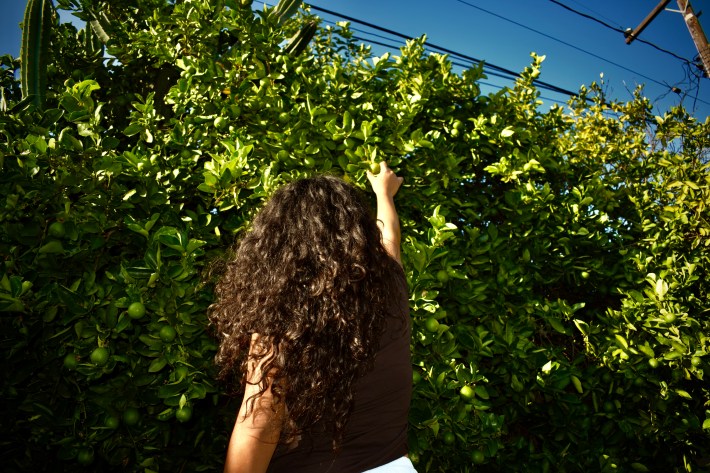 The Scientist picks limes from the tree in her family’s backyard to make agua de limon for dinner. Photo by Odessa Hairapetian for L.A. TACO.
That fear follows them outside their home after they feel comfortable enough to walk out the front door. Sightings of cars with blacked-out windows and bright orange cones on the road quickly raise anxiety, and her evening walks are cut short by cars she feels are driving suspiciously close.
On top of her own terror, she worries about the safety of her parents, whose accents are thick as they struggle to speak perfect English. She steers the wheel for their family drives and has become her brother’s designated pickup from school, since her identity—young, accent-free, English-speaking, with a “nicer” car—makes her less of a target.
Simple pleasures like listening to music and hanging out with friends also carry more weight in her day-to-day life. With her safety on the line, she avoids playing Spanish music at a loud volume depending on the area she’s in, refuses to travel to certain places, and refrains from “looking a little . . . too Hispanic.”
She no longer feels comfortable sharing her story with those she presumes would judge her or wouldn’t understand, and fixates on the disparity of awareness that exists between her friends and her.
“I’ve noticed when I’m with other people, they’re not really thinking about the car that’s right next to us,” she says. “I understand that some people don’t have that on their mind . . . that is on my mind, that is something I carry.”
While the days can feel heavier, their faith guides the family. Together, they pray for their safety as the mornings begin and nights conclude. Psalm 91, specifically—a prayer for protection—has become a pillar of their trust.
“We found a lot of peace in knowing that we’re in God’s hands,” The Scientist says. “If God’s plan was for us to go back, then we know that his way is divine and bigger than ours because we’ve seen it in our lives in many other ways.”
RecommendedTHE ASPIRING SCHOLAR
At 21 years old, The Aspiring Scholar gets ready for the 15 hours of work that lay ahead of her as the sun slowly creeps into the morning sky. After working the early bird shift at her full-time job, serving smoothies to customers who are just starting their own days, she races off to her part-time job, where she prepares hot meals and restocks products at a grocery store until 10 p.m.
She reflects on her two years at community college, where she earned an associate degree, and hopes to return to her studies when the time is right. Her student journey came to a halt when the concerns over her parents’ safety began to rise.
The Aspiring Scholar’s parents traveled on foot from Mexico to pursue a “better life,” lying flat beneath the seats during days-long trailer rides to hide. Her mom arrived a year later than her dad, in 2000, after being caught and detained 19 times, leaving multiple fingerprints and mugshots tied to her name. The couple soon built a family in the same Los Angeles County city where their first U.S. bus dropped them off.
After having their three American-born children, they had not yet sought U.S. citizenship for themselves.
“They just assumed that we [their children] would turn 21 and then boom, we could get them filed for papers,” says The Aspiring Scholar and the family’s only daughter.
When the oldest son turned 21, the family found that their plan wouldn’t succeed, as the mother would have had to make a perdon—an ask for forgiveness permitted by the government. Because of her prior detainments, she’d be required to go back to Mexico for three years for each of the 19 times she was caught. As it would be a risk for the family, with no guarantee of their mother’s return, they decided not to follow through.
Her parents have been well aware of their identity and circumstances. Predominantly white areas are avoided, and going to school in San Diego was “never an option,” as their parents wouldn’t be able to visit. They feel “uncomfortable” in spaces where they may be ostracized for their features and accents, so they stick to smaller, local spots where they don’t feel judged.
“They get stressed even getting dressed to go eat at Olive Garden,” The Aspiring Scholar says. “They just feel uncomfortable because they can’t speak the language, they have a thick accent, they just feel stared at . . . they just feel like ‘This is not where we belong.’”
Today, they’ve limited their family outings to those comforting, safer restaurants following the mass ICE raids. Their lives, already walking a tight rope, became even more restricted.
The Aspiring Scholar’s father, who has worked in construction for years, felt reassured about his own safety in that he was the only Latino in his crew. That was until news of raids and ICE sightings began to appear closer to his job sites.
As the “sole provider” of the family, there were days he’d stay home from work out of fear of being taken. On other days, his children would separately drive his route to work just minutes before he did to make sure they were clear of ICE activity.
Her mother began to stay home from all her already-limited outings, like shopping at Marshalls, grocery runs, and walks around the neighborhood. She grew frustrated with “hiding” inside her own home and broke down in tears over the loss of her independence. After fighting with her own children over the restrictions imposed on her, The Aspiring Scholar and her older brother secretly purchased an Apple AirTag and snuck it into her everyday purse to keep watch over her.
On top of dropping out of school and working two jobs to help support her parents, The Aspiring Scholar, along with her two brothers, buys groceries for the family—the youngest, sometimes, bringing home the wrong products since “he’s young, so he doesn’t exactly know a good avocado,” she jokes.
She gained access to her father’s bank account information in case the worst-case scenario became reality. She will also receive legal custody of her undocumented cousin’s 3-year-old baby, should the mother be deported.
“It’s scary to think about because, I mean, I’m 21. The baby’s three,” The Aspiring Scholar says.
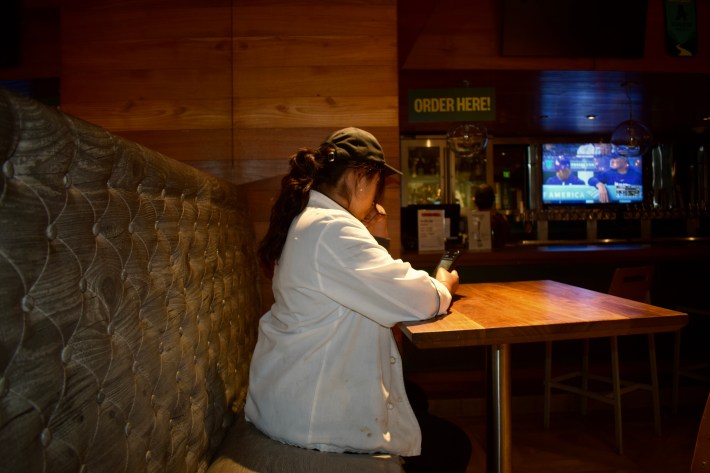 The Aspiring Scholar takes the last 10-minute break of her closing shift. Photo by Odessa Hairapetian for L.A. TACO.
Earlier this year, her mother was diagnosed with dementia and Alzheimer’s. From trying their best to protect their mother from the risks of the outdoors, they now have to brace themselves for each visit to the hospital.
“When we go, we just hope nothing’s there,” says The Aspiring Scholar. “We try to do it quickly and get out of there.”
As the only daughter of a Latino family, she believes it’s her responsibility to step up as her mother’s caregiver. In addition to the anxiety she feels during their drives to the hospital—worried she may get stopped, to or from—and from the long waits in the cold lobby, she feels a “sense of jealousy” when seeing her peers post about their early successes on social media.
“It’s a little stressful because I see my friends move out, have their life, but, you know, it’s okay, I will get that eventually,” The Aspiring Scholar says. “Right now my mom needs me, she needs me to be there, and if I could be there, I will be there for as long as I can . . . I have one mom.”
Frequent tears are inevitable for the 21-year-old. She feels she carries the weight of the world on her back, having to watch over both her parents while trying to build a life of her own. While constantly worrying about her parents’ safety and well-being, she finds peace in knowing that neither of them has any issues with the law—not even a parking ticket—and that they pay their taxes.
She refuses to lose hope that her family will one day be free of worry, and savors their every moment of bliss while she can.
“When we get ice cream and sit down, and we’re laughing, for a second, life feels normal,” The Aspiring Scholar says.
Though at times she’s bitter about the circumstances that put her life “on pause,” she takes pride in the fact that the family’s ever-evolving story has pushed her to be more compassionate and selfless.
“I’ll always think of me, but it’s not just me at this point; it’s my mom, my dad,” The Aspiring Scholar says. “They gave everything up for us; the least I could do is give up a couple of years of my life for them.”