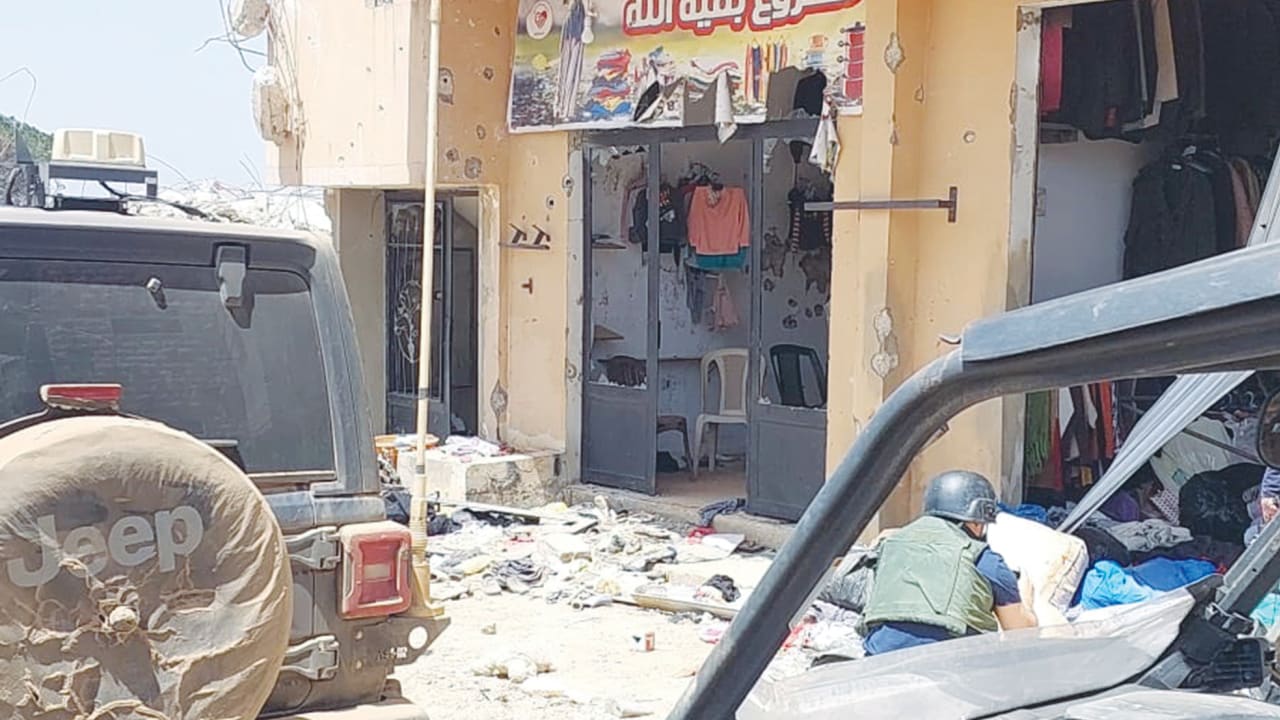
EL-KHIAM, Lebanon – Those looking to understand Israel’s new security doctrine – one born out of the horrors of October 7 – need look no further than El-Khiam, a Shia town in southern Lebanon, just 6 kilometers from Israel’s border.
Once a town of nearly 30,000 people, it is now a pile of rubble – heaps of twisted metal, steel rods, and massive broken concrete slabs where homes and businesses once stood.
Why? Because this was not just a pastoral town surrounded by vineyards and olive trees, but a Hezbollah stronghold, with arms caches stored in people’s homes and Hezbollah command and control centers buried in tunnels beneath the floors of civilian structures, such as an innocent-looking clothing store with a teddy bear hanging on its wall.
El-Khiam was also deeply symbolic.
Once the site of a notorious prison used by the South Lebanon Army, it was overtaken by Hezbollah after Israel withdrew from Lebanon in 2000 and turned into a symbol of Hezbollah’s “liberation” of Lebanon.
 INSIDE THE remains of a small clothing store, where some articles of clothing still hung on racks, the ‘Post’ was shown a 25-meter shaft leading to an underground Hezbollah command center beneath the floorboards, where communications equipment, weapons, and uniforms were found. (credit: HERB KEINON)
But it was much more than just a symbol.
The town sits astride key routes linking southern Lebanon to Hezbollah’s heartland in the Bekaa Valley, making it a central corridor for moving fighters and equipment across the country.
Over the years, Hezbollah transformed it into a major logistical and operational hub, fortifying the area with tunnels carved deep into the rock – a far more difficult and expensive undertaking than digging through the sands of Gaza – and building command posts used to direct anti-tank missile attacks, rocket fire, and potential cross-border infiltration missions by Radwan forces.
Over the years, El-Khiam, with its commanding view of border communities in Israel just to the south, was the site from which Hezbollah had a direct line of fire for anti-tank missiles into Metula and Kfar Yuval – from which it could terrorize those communities at will.
No more.
In place of Hezbollah terrorists peering through gun sights into Metula, what remains of the town is now in the hands of Givati’s Sabar Battalion, and to hear its deputy commander, identified only by the initial of his first name, A., talk about it, they are there for the long haul.
“Our most important goal is that the residents of Metula and Kfar Yuval will no longer endure the anti-tank missiles and direct fire they’ve suffered until now,” he told a group of journalists the IDF brought to the site on Wednesday.
“We are here with a very strong forward defense posture, here to stay for as long as necessary.”
And therein lies the crux of Israel’s new defense posture – one visible not only in southern Lebanon but also along eastern Gaza and in southwestern Syria.
Never again allow forces dedicated to your destruction to sit directly on your border. Not within anti-tank missile range, and not close enough to overrun border communities within minutes, as Hamas did on October 7.
Push them back, and level the towns from which they operated so they will be unable to hide there again.
Is it aesthetic? No. Are the visuals of a once vibrant town now leveled to the ground going to win friends and supporters overseas? Absolutely not.
Israel’s post-October 7 security mindset
But the post-October 7 Israeli security mindset – one which, by the way, the world should realize will not change even if Prime Minister Benjamin Netanyahu is ousted in the coming election – is that the country cannot just allow terrorists to sit on its porch and hope they will be deterred from breaking into or shooting into the house. Instead, the porch must be demolished.
Which is the El-Khiam story.
Asked whether he thought it likely that civilians will ever be allowed to return to live in the town, A. – an officer, not a politician making those decisions or a diplomat trying to explain them – said simply: “I do not see a situation where we leave this area and civilians return here. I think we know from experience that this does not work. Every time people return to a point like this, it simply creates vulnerability and renews the threat to the residents of the North.”
A. said that “we do not have the right or the privilege to abandon this territory,” until a real solution removes the threat and provides security. He didn’t say so, but that would mean the dismantling and disarming of Hezbollah – something few foresee in the foreseeable future.
So in the meantime, the IDF will remain, and the town – formerly a staging ground for attacks against Israel – will not be allowed to be rebuilt.
“We are creating a protective barrier between Hezbollah and the residents,” the officer said, echoing what Amir Shoshani, commander of the local security squad in Metula, said a few hours earlier in an Army Radio interview, heard on the drive to the northern border.
“The state understands that you defend civilians from outside the community, not from within it,” Shoshani said. “Right now, we have residents in Metula, terrorists inside Lebanon, and between the terrorists and the residents stands the IDF – and that’s how it should be.”
The quicker route or the safer route?
IT’S ABOUT a 15-minute ride from Kiryat Shmona to the border fence with Lebanon and a gate that opens into the country, and then another 25-minute ride in an armored tactical vehicle to El-Khiam. The road is jarringly bumpy, the kind that rattles your internal organs, with the vehicle at times hitting bumps so hard that those sitting in the back are jolted off their seats.
There is a quicker route from the fence to the destroyed town, but this one is safer because it is less exposed.
Little is visible from the back of the vehicle through narrow windows, though one can see vineyards punctuated by the sight of destroyed buildings along the way.
During the fighting with Hezbollah in 2024, it took the IDF weeks to reach the outskirts of El-Khiam. This time, after Hezbollah fired rockets into Israel following the February 28 attack on Iran, the IDF moved on the city at lightning speed, doing in a matter of hours what in 2024 took weeks to do.
Commanders on the ground said Hezbollah was caught off guard by both the speed and depth of the Israeli maneuver in early March, not expecting Israeli troops to penetrate this quickly into the town. Intense battles then took place before the IDF took control.
What Israeli troops discovered was a town that was nothing less than a fortified Hezbollah launching pad for attacks on Israel.
Nearly every 30 meters, officers said, there was another tunnel shaft, another underground passage, another piece of military infrastructure woven into the civilian landscape.
The homes themselves were large and well built, evidence, the officers noted, that this was not a place driven by desperate poverty. “The hatred toward Israel and the desire to kill Israelis or Jews exists everywhere,” one officer said.
Underground Hezbollah command center beneath the floorboards
THE GROUP of journalists was met in what was once the center of the town by Col. Y., the head of Battalion 779.
After giving a brief overview of the area, pointing out the town of Marjayoun on a distant hill and gesturing toward the Litani River, Y. led the group into the remains of a small clothing store, with some articles of clothing still hanging on the racks. Beneath the floorboards was a 25-meter shaft leading to an underground Hezbollah command center, where communications equipment, weapons, and uniforms were found.
Y. described an elaborate network linking homes, alleyways, tunnels, and fortified positions. This gave the terrorists the ability to move through large sections of the neighborhood without ever exposing themselves in the street.
For A., the operation also carried personal resonance. The commander noted that in 2014, a Givati deputy battalion commander was killed by anti-tank fire launched from this very area. “For us, this is closing a circle,” he said.
Just as the brigade commander began his explanation of the area, equipped with detailed maps, an aide suddenly interrupted with the words “Air hammer” – code for a drone identified overhead – and the journalists were hurriedly shuffled into the hulk of a destroyed building for shelter.
In the meantime, Givati soldiers scanned the skies and pointed their rifles in the direction of the drone. Gunfire echoed in the distance, and the delegation was later told the drone had been shot down by a soldier using his personal rifle.
The drones, the officers at the scene stressed repeatedly, are viewed by the IDF as a tactical challenge, not a strategic threat – a message echoed so consistently by the commanders on the ground that it was clear the army was trying to reassure a jittery public increasingly focused on the issue.
“The drones do not affect our operational work,” A. said. “We have made adjustments. We operate somewhat differently now, with adaptations that I won’t elaborate on, but the threat is manageable.”
Those adjustments include low-tech solutions such as nets and protective coverings, along with soldiers tasked with constantly scanning the skies for incoming drones.
One officer said the experience had reinforced an old military lesson: “Simple, old-school fieldcraft is often the most effective solution – not relying solely on technology.”
Another company commander argued that Hezbollah’s growing reliance on drones reflected weakness more than strength.
“It shows how desperate and afraid they are, and how much they don’t want to engage the IDF in direct combat,” he said.
What El-Khiam illustrates is that Israel is no longer relying solely on deterrence to prevent terrorist attacks, but is instead taking operative steps to deny its enemies the capability to carry them out in the first place. The goal is not only to weaken the enemy’s desire to attack, but to rob it of the ability to do so from right on the country’s doorstep.
What is taking shape in El-Khiam is not merely a military operation against one Hezbollah stronghold, but the real-time implementation of a new Israeli security doctrine – one that says hostile forces will no longer be allowed to entrench themselves directly along Israel’s borders and threaten civilian communities from just over the fence.
The destruction in this town may draw condemnation abroad, but among the officers operating here, there is little doubt that the country has crossed a psychological Rubicon. The era of relying on deterrence alone ended on October 7.
Or, as Shimoni said in that Army Radio interview: “Right now, we have residents in Metula, terrorists inside Lebanon, and between the terrorists and the residents stands the IDF – and that’s how it should be.