What Californian hasn’t walked along one of our superb beaches only to stumble upon water bottles, cigarette butts, clamshell burger boxes and all manner of nasty plastic trash? We sigh, and plod on.
A Dutch teenager named Boyan Slat experienced similar dismay on a family scuba diving trip about 15 years ago in the Greek islands. But instead of accepting the disheartening ubiquity of plastic pollution, Slat set about looking for a solution.
His quest to rid the oceans of plastic would eventually focus on heavily polluted rivers (the source of an estimated 80% of the plastic that pollutes oceans worldwide), including the concrete flood channels that spew countless tons of trash into the Pacific in Los Angeles County.
You’re reading the Essential California newsletter
Sign up to start every day with California’s most important stories.
By continuing, you agree to our Terms of Service, which include arbitration and a class action waiver. You agree that we and our third-party vendors may collect and use your information, including through cookies, pixels and similar technologies, for the purposes set forth in our Privacy Policy such as personalizing your experience and ads.
A huge source of ocean plastic: river plastic
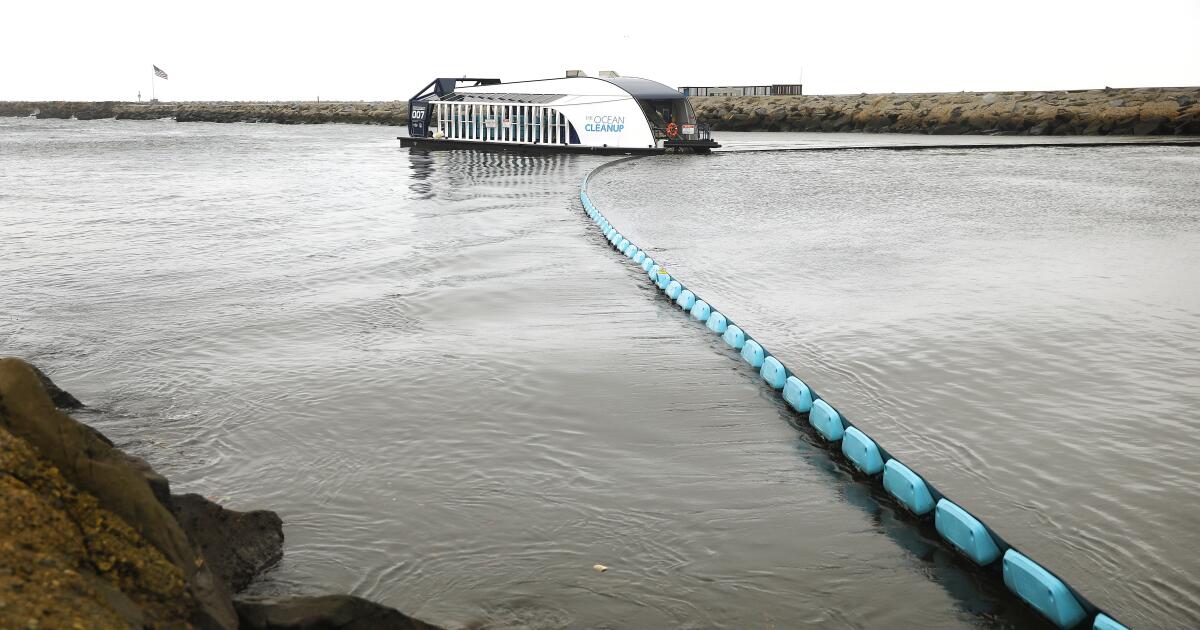
The work brought him to Long Beach this week, to help announce the planned deployment of two mechanized trash “interceptors” that will trap tons of plastic and other detritus near the mouths of the Los Angeles and San Gabriel rivers. When deployed sometime before the summer of 2028, the devices should drastically reduce the foul stew plastic pollution that for years has poured into the Pacific Ocean in Long Beach and Seal Beach — ensnaring birds, fish and other sea creatures while creating an eyesore on our beaches.
My colleague Lila Seidman spent a day reporting at the rivers and much more.
Slat’s nonprofit, the Ocean Cleanup, plans to deploy the plastic-catching systems before the 2028 Olympics in Los Angeles, making them the second and third trash interceptors in Los Angeles County. The organization installed a plastics-blocker in Ballona Creek near Marina del Rey in October 2022. That device has captured 206 tons of garbage that otherwise would have ended up in the Pacific.
“By bringing these interceptors here now to the two other rivers, we should be able to call plastic pollution in Santa Monica Bay and San Pedro Bay a thing of the past,” Slat said in a phone interview Thursday, as he paused during a run near the Santa Monica Pier. “It’s something to look forward to.” Los Angeles County will operate the new interceptors at a cost of between $2 million and $4 million a year, Ocean Cleanup officials said.
The focus of the organization has evolved substantially over the last decade. When I first interviewed Slat in 2018, he was about to deploy a massive cleanup device in the middle of the Great Pacific Garbage Patch, the largest of multiple rotating ocean “gyres” that attract waste like giant drains.
Slat and his team suffered a number of humbling setbacks with the mid-ocean trash collection effort. One early system didn’t effectively collect plastic and then broke apart in a ferocious storm. At other points, the nonprofit “came close to financial death,” he said. “At times it’s been like, how on earth are we going to make this work?”
Los Angeles is just the start
Probably nothing will entirely eliminate plastic in the ocean, given the ubiquity of humans and the tendency of some to thoughtlessly toss trash in or near the water. But Slat’s Netherlands-based organization — with an annual budget of about $50 million and about 200 full-time employees — will not relent in its quest. In recent years, it has focused its work around 30 cities globally that spew a large portion of the waste into the ocean.
The Ocean Cleanup eventually intends to trap and remove plastic in 200 cities worldwide, Slat said. Rivers in the developing world — in places like Malaysia, Jamaica, Guatemala and Indonesia — have been an even bigger source of plastic pollution, given substandard waste management practices. So the Ocean Cleanup also has installed trash interceptors in rivers in those nations.
The dream of a clean ocean
Since the beginning of his crusade, Slat has heard from doubters who wonder whether it’s possible to engineer a plastic cleanup in the midst of powerful seas. Others have called for more focus on reducing the production of plastic products and on improving waste collection. But Slat insists that, in addition to those efforts, the world must focus on removing the plastic already swamping oceans, killing sea life and even making its way up the food chain into humans.
He says the new focus on removing plastic closer to the source, in rivers, has been a big success. And the Ocean Cleanup now has a design — featuring a trash-catching boom that stretches 1.3 miles — that successfully captures plastic, Slat said. His team is putting the finishing touches on a drone-assisted technology that will help to best position the cleanup system in the parts of the ocean with the highest concentration of plastic.
“Everything works now. We know what to do,” Slat said. “It’s just about execution. Execution and funding. Humanity now has all the tools it needs to get back to a clean ocean.”
Today’s top stories 
A surfer goes over the falls on a big wave in Seal Beach during stormy weather.
(Allen J. Schaben / Los Angeles Times)
This coming El Niño could be a monster
- A super-strength El Niño appears to be taking shape in the Pacific Ocean, heightening concerns that Southern California could be in for an extreme rainy season.
- There is now an 82% chance that El Niño is likely to emerge over the next few months, up from the 61% chance estimated a month ago.
California updates its science on two air contaminants
- California officials announced two everyday air contaminants — acrolein and ethylene oxide — may be more than 10 times more carcinogenic than benzene, posing unacceptable cancer risks to the state’s residents.
- California continues to face the nation’s worst air quality, with 82% of residents living in counties with unhealthy air.
What Newsom’s proposed budget means for education in California
- Public school districts would receive $2.4 billion in ongoing special education funding, with Gov. Newsom calling it the largest such investment in California history.
- Los Angeles Unified would likely be able to afford recent union salary raises thanks to increased state education funding and cost-of-living adjustments.
What else is going onCommentary and opinionsThis morning’s must-readOther must-readsFor your downtime 
(Los Angeles Times photo illustration; Photos via Getty Images)
Going outStaying inA question for you: With three new stations open, will you ride L.A. Metro’s D Line?
Judy says, “Yes! Certainly I will take a ride and I did last Friday. It happened to be the first open day and luckily we got a free ride. My oldest son took me there to visit the new David Geffen Galleries for Mother’s Day … I remember a long time ago, I had to struggle to drive over to that area for hours because of traffic. Now I am glad to take the convenient Metro to reach there.”
Email us at essentialcalifornia@latimes.com, and your response might appear in the newsletter this week.
And finally … your photo of the day 
A portion of Route 66 that runs parallel with I-15.
(David Fouts / For The Times)
Today’s great photo is from Times contributor David Fouts along a portion of Route 66, which turns 100 this year.
Have a great day, from the Essential California team
Jim Rainey, staff reporter
Hugo Martín, assistant editor, fast break desk
Kevinisha Walker, multiplatform editor
Andrew Campa, weekend writer
Karim Doumar, head of newsletters
How can we make this newsletter more useful? Send comments to essentialcalifornia@latimes.com. Check our top stories, topics and the latest articles on latimes.com.