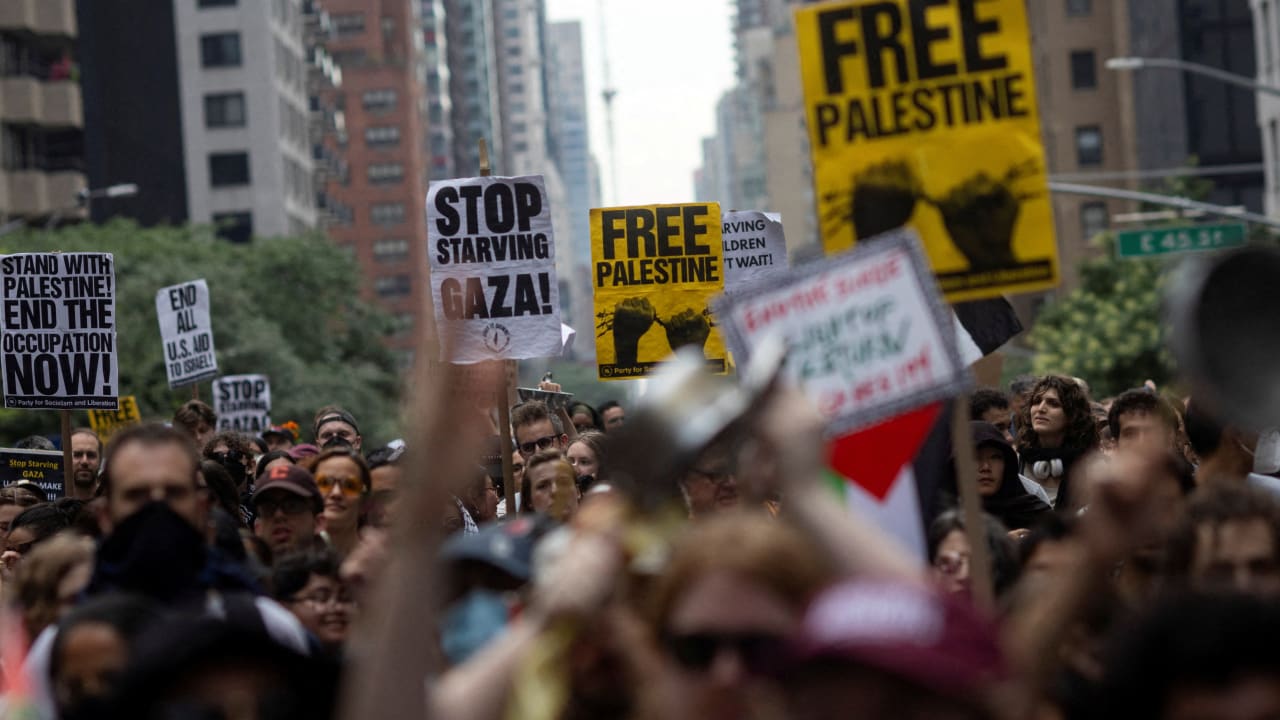
New York, the city that for decades symbolized freedom, pluralism, and acceptance of others, has undergone a deep and troubling change in recent years. The city, long-considered the largest home for Jews outside Israel, is gradually becoming an arena in which many Jews feel threatened, humiliated, and, at times, unwanted.
At the center of the public debate is Mayor Zohran Mamdani, a politician who built a broad power base through sharp anti-Israel rhetoric, which many in the Jewish community view as crossing dangerous lines into modern antisemitism.
The latest storm erupted after Israeli model and influencer Melanie Shiraz published an account of a chance encounter at a Brooklyn cafe with Mamdani’s wife, Rama Duwaji. According to Shiraz, the conversation between them was pleasant until she mentioned that she was Israeli and Miss Israel.
At that moment, she claimed, the attitude of the mayor’s wife changed completely. Duwaji refused to continue the conversation and asked not to be photographed with her. The post itself sparked a broad uproar on social media and among the city’s Jewish community.
The incident joins a series of posts and social media statements attributed to Mamdani’s wife, which critics have described as anti-Israel and antisemitic. Among other things, it was reported that she had previously shared a post claiming that “Tel Aviv should not exist,” and that she expressed support for content connected to figures identified with the Popular Front for the Liberation of Palestine, an organization designated as a terrorist group by the United States and the European Union.
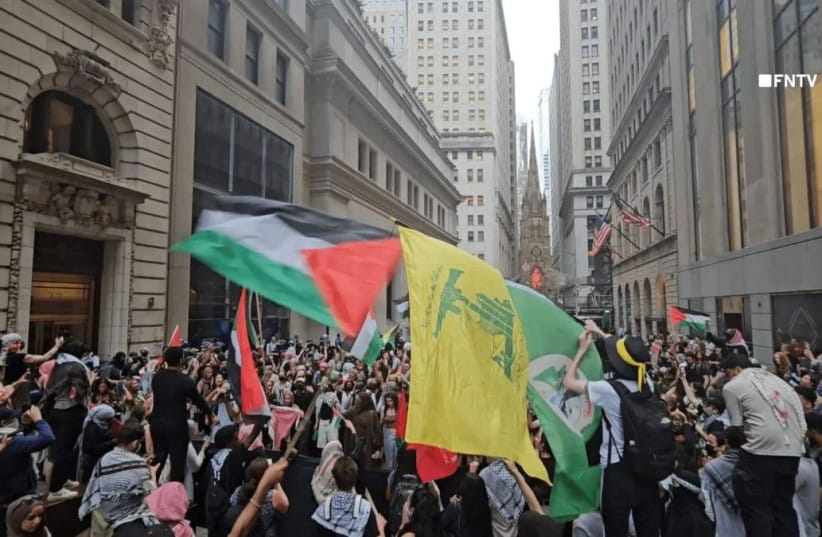 Hezbollah, Palestinian flags waved during a march in New York, June 11, 2024. (Illustrative) (credit: Freedom New TV)
It was also reported that she liked posts questioning testimonies about Hamas atrocities after the Oct. 7 Hamas-led massacre in Israel. Following public criticism, she issued a partial apology and claimed that some of her old posts do not reflect her views today.
Mamdani uses harsh language on Israel
But the public debate is not focused only on the mayor’s wife. It is focused mainly on Mamdani himself. In recent years, Mamdani has become a prominent figure in the progressive camp in the United States, frequently using harsh language against Israel. He has expressed support for the Boycott, Divestment, and Sanctions movement against Israel; promoted initiatives against donations to organizations connected to Israeli settlement activity; and even stated that he would support enforcing international decisions against senior Israeli officials if they came to New York.
Mamdani is careful to state that he “opposes antisemitism.” But for many Jews in New York, the gap between those declarations and his political statements has become unbearable. It is difficult to convince a Jewish public that you are fighting hatred when you repeatedly use language that presents Israel as an illegitimate state in the eyes of many of your supporters.
The most troubling part of this phenomenon is its normalization. In the past, anti-Jewish statements were excluded from mainstream discourse in the United States. Today, under the cover of “human rights” and an “anti-colonial struggle,” the new antisemitism is gaining legitimacy in certain circles. It no longer appears only on the extreme fringes, but also on college campuses, in street protests, and in parts of the progressive political system.
Since the Oct. 7 massacre, New York Jews have reported a sharp rise in assaults, threats, and harassment. Jewish students are afraid to go to campus. Business owners hide Jewish symbols. Many families are wondering whether the city that was a safe home for them for generations still accepts them as it once did. In this atmosphere, Mamdani’s statements are not perceived merely as political criticism, but as part of a broader mechanism of delegitimization against Israel that sometimes spills over into hostility toward Jews.
New York has always been a city of immigrants, communities, and tolerance. Jews built institutions, universities, newspapers, businesses, and culture there. They were an inseparable part of the city’s DNA. Therefore, when its mayor uses language that many Jews perceive as incitement against Israel, and when those close to him are linked to extreme anti-Israel posts, many Jews feel that something basic in the city’s identity has broken.
The great tragedy is that this hatred is now disguised in seemingly moral language. Instead of shouting “Jews out,” people speak of “colonialist Zionism.” Instead of openly calling for discrimination, they portray Israelis as illegitimate. But for many Jews, the final result is very similar: fear, isolation, and a growing sense that they are becoming a target.
The fight against antisemitism cannot be selective. One cannot fight hatred against one minority while ignoring hatred against Jews and Israel. New York now faces a real moral test. The important question is this: Even after Mayor Mamdani is thrown into the dustbin of history, will the city that for many years symbolized freedom and tolerance remain that way, or will it become a place where Jews are forced to hide their identity for fear of growing hostility?
The writer is the CEO of Radios 100FM, honorary consul and deputy dean of the Consular Diplomatic Corps, president of the Israeli Radio Communications Association, and a former Army Radio correspondent and NBC television correspondent.