
The coalition’s ultra-Orthodox draft exemption bill has been placed back on the parliamentary agenda for Wednesday, with a discussion planned in the Knesset Foreign Affairs and Defense Committee to prepare the controversial legislation for the final two readings needed for it to pass into law.
A separate discussion will also be held on a bill to extend the length of service for regular Israel Defense Forces conscripts.
The announcement came shortly after Haredi political sources told the press that Prime Minister Benjamin Netanyahu’s office offered to resume discussions in the committee in an effort to postpone elections until October, while the Haredim want a September date, during the High Holidays.
Netanyahu’s suggestion was rejected by the ultra-Orthodox, with Degel HaTorah spiritual leader Rabbi Dov Lando telling lawmakers “not to get drawn into political games and to support the dissolution of the Knesset this coming Wednesday.”
The move to resume deliberations on the bill also sparked harsh criticism from the anti-Netanyahu bloc, with Opposition Leader Yair Lapid denouncing it as an attempt “to sell out Israel’s security” in order “to gain a few more days in the Prime Minister’s Office.”
Get The Times of Israel’s Daily Edition
by email and never miss our top stories
By signing up, you agree to the terms
Yashar chairman Gadi Eisenkot similarly dismissed “another desperate attempt” by the premier “to buy himself a few more weeks in power at the expense of the national interest of strengthening the IDF during a war.”
The Haredim decided to push for the dissolution of the Knesset last week after Netanyahu informed them that his coalition does not have a majority to pass the controversial bill in the current Knesset, and suggested waiting until after the 2026 elections. They further rejected Netanyahu’s proposal allowing work on the bill to continue in the next Knesset under a proposed amendment to the Law of Continuity.
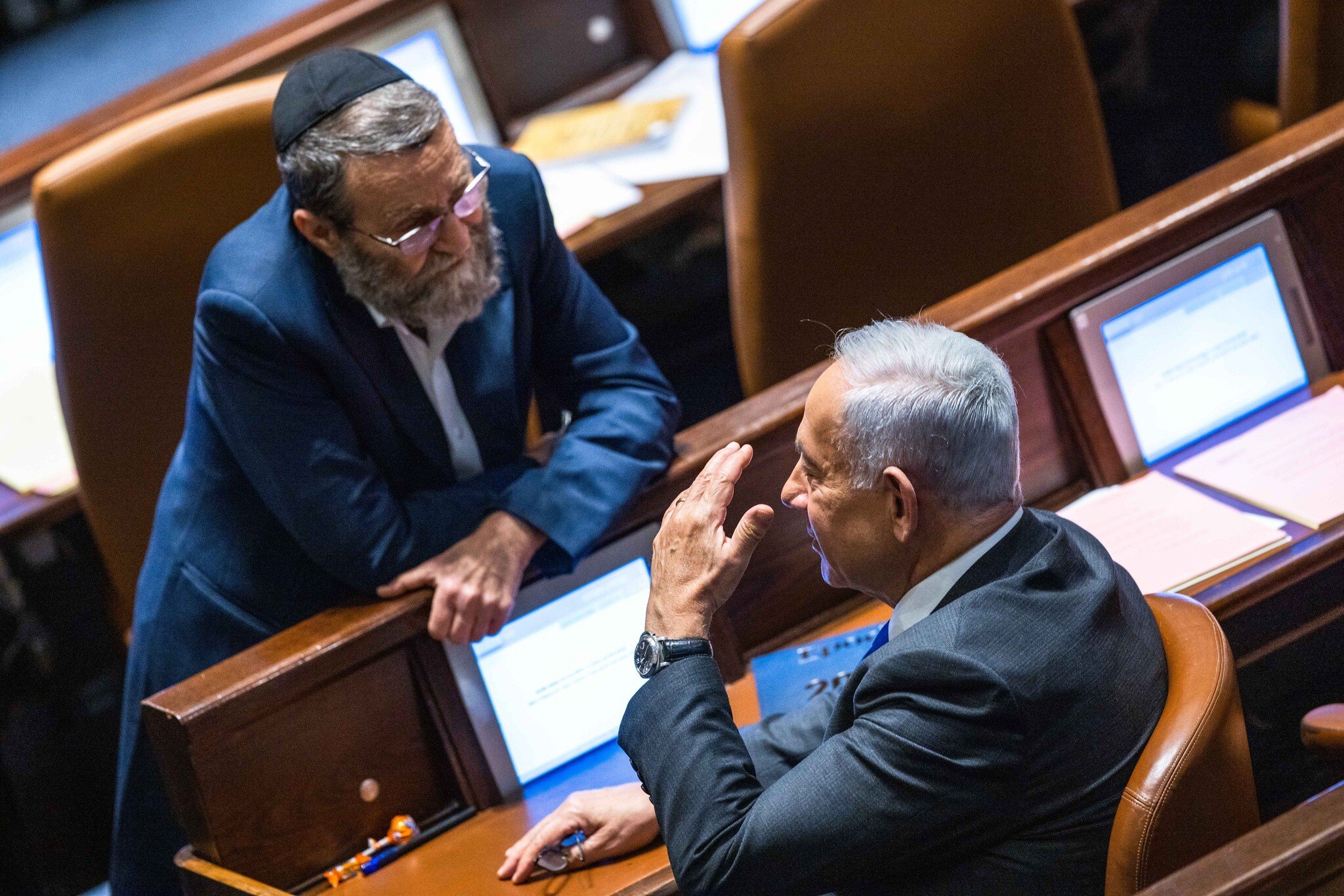
Likud’s Benjamin Netanyahu, right, with UTJ MK Moshe Gafni in the Knesset on December 28, 2022. (Olivier Fitoussi/Flash90)
In an effort to control the timing of the dissolution, Netanyahu’s coalition last week submitted its own bill to dissolve the Knesset and trigger elections, a preliminary vote on which is widely expected to take place on Wednesday.
Netanyahu warned the ultra-Orthodox parties not to force early elections in September because such a timeline would “endanger” the right-wing bloc’s chances of winning, Channel 12 reported Thursday. Elections must occur by October 27.
The Haredi parties are widely reported to favor advancing elections to September 1, close to the High Holidays, assessing that the presence of students at yeshivas at the start of the school year, as well as potential voters attending Selichot rituals, will allow them to effectively canvas for votes and maximize their support.
Some 80,000 ultra-Orthodox men aged between 18 and 24 are currently believed to be eligible for military service, but have not enlisted, despite a persistent IDF manpower shortage. The ultra-Orthodox parties have long demanded a law enshrining their communities’ exemption from military service.
This effort was kicked into overdrive after the High Court in June 2024 ruled that there was no legal basis for the Haredi yeshiva students’ decades-long blanket exemption from the draft.
The coalition’s draft exemption bill — which would ostensibly increase military conscription in the Haredi community, but ultimately enshrines continued exemptions for full-time yeshiva students — is widely seen as legally iffy and loophole-laden and has generated intense resistance even among members of Netanyahu’s coalition, leading to the current crisis.
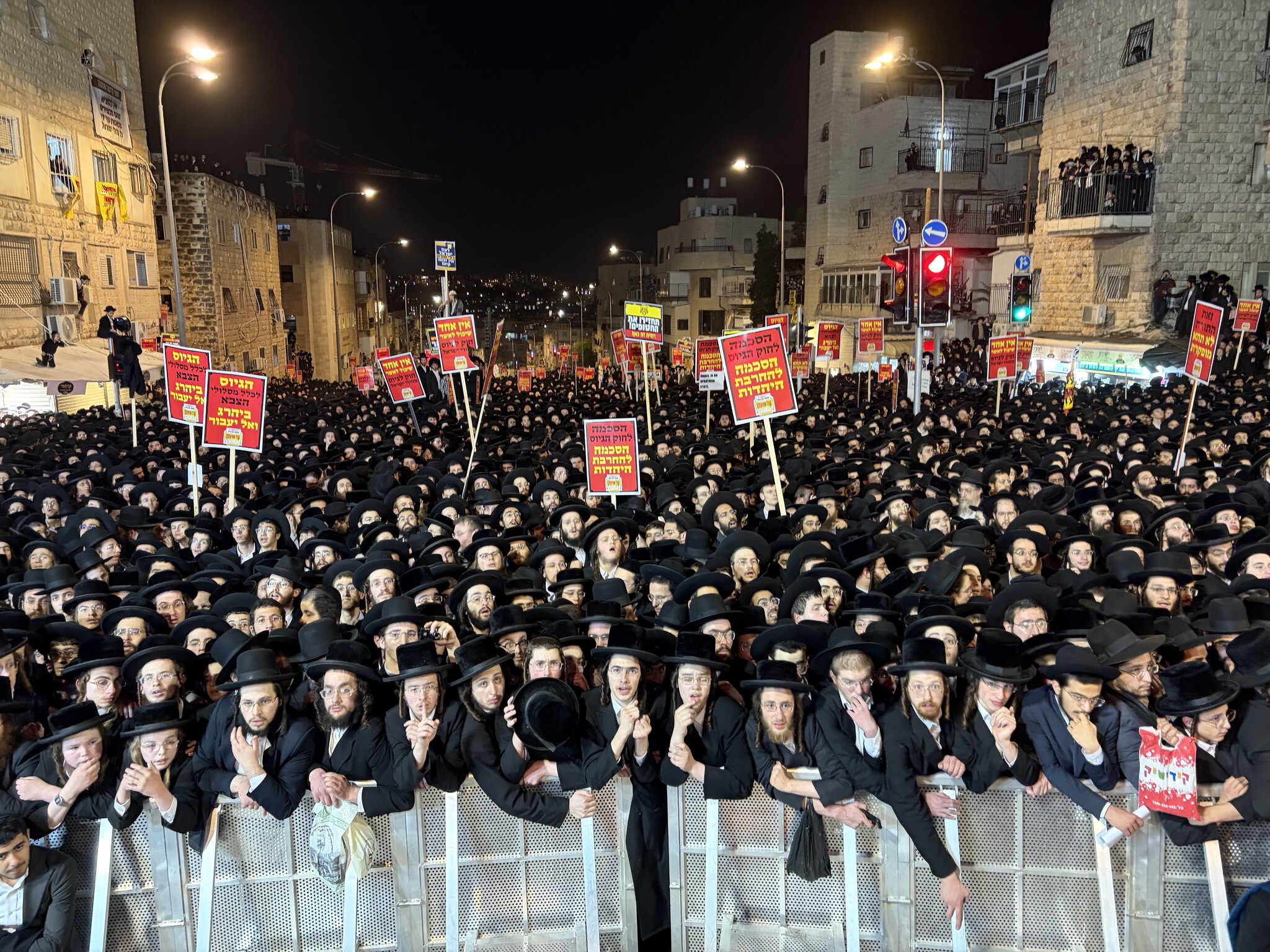
Haredim protest against military conscription in Jerusalem, January 6, 2026. (Sam Sokol/Times of Israel)
It was taken off the table in March with the outbreak of the US-Israeli war with Iran. However, Knesset Foreign Affairs and Defense Committee Chairman Boaz Bismuth later announced that he would continue to advance it, although it failed to progress due to a last-minute disagreement with the United Torah Judaism party’s Degel HaTorah faction’s rabbinic leadership over the bill’s contents.
The news that committee discussions of the bill would resume was dismissed Sunday by both the coalition and opposition.
“Last week Bibi informed Degel HaTorah that he didn’t have a majority for the bill. Today, he’s making noise about wanting to pass it. What changed over the last week? Nothing. It’s just an attempt to delay the election date,” accused Motti Babchik, UTJ chairman Yitzhak Goldknopf’s top aide, in a WhatsApp message to The Times of Israel.
According to the ultra-Orthodox news site Kikar Hashabbat, Shas chairman Aryeh Deri told his party’s lawmakers over the weekend that “the coalition failed to deliver our most basic and crucial law” and “we have no choice but to bring about the dissolution of the Knesset and new elections as soon as possible.”
A Shas spokesman did not respond to a request for comment regarding the renewal of committee deliberations.

Deputy Foreign Minister MK Sharren Haskel attends a Foreign Affairs and Defense Committee meeting at the Knesset in Jerusalem, December 2, 2025. (Yonatan Sindel/Flash90)
Speaking with The Times of Israel, Foreign Affairs and Defense Committee member Moshe Tur-Paz (Yesh Atid) said that what the coalition “didn’t do in two years won’t happen in two hours. There’s no way it’s passing.”
Fellow committee member Tally Gotliv (Likud) also dismissed the return of the bill to the agenda, but laid the blame on the Haredim themselves, telling The Times of Israel that “as long as [Degel HaTorah chairman Moshe] Gafni agrees to pass the law, the law will pass. Gafni doesn’t want to pass the law, and therefore, in my eyes, this is only meant to prove that Gafni is not interested in the law.”
“For the past four days, they have been trying to cut deals in backrooms. I will not allow the state’s security to be sold out like it was in Oslo. I will lead a blocking coalition against the bill, whatever the cost may be,” Deputy Foreign Minister Sharren Haskel, a leading opponent of the bill within the coalition, told The Times of Israel.
Last week, national broadcaster Kan reported that at the same time the Haredim are set on dissolving the Knesset, the government is planning to advance a five-year plan to support the ultra-Orthodox community that would include transferring hundreds of millions of shekels to programs focused on that population.
Which gorgeous bird do you prefer?

THIS MONTH ONLY: Join our reader support group for as little as $6/month and receive an exclusive tote bag featuring one of Israel’s native birds.
Choose between the Duchifat (orange), Israel’s national bird, or the Shaldag (blue), a beloved symbol of the Israeli landscape.
As a member of the Times of Israel Community, you’ll also enjoy:
- An ad-free experience of our site and podcasts.
- Exclusive access to award-winning films via DocuNation.
- Weekly letters from founding editor David Horovitz.
Join ToI Community & claim my bag
Already a member? Sign in to stop seeing this
You’re a dedicated reader

That’s why we started the Times of Israel – to provide discerning readers like you with must-read coverage of Israel and the Jewish world.
So now we have a request. Unlike other news outlets, we haven’t put up a paywall. But as the journalism we do is costly, we invite readers for whom The Times of Israel has become important to help support our work by joining The Times of Israel Community.
For as little as $6 a month you can help support our quality journalism while enjoying The Times of Israel AD-FREE, as well as accessing exclusive content available only to Times of Israel Community members.
Thank you,
David Horovitz, Founding Editor of The Times of Israel
Already a member? Sign in to stop seeing this