
May’s blue moon will illuminate the night sky this weekend, but don’t expect the moon to actually look blue.
On Sunday, May 31, a blue moon will occur, which means there will be two full moons during the month of May. May’s Flower Moon already occurred on the first day of the month, and the blue moon will occur on the last day of the month.
The phenomenon is rare and only happens once every two to three years, according to NASA. This rarity is where the moon gets its name – not because of its color.
What makes this moon even more unique is that it will be a micromoon. The phenomenon occurs when the moon is at its farthest point from Earth during that month, according to NASA. The moon could be around 251,000 miles away from our planet.
Because of the distance, the moon might appear smaller than usual.
Here’s what to know about the rare blue moon.
NASA wants to build astronaut moon base. These photos provide glimpse
1 of 14
NASA Administrator Jared Isaacman, with acting Associate Administrator Lori Glaze and Moon Base Program Executive Carlos Garcia-Galan, holds a news conference May 26 at NASA headquarters in Washington, D.C. on updated plans for the agency’s Moon Base initiative for a long-term lunar presence.
(Jonathan Ernst/Reuters)When is the blue moon?
The moon is set to peak on Sunday, May 31, at 4:45 a.m. ET, according to the Farmer’s Almanac.
While the moon will peak early Sunday morning, it will still look full a few days before and after it peaks.
What causes a blue moon?
The phenomenon happens because, unlike a calendar month, which is around 30 to 31 days, except for February, the moon’s lunar cycle is around 29.5 days, according to NASA.
So, once every two to three years, a full lunar cycle will occur within a month, giving us a full moon at the beginning of the month and another at the end of the month, which is what we know as the blue moon.
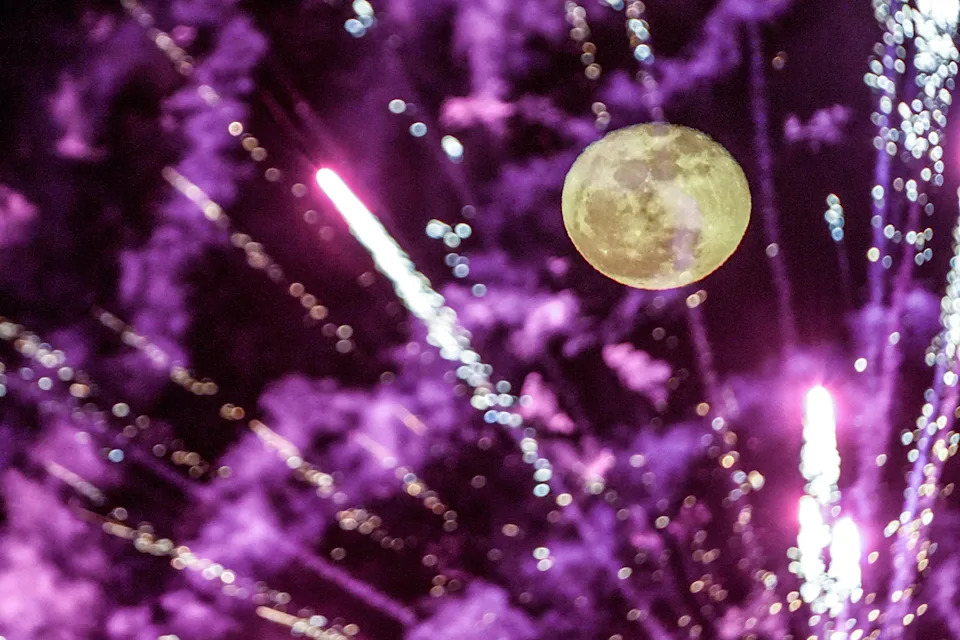
Postgame fireworks blast in the air with a moon, one day after the Pink full moon, after the season opening game at Fifth Third Park in Spartanburg, South Carolina, on Friday, April 3, 2026.
How often do blue moons occur?
Blue moons occur every two to three years.
Is the blue moon actually blue?
The blue moon won’t actually look blue.
The term “blue moon” originated in the 16th century, when people said “the moon is blue” to mean something that seemed impossible, according to Encyclopedia Britannica.
How rare is a blue moon?
It isn’t a common occurrence, hence the expression “once in a blue moon,” and only occurs every 2.5 years, according to NASA.
The last blue moon occurred on Aug. 19, 2024, when the moon was a super blue moon, meaning, unlike the micromoon, it was closest it had been to Earth that month and appeared brighter and larger.
When is the next blue moon?
The next time two full moons will take place in the same month will be in December 2028, according to Time and Date. A seasonal blue moon, which is the third full moon that will occur in a season, will occur on May 20, 2027.
2026 full moons
The moon will be full on the following dates, according to the Farmer’s Almanac:
-
Blue Moon: Peaks May 31, at 4:45 a.m. ET
-
Strawberry Moon: Peaks June 29, at 7:57 p.m. ET
-
Buck Moon: Peaks July 29, at 10:36 a.m. ET
-
Sturgeon Moon (partial lunar eclipse): Peaks Aug. 28, at 12:18 a.m. ET
-
Harvest Moon: Peaks Sept. 26, at 12:49 p.m. ET
-
Hunter’s Moon: Peaks Oct. 26, at 12:12 a.m. ET
-
Beaver Moon (super moon): Peaks Nov. 24, at 9:53 a.m. ET
-
Cold Moon (super moon): Peaks Dec. 23, at 8:28 p.m.
Julia Gomez is a Trending reporter for USA TODAY and covers space phenomena, scientific studies and natural disasters. Connect with her on LinkedIn, X, Instagram, and TikTok: @juliamariegz, or email her at jgomez@gannett.com.
This article originally appeared on USA TODAY: A blue moon peaks May 31. Here’s why it’s considered rare