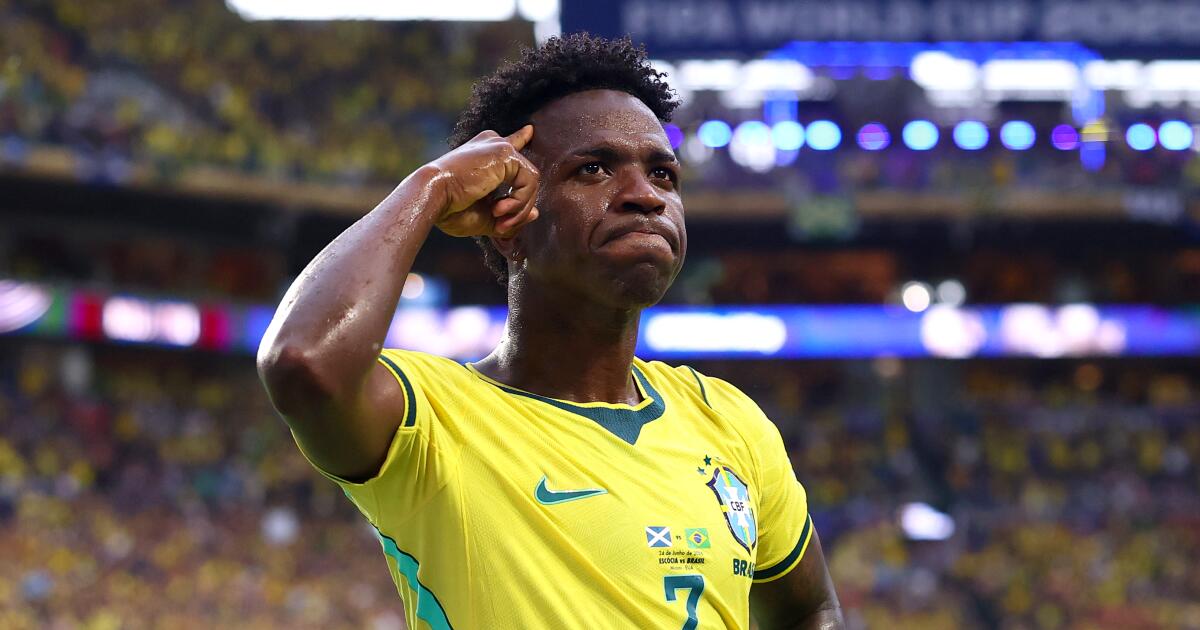
Halftime in Houston as Japan holds a one-goal lead over Brazil
By Los Angeles Times staff
Japan 1, Brazil 0, halftime
We’ve reached halftime in Houston as Kaishu Sano 29th-minute goal has stood up to this point for Japan. A reminder that Japan has not won a World Cup knockout-stage game in four tries, and Brazil has not lost its first knockout-stage game since 1990.
Show more
Kaishu Sano’s goal gives Japan the lead over Brazil

Japan’s Kaishu Sano scores their opening goal past Brazil goalkeeper Alisson Becker during their World Cup round of 32 match.
(Ashley Landis / Associated Press)
By Los Angeles Times staff
Japan 1, Brazil 0, 29th minute
Japan struck first against Brazil in Houston when Kaishu Sano took advantage of a midfield giveway by Brazil.
Show more
Brazil and Japan remain scoreless midway through first half
By Los Angeles Times staff
Brazil 0, Japan 0, 24th minute
No scoring as of yet in Houston but Japan has already received a yellow card after Kaishu Sano challenged Vinícius Júnior in the 12th minute. Brazil’s Casemiro received a yellow card two minutes later.
Show more
Brazil and Japan get underway in Houston in a knockout match

The teams from Brazil and Japan line up on the field for the national anthems on Monday in Houston before their match.
(Eric Smith / Ap Photo/eric Smith)
By Los Angeles Times staff
Brazil won Group C, posting consecutive 3-0 wins over Haiti and Scotland to close out the first round and run goalkeeper Alisson Becker’s shutout streak to 249 minutes. Vinícius Júnior, with four goals, and Matheus Cunha, with three, have accounted for all of Brazil’s scoring. Brazil hasn’t been eliminated in the first knockout stage of a World Cup since 1990. Japan has received goals from five players in an unbeaten run through Group F, where it finished second to the Netherlands. Japan has not won a World Cup knockout-round game in four tries.
Show more
‘The clear choice by far.’ Why rising U.S. star Alex Freeman chose soccer over the NFL

U.S. defender Alex Freeman, left, and Paraguay forward Julio Enciso battle for control of the ball during the United States’ 4-1 win in its World Cup opener on June 12.
(Kelvin Kuo / Los Angeles Times)
SEATTLE — Growing up the son of an NFL wide receiver, Alex Freeman said he felt a lot of pressure to play the American version of football, not the one the rest of the world plays.
“I always got asked if football was the path,” he said last summer. “But I always had a secret love for soccer.”
And he had to keep it a secret because he wasn’t sure his father Antonio, a Super Bowl winner with the Green Bay Packers, would understand.
Born in Brooklyn, raised in London, Folarin Balogun lights up the World Cup for the U.S.

U.S. forward Folarin Balogun, left, scored twice against Paraguy during the USMNT’s World Cup group stage opener on Friday, the first American player to score multiple goals in a World Cup match in 96 years.
(Ronaldo Bolanos / Los Angeles Times)
SEATTLE — If a pregnant Nigerian woman had been allowed to board a plane 25 years ago, the U.S. team’s path through this summer’s World Cup may have unfolded much differently. Instead, a gate agent turned her away, insisting it wasn’t safe for her to fly from New York to London.
So Florence Balogun returned to Brooklyn, where she had been visiting relatives, and waited for her second son to be born. And when Folarin arrived a few weeks later, entering the world just hours before Independence Day dawned, he did so as an American citizen.
It was that quirk of fate that allowed Balogun, who lived just two months in the U.S., to represent the country on soccer’s biggest stage.
Why this World Cup could do for Canada what 1994 did for soccer in the U.S.

Canada’s Jonathan David celebrates after scoring one of three goals during a 6-0 win over Qatar at the World Cup on Thursday.
(Emilee Chinn / Getty Images)
VANCOUVER, Canada — When the first men’s World Cup game played in Canada kicked off last week, Anthony Totera sat in the stands and wept.
“It was a dream come true,” said Totera, who has spent most of his 57 years on earth promoting Canadian soccer. “I can’t describe the emotions. It was something surreal.”
If the 1994 World Cup, the first held in the U.S., forever altered the direction of American soccer, this summer’s tournament, which Canada is sharing with the U.S. and Mexico, has the potential to do the same for that country.
Pico Rivera’s Cristian Roldan may be last made-in-high-school U.S. World Cup star

U.S. men’s national team player Cristian Roldan, center, and his teammates arrive at SoFi Stadium before the World Cup group stage match between the United States and Paraguay on June 12 in Inglewood.
(Kelvin Kuo / Los Angeles Times)
SEATTLE — Cristian Roldan and Haji Wright grew up less than three years and 30 miles apart, Roldan in Pico Rivera and Wright in Culver City. The odds that they would go on to become teammates on not one, but two, U.S. World Cup teams seem astronomical.
Yet despite starting at the same time and place and arriving together at the same destination, the two players followed completely different paths to get there.
Wright joined the Galaxy’s academy at 14 and signed with Schalke of the top tier German Bundesliga days after his 18th birthday. Roldan was still playing for El Rancho, when he was 17, making him the only member of the U.S. World Cup team to play four years at a public high school.
‘A great vibe.’ Pacific Northwest joins Los Angeles in an embrace of World Cup fever

U.S. fans march outside Lumen Field in Seattle before the U.S.-Australia World Cup game on June 19, 2026.
(Lindsey Wasson / Associated Press)
SEATTLE — Jaysen Dickinson flew to Seattle from Vermont to cross an item off his lengthy bucket list.
“To see the World Cup and the U.S. play in the World Cup,” he said.
Kim Fletcher and her 17-year-old son Kelan caught a 5 a.m. flight from Sacramento last week for the same reason.
“It’s a must-do right now,” she said.
They weren’t alone. Tens of thousands of people poured into Seattle on Friday morning for the U.S. team’s group-stage game with Australia, turning the Emerald City into a sea of red, white and blue. Some had tickets, most did not.
Harvard alum Matt Freese took an unusual path to starting in goal for U.S. at World Cup

U.S. goalkeeper Matt Freese directs his teammates before Paraguay takes a free kick during a World Cup match at SoFi Stadium on June 12.
(Kelvin Kuo/Los Angeles Times)
Playing in goal for the U.S. men’s national soccer team is a little like playing right field for the Yankees. You’re following a long line of great players, making the comparisons — and the high expectations — unavoidable.
Matt Freese is the latest to be thrown into that crucible. But he considers that pressure to be a privilege, not a problem.
“I wouldn’t say it’s intimidating, I would say it’s inspiring,” he said before the U.S. training session Tuesday morning in Irvine. “It’s a long line of goalkeepers that I’ve looked up to for my whole life — and there were some before my life as well.”
‘Worth every penny’: This is how much fans spent to attend the World Cup in L.A.

Collage of photos for fans that attended World Cup games at SoFi Stadium.
(Alisha Jucevic / For The Times)
“Do you have an extra ticket?” a man shouted outside SoFi Stadium last Thursday.
The World Cup has been drawing fans from around the globe. But for many, getting a seat in the stadium has come at a steep price.

-
Share via Close extra sharing options
Some were lucky enough to nab $400 to $500 tickets through official World Cup lotteries, others paid thousands of dollars to catch the action IRL. Tickets for the upcoming USA versus Turkey match were selling for more than $1,400 on resale sites.
The demand has been so high that authorities have been warning fans about how to avoid ticket scams.
As crowds flocked into the stadium, we asked attendees about how much they paid to get into the most-watched sporting event in the world. Here’s what they shared.
Amid travel bans, ICE fears and political turmoil, wary fans try to find World Cup joy

(Allen J. Schaben / Los Angeles Times)
In many ways, the most ambitious World Cup in history — which kicked off Thursday in Mexico City — has inspired more angst than anticipation, more fear than fervor.
The competition, returning to North America for the first time in more than three decades, has expanded to 48 teams and 104 matches, to be played over 39 days in 16 cities in the U.S., Mexico and Canada. The complex planning was eight years in the making.
Yet even before the competition opened with Mexico facing South Africa at the iconic Estadio Azteca, it has been marred by a number of controversies that threaten to overshadow the soccer and cloud the tournament’s legacy.
L.A. museum highlights Jewish roots that shaped world’s most popular soccer styles

A painting made by an artist in a concentration camp depicts prisoners playing soccer. The image is one of items on display in a new Holocaust Museum LA exhibit.
(Eric Thayer/Los Angeles Times)
Béla Guttmann may be the most consequential soccer coach you’ve never heard of. But if it weren’t for Guttmann, you may never have heard of Pelé.
And Brazil may never have become the greatest soccer-playing country on Earth.
That’s because Guttmann changed the shape of modern Brazilian soccer — and changed the sport forever — when he imported the revolutionary 4-2-4 system from Hungary to Sao Paulo in 1957. A year later, Brazil won the first of five World Cups and the joga bonito was born.
Swanson: From poker pro to World Cup coach: Sergej Barbarez all in with Bosnia-Herzegovina

Bosnia and Herzegovina coach Sergej Barbarez shakes hands with one of his players before a loss to Switzerland in the World Cup Group B play at Los Angeles Stadium (SoFi Stadium) on Thursday.
(Allen J. Schaben / Los Angeles Times)
Imagine it. A neophyte coach, leading a team for the first time at any competitive level, and it being a high-profile assignment on the biggest of big stages.
A self-assured broadcaster, critical and competitive, having his bluff called, being invited to not just talk about it, but to be about it: Walk the walk, why don’t you?
A former player — scorer, shooter — being challenged to step up and right a listing ship while navigating politics and the push and pull of history and high hopes.
‘Why not us?’ How Mauricio Pochettino taught the U.S. to believe it could win a World Cup

Mauricio Pochettino is the first U.S. men’s coach to win the group stage of a World Cup in 96 years.
(Ronaldo Bolanos / Los Angeles Times)
A bowl of lemons sits on a table in the conference room Mauricio Pochettino has turned into an office at the U.S. men’s soccer team’s beachfront resort in south Orange County. The citrus fruit, the coach believes, has the spiritual ability to absorb negative energy. On the corner of another table, the flame from a candle flickers.
“I like candles,” says Pochettino, who believes they release therapeutic fragrances and create a calming environment.
But it is the massive, blood-red mural covering the entire south side of the room that truly reveals what Pochettino believes. In the center of the wall, just behind the coach’s desk, white block letters spell out “Why Not” above a script “U.S.,” which, despite the periods, is meant to be read as “us.”
Norwegians ‘row’ Times Square and Tartan Army storms Boston as World Cup fandom takes over U.S. streets

Norwegian team supporters gather at Times Square ahead of a World Cup match, creating a festive atmosphere with chants and traditional rowing celebrations.
(Lokman Vural Elibol / Anadolu via Getty Images)
Sometimes it takes a visitor or six million to remind folks of treasures in their own backyard.
How else to explain the fascination of World Cup fans from 47 other countries expressing unabashed delight on social media for destinations and products woven deeply into American life but hardly considered cutting-edge: ranch dressing, Waffle House, Boston Lager on tap, Texas barbecue, ubiquitous supermarkets — the list goes on.
Meanwhile, the allure is reciprocal. Americans are captivated by the dizzying displays of group fervor, zany behavior and national pride that accompany nearly every match at each of the 16 venues in the United States, Canada and Mexico.
Swanson: World Cup shows MLS still needs to achieve major goals to grow the game

Canadian fans react after Stephen Eustáquio scores in stoppage time of a 1-0 win over South Africa at the World Cup at SoFi Stadium on Sunday.
(Allen J. Schaben / Los Angeles Times)
Remember when we were sure the World Cup would suffer from all the issues that had everyone seeing red before the first ball was kicked?
And remember when we were certain soccer could never catch on in this country?
Despite controversies over visas and ticket prices and transportation, and in spite of consternation over expansion and new rules, the game has, as usual, proved too good to fail.
Expanded World Cup brings drama as Canada ousts South Africa on stoppage-time goal

Canada midfielder Stephen Eustáquio (7) celebrates with teammates after scoring in the 92nd minute of a 1-0 win over South Africa in a World Cup round of 32 match at SoFi Stadium on Sunday.
(Ronaldo Bolanos / Los Angeles Times)
When FIFA expanded the World Cup field from 32 to 48 teams for this summer’s tournament, the gnashing of teeth and clutching of pearls was as predictable as it was loud. The field would be watered down, the traditionalists protested. The group stage would be a series of blowouts, the sharks would devour the minnows.
In fact, none of that happened.
What we got instead was plucky Cape Verde playing No. 3 Spain to a draw and becoming the smallest nation to reach the elimination rounds. We got Austria advancing on a goal six minutes into stoppage time — eliminating unbeaten Iran, which deserved better — and Canada, Egypt and the Democratic Republic of Congo all winning World Cup games for the first time.
2026 World Cup knockout round TV schedule, game previews and results

Mexico’s Julián Quiñones, center, celebrates with teammates after scoring during a win over Czechia at the World Cup on June 24.
(Silvia Izquierdo / Associated Press)
Group play is over and it’s knockout time at the 2026 FIFA World Cup.
The round of 32 is set, with tournament co-host Canada defeating South Africa in the first round-of-32 match on Sunday.
Here’s everything you need to know about World Cup knockout stage matches being played Monday and Tuesday across the U.S., Mexico and Canada (all times Pacific).
Looking back at the first 18 days of the World Cup
The first 18 days of the 2026 FIFA World Cup offered plenty of memorable moments.
Check out The Times’ daily recaps ahead of Monday’s three-game slate:
Show more