
For decades, public health campaigns have warned citizens about the dangers of smoking — yet in Virginia, smoke remained a hazard inside operating rooms until recently.
Surgical smoke is generated when electrosurgical pencils or lasers are used to cut tissue and cauterize the wound. Around 90% of surgeries generate this smoke, with an estimated 500,000 healthcare workers exposed every year, according to the Virginia Nurses Association.
“That’s always been a question, what that smoke — that plume, as they call it — what that does to us standing there every day while it’s just kind of lingering there in the air,” said Debbie Morrison, manager of surgical services at Sentara Williamsburg Regional Medical Center.
The impact of the smoke for the surgical team, according to VNA, is the daily equivalent of smoking about 30 cigarettes.
“Smoking indoors was banned in, what, 2009 or something like that?” said Leora Brown, who was a nurse at Sentara Careplex in Hampton from 2017-2024 and now helps implement the products for Sentara hospitals.
In 2024, concern over surgical smoke prompted Brown to attend Lobby Day at the General Assembly for VNA, an opportunity for nurses to meet with state legislators to discuss and promote legislation that affects their work. She had the chance to speak at the health professions subcommittee, where she argued in favor of legislation that would require the use of a smoke evacuation system during surgeries.
 Nurse Debbie Morrison, manager of surgical services at Sentara Williamsburg Medical Center, works with the smoke evacuation system in an operating room. (Skylar Hartgerink/The Virginia Gazette)
The system connects directly to the electrosurgical pencil to suction the smoke as soon as it’s created. It’s then stored in a special filter that lasts for 80 hours, after which it is disposed of as hazardous waste, preventing the 150 hazardous chemicals contained in the plume from spreading.
“It was a good experience being able to kind of advocate for our team members, more so than always focusing on a patient,” Brown said. “Sometimes, we have to be able to care for ourselves before we can care for them.”
After former Gov. Glenn Youngkin signed the bills into law on March 28, 2024, Virginia became the 17th state to mandate smoke-evacuation systems in every operating room, with the legislation going into effect in July 2025. By then, all Sentara operating rooms had implemented the systems.
Although it will take a while to gauge the long-term impact, surgical teams say they already notice a difference. The smell of the smoke used to permeate the operating room, particularly for surgeries such as breast reductions that generated a large plume. Now, not so much. “I feel like I don’t have to hold my breath during the whole case,” surgical technologist Missy Thompson said.
Brown noted that when she spoke on the bill, none of the delegates was opposed. If anything, they were surprised that this issue hadn’t been addressed already, she said. Yet, Morrison added that “sometimes it’s harder to get things like this passed or even noticed because it’s just so different,” a perspective that Brown echoed.
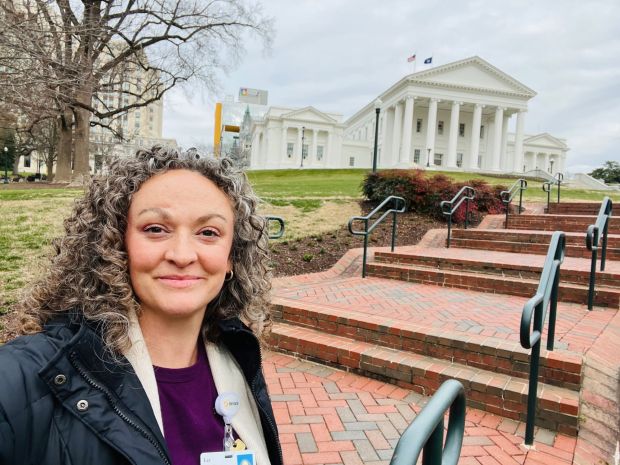 Sentara nurse Leora Brown attends Lobby Day with the Virginia Nurses Association in 2024. (Leora Brown)
“As a nurse, if you start on the floor, this is a magical place — you don’t infiltrate this by chance,” Brown explained about the operating room. “You really have to want to work there, you really have to get yourself to that point. So, you know, all the nurses on the floor, which there are tons more of them than there are of the team that’s here, they’re not affected by it per se — it’s not a nurse-wide condition.”
That makes it important for healthcare professionals to take advantage of advocacy and shared governance opportunities to bring issues like this one to light, she said.
“It’s very nice to know that we do have that sort of platform to be able to support the bills and legislation that come up. It’s not always top-down — even just going through that process, doing lobby day and being able to do public comment at some of those subcommittee meetings,” Brown emphasized. “It’s important to obviously choose a facility or a health system that is supportive, has shared governance, listens to feedback from their team members and allows them to share their opinions as well, because they can make a difference in the future of their facility.”
At the same time, Thompson, who has 34 years’ experience in her field, wonders to what extent that exposure has impacted her health. “I had breast cancer two years ago. I mean, if I were to get lung cancer, was it from that or was it from the environment? Who knows?”
Skylar Hartgerink, skylar.hartgerink@virginiamedia.com