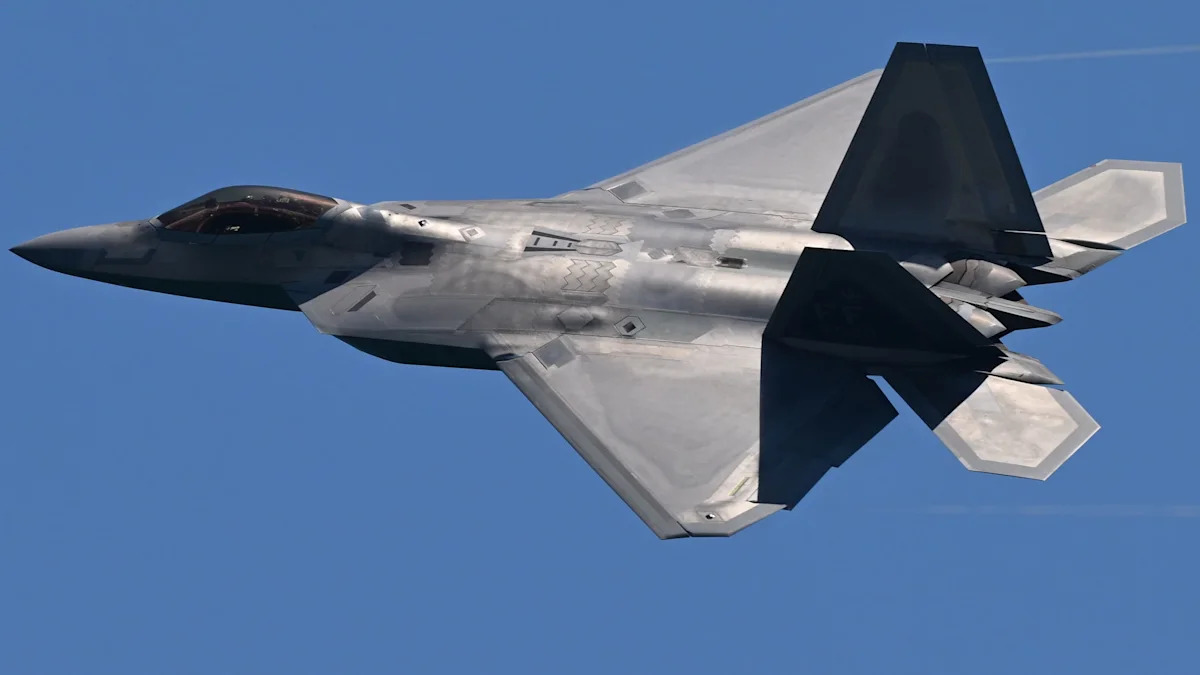
Defense stocks are surging as investors bet that rising military budgets, efforts to replace depleted weapons stockpiles, and the race to deploy artificial intelligence across the battlefield will benefit the often-staid sector.
The momentum was enough to push the iShares U.S. Aerospace & Defense ETF (ITA) to its first intraday record high in four months on Monday, boosted by advances throughout the past month in a number of defense sector names, including GE Aerospace (GE), Boeing (BA), RTX (RTX), and Howmet Aerospace (HWM).
“As geopolitical tensions rise and countries assume greater responsibility for their own security, governments are increasing investments in military capabilities,” Franklin Templeton chief market strategist Stephen Dover and head of research Larry Hatheway wrote in a report for clients.
At the same time, they said, “Rapid technological change is also rendering many traditional defense systems obsolete, creating demand for advanced weapons, cybersecurity, space-based defenses and modernized military infrastructure.”
Renewed spending push
In late June, President Trump summoned the heads of several major US manufacturers who play key roles in the defense supply chain, including Lockheed Martin (LMT), aerospace giant Boeing, and industrial manufacturing giant Honeywell (HON), to discuss a push to quickly ramp up production of key weapons systems to rebuild depleted munitions stockpiles.
Days later, the Department of Defense awarded Lockheed Martin a $35.3 billion multiyear contract to manufacture Terminal High Altitude Area Defense (THAAD) missiles, which cost $15.5 million per unit to produce, according to the Center for Strategic and International Studies.
RTX was awarded a roughly $400 million contract for medium-range air-to-air missiles. That deal comes after an earlier contract awarded to RTX in early February to dramatically enhance the company’s production of long-range Tomahawk missiles, more than 1,000 of which were expended by the US during the war in Iran. Tomahawks cost $2.6 million per unit to build and have a four-year delivery timeline, per CSIS.
 The Arleigh Burke-class guided-missile destroyer USS Frank E. Petersen Jr. fires a Tomahawk Land Attack Missile during operations in support of Operation Epic Fury on Feb. 28, 2026. (US Navy via Getty Images) · U.S. Navy via Getty Images
Bolstering these contracts is the Department of Defense’s fiscal year 2027 budget request to Congress. At $1.5 trillion, which would represent a 44% increase over the FY 2026 enacted budget, the sum would be the largest single-year funding since World War II.
The spending boom is giving business to more than just traditional defense contractors. In April, Boeing signed a seven-year agreement with the Defense Department to produce PAC-3 interceptor missiles. Two months later, the company was awarded a $2 billion contract by the US Space Force to build an array of communications satellites.
Story Continues
In June, General Motors (GM) signed a multibillion-dollar deal with Lockheed Martin focused on expanding production capacity and high-rate manufacturing of critical components for US weapons systems. Ford (F) has begun courting defense contracts from the US and European governments.
While the automakers’ primary business line remains auto manufacturing, Bank of America analysts Alexander Perry and Jack Joyce said in a recent note to clients that they “see the ability for automakers & suppliers to move into diversified industrials, robotics, aerospace, & defense.”
‘A different kind of force’
While traditional weapons systems remain a key part of the US armament, focus is increasingly swinging toward the next technological front: the integration of AI-enabled technologies and weapons on the battlefield — estimated to represent $2 trillion in spending across North America, Europe, and Asia.
The shift is broadening the list of potential defense winners. While legacy contractors remain positioned to benefit from higher spending on missiles, aircraft, and air defense systems, investors are also betting that software and autonomous systems providers will capture a growing share of military budgets.
“Modern warfare is increasingly defined by the ability to ‘sense, make sense, and act,’ depending on processing vast amounts of data and translating it into timely decisions,” JPMorgan analysts led by Jahangir Aziz wrote. They said the new needs are giving rise to companies that offer more autonomous solutions than those currently in wide use.
At the forefront are companies such as Alex Karp’s Palantir (PLTR), which builds software designed to integrate a variety of intelligence across the military’s capabilities, and a host of private military tech companies, where Anduril Industries stands as the leader.
Palantir’s Maven battlefield software was recently designated a “program of record” by the Defense Department, making the product a permanent part of US military infrastructure, with the decision set to finalize by the end of the current fiscal year. Palantir stock gained more than 2% last week after D.A. Davidson analyst Gil Luria upgraded his call to a Buy rating from Neutral and raised his price target on the stock to $175, compared to its current price near $130.
Anduril, which manufactures autonomous weapons systems and AI software for the US military, was recently valued at $61 billion in the private market. In March 2025, the company was awarded a 10-year, $642 million contract to supply the US Marine Corps with AI-powered surveillance equipment capable of taking defensive action autonomously.
An Anduril Industries Barracuda cruise missile is displayed above the company’s booth at Special Operations Forces Week at the Tampa Convention Center on May 19, 2026, in Tampa, Fla. (Luke Sharrett/Getty Images) · Luke Sharrett via Getty Images
“AI software allows us to build a different kind of force: one that isn’t limited by cost or complexity or population or manpower, but instead by adaptability, scale, and speed of manufacturing,” Anduril founder Palmer Luckey said during public remarks in April 2025, arguing that AI “enhances decision making, increases precision, and reduces collateral damage.”
“If the US doesn’t lead this space,” Luckey said, “authoritarian regimes will.”
Jake Conley is a breaking news reporter covering US equities for Yahoo Finance. Follow him on X at @byjakeconley or email him at jake.conley@yahooinc.com.
Click here for in-depth analysis of the latest stock market news and events moving stock prices
Read the latest financial and business news from Yahoo Finance