
With summertime in full swing, Queens residents have more to worry about than wearing sunscreen and air conditioning.
Thanks to more hospitable weather, ticks have spread beyond the forestland and into dense urban areas. In particular, New York City’s health officials have reported a significant uptick in ticks throughout city parks and other urban green spaces, leaving pets and their owners increasingly vulnerable to life-threatening tick-borne diseases.
The city’s health department reported almost 3,000 cases of Lyme disease last year, an increase from the 2,500 cases in 2024 and nearly three times the figure recorded in 2015. Bacterial diseases such as ehrlichia and anaplasma are also transmitted by ticks.
Meanwhile, researchers from Columbia University found that ticks were present in approximately 80% of parks in Brooklyn and Queens in 2025, a 40-percentage-point jump from 2022.
This refutes a commonly held belief about ticks. Regardless of how affluent or spacious a neighborhood is, blood-seeking ticks can flourish wherever vegetation comes in contact with host animals, e.g., rodents or squirrels.
“We think that urban areas are tick-free, and that’s really not true,” said Dr. Kate Elden, DVM, chief medical officer at Dutch, a veterinary telehealth service company. “The ticks and fleas do not care about your ZIP code, and there’s no force field on the sidewalk between you and the park. All pets can get ticks and fleas these days.”
Generally, tick season runs from March to November, as harsh winters make way for the balmy spring. But as climate change prolongs warmer weather and softens the winter cold, New York’s tick infestation will only worsen.
“The warmer environments allow [ticks] to go through their cycles and start laying eggs and breeding sooner and earlier,” Dr. Elden said. “That’s why they’re creeping into these areas.”
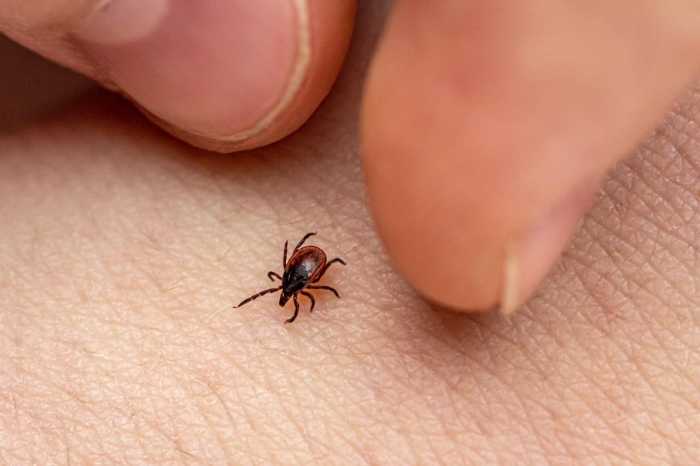 New York City’s health department reported almost 3,000 cases of Lyme disease in 2025, as warmer weather has accelerated the tick life cycle.Photo courtesy of rbkomar from Getty Images
However, proactive measures can be taken, outside of tucking your pants into your socks. If ticks — usually tucked into the body’s warm crevices — are detected and removed quickly, they won’t have time to transmit life-threatening diseases. But if a tick looks engorged, with a big-looking body, that indicates it has already had a blood meal, which increases the likelihood that it has transmitted a disease.
To remove ticks, use clean tweezers and press firmly towards the head. However, avoid squishing the body of the tick, as this is where it carries infectious diseases.
It’s especially important to stay calm in these situations, especially when removing a tick from a pet, who are especially adept at discerning human emotions.
“If you’re panicking, [the pet] might freak out, and then it’s going to be really hard,” Dr. Elden said. “This simple process that I just described of removing the tick with the tweezers, it’s much harder when the pet’s moving and wiggling around.”
Dr. Elden recommends, if possible, having a second person distract the pet with a small treat or toy.
Afterward, the pet should be monitored for several weeks. Pet owners should look for signs of lethargy, loss of appetite, or behaviors and routines that fall outside their usual patterns.
Further preventative measures are encouraged, as well. For pets, this includes daily grooming and body checks, attentively checking areas like the toes and collar for potential ticks. Dr. Elden also encourages pet owners to invest in products such as Credelio Quattro.
“When I recommend to my friends and family that they put their dog on a Credelio Quattro product, they’re like, ‘Ah, it’s so expensive,’” she said. “I’m like, ‘But it’s a lot cheaper than going to the vet.’ So, the prevention is always cheaper than treating the infestation and then a tick-borne disease later. It’s way cheaper to prevent than it is to treat.”