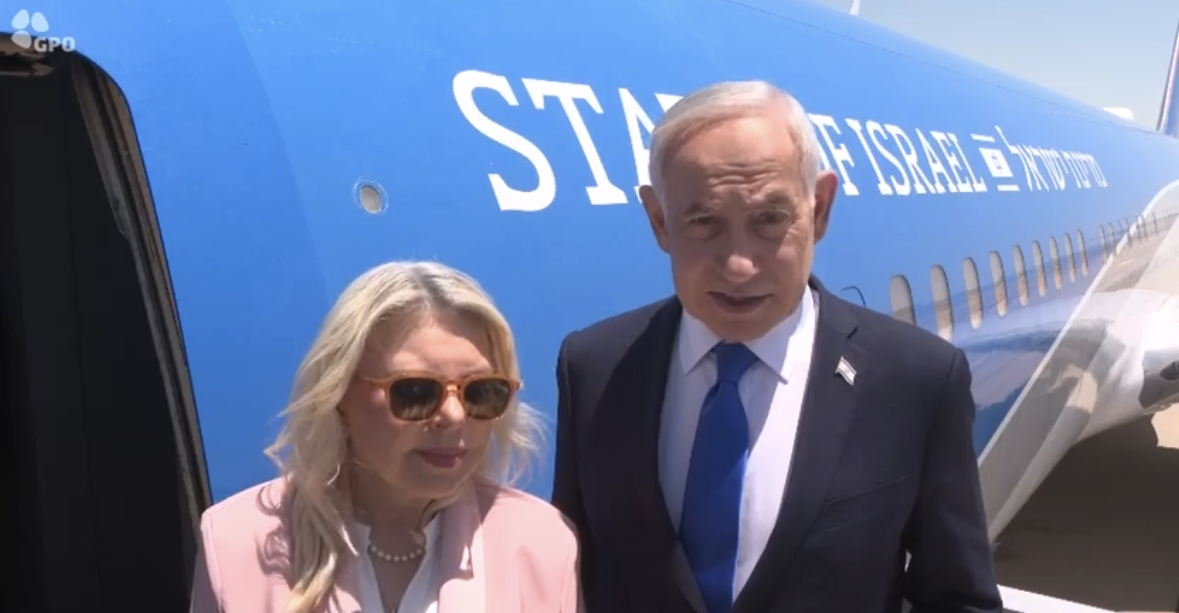
Iran will top the agenda in his meeting with US President Donald Trump, Prime Minister Benjamin Netanyahu said on Monday minutes before taking off from an Israeli Air Force base for Washington, DC.
“In these complex times one must act with both great determination and great wisdom,” he said in a Hebrew-language video statement alongside his wife Sara. “We will discuss all the issues on the agenda, first and foremost Iran. Of course, our goal is to safeguard our security while also expanding the circle of peace around us.”
“I am embarking on this mission with one clear objective,” he said, “to ensure the security, strength, and future of our beloved State of Israel.”
Netanyahu is set to meet Trump on Tuesday at 11 a.m, local time, after more than five months since their last meeting. His schedule that day will include attending a memorial service for the late pro-Israel Republican senator Lindsey Graham.
Netanyahu noted that he is also traveling to pay last respects to Graham, “one of Israel’s greatest friends of all time.”
Get The Times of Israel’s Daily Edition
by email and never miss our top stories
By signing up, you agree to the terms
His visit comes during a lull in the Middle East war after 13 days of intensifying US airstrikes on Iran and retaliatory attacks across the region by the Islamic Republic.

Iranian Shite pilgrims carrying Iranian flags arrive at the Al-Mundheriya border crossing to join millions of Muslims heading to the holy city of Karbala for the annual Arbaeen pilgrimage, in Diyala, Iraq, July 27, 2026. (AP Photo/Hadi Mizban)
The Pentagon suspended the bombing campaign late on Friday, with no US attacks reported on either Saturday or Sunday. Iran, which had been following each night of US attacks with its own strikes on neighboring countries that host US bases, has also held its fire, saying it will continue to do so for as long as the US does.
It will be the first sit-down between the leaders since before the outbreak of the Iran war on February 28.
The pair last met on February 11 in the White House, where Netanyahu made a high-stakes Situation Room pitch for the US to join Israel in another war, which included a series of predictions that didn’t pan out.

US President Donald Trump, right, shakes hands with Prime Minister Benjamin Netanyahu during a news conference at Mar-a-Lago, in Palm Beach, Florida, December 29, 2025. (Alex Brandon/AP)
Trump has been considering another major attack after the memorandum of understanding he signed last month to end the war fell apart due to disputes over control of the Strait of Hormuz.
Quiet departure
Netanyahu left Israel in circumstances that raised eyebrows. His office offered no explanation for why he took off from Nevatim Air Base, not Ben Gurion Airport, nor did it publicize beforehand the time of his takeoff.
According to Channel 12, the move to a military base was a security consideration taken in light of a potential threat from Iran. Netanyahu’s cabinet meeting on Sunday was moved from his office to an undisclosed underground location.

F-35i fighter jets are seen at the Nevatim Air Base in southern Israel, in an undated handout photo. (Israel Defense Forces)
Netanyahu’s office is also not allowing Israel’s diplomatic media pool to travel with him on the taxpayer-funded Wing of Zion plane. No explanation was given for that move either, though this is not the first time that the Prime Minister’s Office has forced reporters to find their own way to the US, and his relationship with the press has long been cold.
Opposition Leader Yair Lapid is also flying to Washington for Graham’s funeral, and will participate in an event at the Atlantic Council.
Beyond Iran
Other pressing issues will be discussed at the Tuesday meeting between Netanyahu and Trump.
The security cabinet on Sunday voted to approve the limited entry of the International Stabilization Force into the Gaza Strip, showing a willingness to support Trump’s 20-point plan for the devastated Palestinian enclave.

Palestinians inspect a site of an Israeli strike on a storage facility that was warned by the Israeli military to evacuate earlier before it was struck, in Gaza City, July 27, 2026. (Ebrahim Hajjaj/Reuters)
Still, the plan has faced delays as Hamas continues to refuse to disarm and Israel has withheld approval for several of its key provisions, including reconstruction of the Strip.
There has been some movement in US-backed plans for Lebanon as well, though there too Hezbollah says it won’t give up its weapons. Last week, Lebanese army troops began deploying in a southern Lebanese town after Israeli forces withdrew from the area, in line with a US-brokered plan for “pilot zones.”
The plan, hammered out in direct talks between Israel and Lebanon, envisions Lebanese army troops confiscating weapons from the Iran-aligned terror group in parts of southern Lebanon and phased withdrawals of Israeli troops, who are eventually meant to leave the country altogether.

A Lebanese soldier stands in front of a destroyed house after deploying in the village of Zawtar al-Gharbiyeh, southern Lebanon, July 26, 2026. (AP Photo/Ahmad Mantash)
Last week, Lebanese President Joseph Aoun met with Trump, declaring that his country will permanently end hostilities with Israel and asking for backing in his efforts to disarm Hezbollah.
Israeli officials have voiced skepticism regarding Lebanon’s ability to disarm Hezbollah, but Israel sees the deal as a vital step toward building peace with Lebanon in the long run.
Saudi Arabia is also back on the agenda.
Last week, the US signed a deal with Riyadh that would see US companies provide nuclear energy to Saudi Arabia, and included the possibility of nuclear enrichment taking place on Saudi territory, a provision that alarmed experts in nuclear proliferation.

Crown Prince of Saudi Arabia Mohammed bin Salman looks on during a meeting with US President Donald Trump (not pictured) in the Oval Office of the White House in Washington, DC on November 18, 2025. (Brendan SMIALOWSKI / AFP)
Trump said on Thursday that the agreement would require Riyadh to normalize relations with Israel, drawing praise from Netanyahu’s office.
Trump’s post came after pro-Israel advocates — and reportedly Jerusalem itself — expressed alarm over his administration’s decision to proceed with the civilian nuclear deal without conditioning it on Riyadh’s entry into the Abraham Accords.
Saudi Arabia’s longstanding position has been that it will not sign the Abraham Accords without an agreement on a roadmap to Palestinian statehood, a nonstarter for Israel’s current government.
On Friday, Trump insisted that Saudi Arabia would establish ties with Israel “at some point,” in an apparent acknowledgement that such a deal was not likely to happen in the near future.
Trump claimed that countries such as Saudi Arabia had been hesitant to join the Abraham Accords due to Iran, insisting that the problem has been resolved thanks to the US strikes against the Islamic Republic.
We can’t do this work alone.

The war with Iran has been draining for all of us in Israel. But when I heard about a high casualty incident – ballistic missile impacts in Arad and Dimona that left nearly 200 people wounded – I drank a cup of coffee, packed a bag, and headed south.
There, I spoke with Shilgit, the head of an after-school program for underprivileged youth. Standing outside her destroyed center, Shilgit said it was a miracle that no children were hurt and spoke about the community coming together in the hours since.
As a Times of Israel reporter, I’m committed to telling stories of resilience like Shilgit’s. But my colleagues and I can’t do this alone. If you value work like this, please consider joining our reader support group, The Times of Israel Community. Your financial support is essential to keep real human reporting like this going.
— Stav Levaton, military reporter
Already a member? Sign in to stop seeing this
You’re a dedicated reader

That’s why we started the Times of Israel – to provide discerning readers like you with must-read coverage of Israel and the Jewish world.
So now we have a request. Unlike other news outlets, we haven’t put up a paywall. But as the journalism we do is costly, we invite readers for whom The Times of Israel has become important to help support our work by joining The Times of Israel Community.
For as little as $6 a month you can help support our quality journalism while enjoying The Times of Israel AD-FREE, as well as accessing exclusive content available only to Times of Israel Community members.
Thank you,
David Horovitz, Founding Editor of The Times of Israel