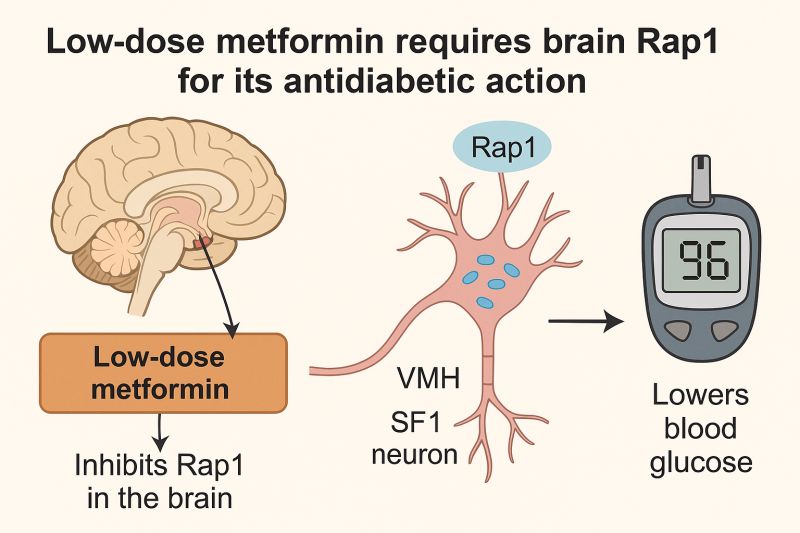
I can’t take Metformin because it gives me severe diarrhea, but for others, it is good news that scientists have discover metformin’s action in the brain, suppressing a protein called RAP1 to lower blood glucose.
Metformin, the first line drug for Type 2 diabetes, has been used for 60 years without a clearcut mechanism of action. It turns out it’s not just reducing glucose output from the liver. Metformin also works via the brain www.science.org/doi/10.1126/…
— Eric Topol (@erictopol.bsky.social) 2025-07-31T18:52:09.234Z
After 60 years, scientists uncover metformin’s hidden brain effects
Baylor College of Medicine
A decades-old diabetes drug just got a surprising twist. Scientists have discovered that metformin doesn’t just work in the liver and gut—it also acts directly in the brain, where it taps into a hidden control center for blood sugar. By switching off a protein called Rap1 in a key brain region, the drug activates specific neurons that help lower glucose levels, even at tiny doses.
Although only a few diabetes drugs are known to act on the brain, this research suggests that metformin has been doing so all along. The findings point to new opportunities for developing therapies that directly target this brain pathway.
Wikipedia
Metformin is generally well tolerated.[21] Common adverse effects include diarrhea, nausea, and abdominal pain.[15] It has a small risk of causing low blood sugar.[15]
Metformin use is typically associated with weight loss.[67] Some evidence shows that metformin is associated with weight loss in obesity in the absence of diabetes.
Rap1 (Ras-proximate-1 or Ras-related protein 1) is a small GTPase, which are small cytosolic proteins that act like cellular switches and are vital for effective signal transduction.[1]
GTPases are inactive when in their GDP-bound form, and become active when they bind to GTP. GTPase activating proteins (GAPs) and guanine nucleotide exchange factors (GEFs) regulate small GTPases, with GAPs promoting the GDP-bound (inactive) form, and GEFs promoting the GTP-bound (active) form. When bound to GTP, small GTPases regulate myriad cellular processes. These proteins are divided into families depending on their protein structure, and the most well studied is the Ras superfamily, of which Rap1 is a member. Whereas Ras is known for its role in cell proliferation and survival, Rap1 is predominantly involved in cell adhesion and cell junction formation. Ras and Rap are regulated by different sets of guanine nucleotide exchange factors and GTPase-activating proteins, thus providing one level of specificity.[2]
metformin, that diabetes drug used for 60+ years? turns out everyone missed that it works directly in your brain. it’s suppressing a protein called rap1 in the ventromedial hypothalamus to lower blood sugar. even tiny doses do this! kinda wild to learn that after all this time.
— licia (@astra99.bsky.social) 2026-07-26T23:01:34.790052+00:00
Other Metformin News
💊 A cheap diabetes drug may slash long COVID(LC) risk. Metformin cut cases by ~64% in overweight/obese adults.-Without metformin: 1 in 3 got LC-With metformin: 💊 1 in 5. academic.oup.com/cid/advance-… #BlueSky #MedSky 🧪 #IDSky#SciSky #EMSky #EndoSky #NurseSky #FmSky #PedsSky #ObSky
— Carolyn Barber, MD (@cbarbermd.bsky.social) 2025-09-02T19:46:12.018Z
We’ll get straight to the point: The financial hardships that Daily Kos is facing this year are tough.
We continue to be paywall-free. We continue to be supported by our readers, not billionaires or corporations. But we need to bring in more revenue. We are leaning on our community more than ever to help make ends meet.
Power matters.
Was this story worth reading?
Recommending and sharing stories helps us decide which stories are most important to show our readers.