
Antarctica’s Mount Erebus has been erupting for more than half a century, churning a permanent lava lake beneath its icy summit. Its plume may carry an estimated 80 grams of microscopic gold each day, which would be worth over $10,000
But that’s not even the coolest thing about it.
The geology of darkness
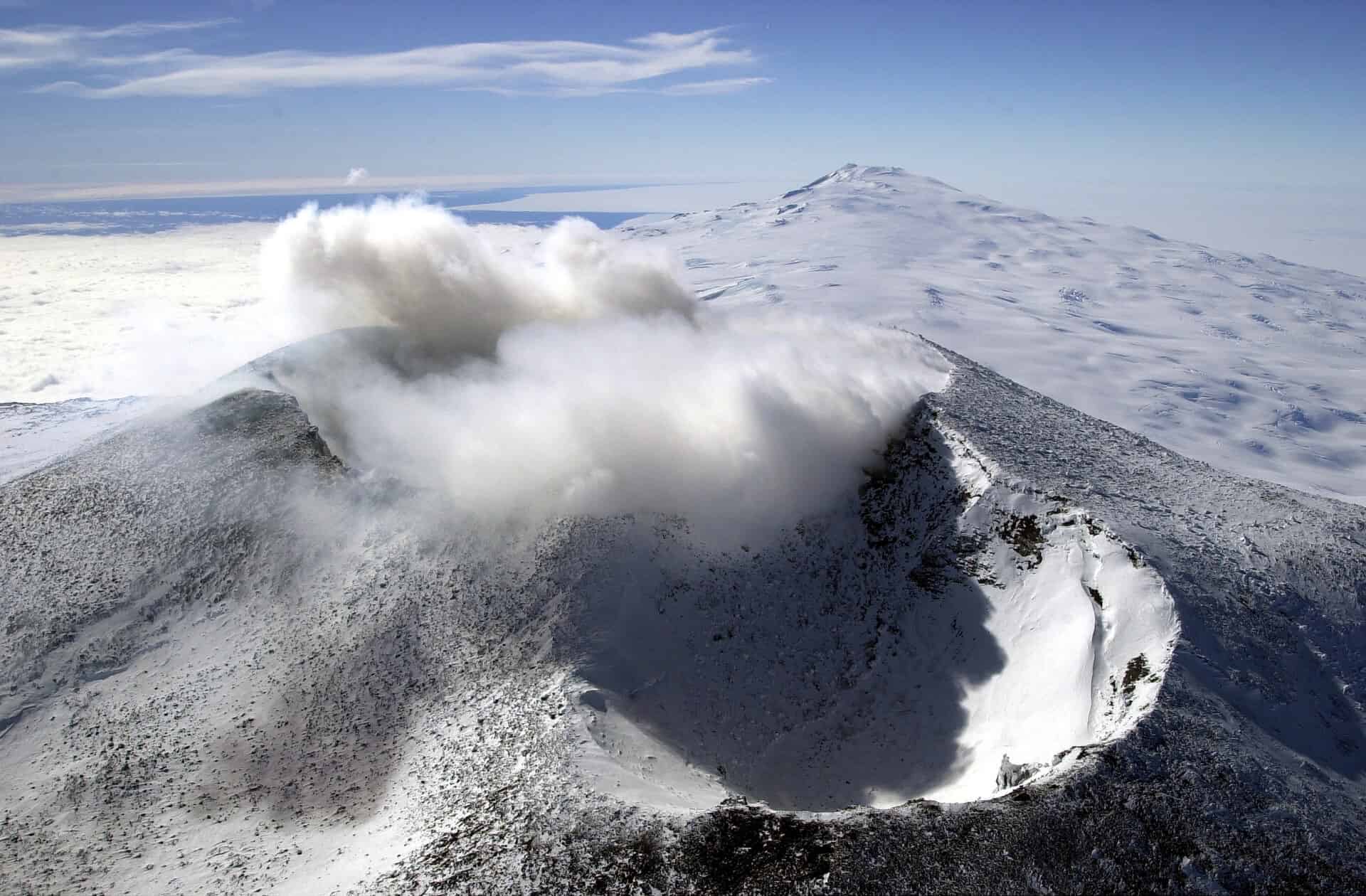 Aerial view of Mount Erebus craters. Image via Wikimedia Commons.
Antarctica is known for its vast expanse of ice and snow. But it’s also a very active volcanic place. According to a 2017 study, the continent has at least 138 volcanoes, and Erebus is one of the most active. There’s also growing evidence that parts of Antarctica remain geologically restless. In 2025, researchers reported dozens of previously undetected earthquakes and 251 additional similar events recorded between 2019 and 2024.
Yet even among this, Erebus stands out.
Mount Erebus is a stratovolcano, formed from layers of lava flows and tephra — a mix of volcanic ash, pumice, and other debris. Its summit reaches an altitude of 3,794 meters (12,450 ft), making it the second-tallest volcano in Antarctica, after the dormant Mount Sidley. What sets Erebus apart is its persistent lava lake (one of only a handful on Earth), which resides within the main crater.
 Satellite picture of Mount Erebus showing glow from its persistent lava lake. Image credits: NASA.
Mount Erebus’ activity is characterized by so-called “strombolian eruptions”. These are moderate bursts of explosive activity. Large bubbles of volcanic gas rise through the lake and burst at the surface, sometimes propelling partly molten rocks more than 100 meters into the air. Although these explosions are small by volcanic standards, they present a genuine danger to anyone working near the crater rim.
In 1841, explorer James Clark Ross and his crew sailed past the island on which Erebus lies and found it erupting. The explorer named it (and its neighbor, Mount Terror) after his ships, HMS Erebus and HMS Terror. In Greek mythology, Erebus is the personification of darkness and one of the first creatures to exist, born out of chaos and the night.
The first party to reach the summit did so in March 1908 during Ernest Shackleton’s Nimrod expedition. Led by geologist Edgeworth David and including Douglas Mawson, the climbers endured a blizzard, exhaustion and severe frostbite before looking into the crater.
×
Thank you! One more thing…
Please check your inbox and confirm your subscription.
Members of Robert Falcon Scott’s Terra Nova expedition returned to survey the volcano in 1912. During that work, geologists Frank Debenham and Raymond Priestley discussed the need for a permanent institution that could preserve polar records and help future explorers learn from previous expeditions. That conversation helped inspire the creation of the Scott Polar Research Institute.

A strange type of magma
Erebus is remote enough to pose little threat to towns or cities, but scientists do not treat it as harmless. Explosions can scatter lava bombs across the summit, while corrosive gases, extreme cold, altitude and sudden weather changes make fieldwork unusually hazardous.
Nowadays, Antarctica’s largest research settlement, McMurdo Station, stands on the same island. The US National Science Foundation says the station can accommodate up to 1,100 people during a summer week and about 200 during winter. It provides laboratories, aircraft, communications and logistical support for research across Ross Island, including work on Erebus.
Researchers also monitor Erebus with seismometers and satellites. The Mount Erebus Volcano Observatory’s seismic network began operating in 1981, and satellite instruments track the lava lake’s thermal signal when weather and orbital coverage allow. The latest detailed Smithsonian bulletin, covering 2023, reported that the lava lake remained active and produced more satellite thermal alerts than in any year since 2019.
 Human settlements around Erebus. Image credits: Alan Light.oi
In 1992, the interior of Mount Erebus was explored by Dante I, a robotic explorer with eight legs designed for tethered descents. Dante was tasked with collecting gas samples from the magma lake within the inner crater using its onboard gas chromatograph, while also measuring the volcano’s internal temperature and the radioactivity of its materials.
Mount Erebus has an unusual magma composition, primarily due to its phonolitic lava, which is rare among Earth’s volcanoes. Phonolitic lava is a type of volcanic rock that forms from magma with a specific type of chemistry. It contains minerals like nepheline or leucite instead of the more common quartz.
Phonolite is also considerably more viscous than the basaltic magma found in better-known lava lakes such as those at Kīlauea or Erta Ale. Erebus can sustain a lava lake because hot magma and gas continually circulate through an open plumbing system, replacing heat lost at the surface.
 Erebus seen from a satellite. Image credits: Copernicus / ESA.
Gold eruption
But it gets even more interesting. The gases from Mount Erebus contain particles and metals, including gold.
In a 1991 study, researchers reported finding crystalline particles of elemental gold in the plume near the crater, in shallow surface deposits and in Antarctic air samples collected as far as 1,000 kilometres away. The observed particles were generally only about 20 to 60 micrometres across — slightly less than the width of the average human hair.
The gold probably begins its journey dissolved in hot volcanic gases, potentially transported as a gold-chloride compound. As the gases leave the magma and cool, the metal condenses into solid particles or attaches itself to other aerosols. Erebus is especially rich in chlorine-bearing particles, which may help mobilize metals within its unusual magmatic system.
If the old estimate of 80 grams per day were maintained for a full year, Erebus would release roughly 29 kilograms of gold, which would already be a pretty sizeable treasure worth around $4 million.
But it would not form a 29-kilogram pile.
The particles would be dispersed across enormous volumes of air, snow and volcanic material, mixed with salts, rock fragments and other trace metals. Recovering them would require complex processing.
Mining it would also be prohibited. Article 7 of the Environmental Protocol to the Antarctic Treaty bans activities relating to Antarctic mineral resources, except scientific research. Contrary to a common misconception, that prohibition does not automatically expire in 2048.
It’s not the only volcano that erupts gold. A few others, including the White Volcano in New Zealand, have the same characteristics. While it’s not out of the question to mine some of those in the future, the cold, inaccessible Antarctic is just not worth it.
A window into the Earth
Erebus has been active for around 1.3 million years and is the southernmost active volcano on Earth. The fact that it erupts gold is a neat curiosity, but other things about it are way more interesting.
As one of the few volcanoes with an active and accessible lava lake, Erebus offers direct observations of magma dynamics, including convection and gas emissions. These observations can help scientists to understand the behavior of magma under the Earth’s surface, particularly in terms of how gases escape from magma and how this influences volcanic eruptions.
Erebus’s phonolitic lava composition is also significant because it is relatively rare, leading to a specific type of eruption. Studying this type of lava can help volcanologists predict and model eruptions of similar volcanoes worldwide.
This spills into biology as well. The heat from Erebus affects the surrounding ice and creates subglacial environments that can harbor extremophiles — creatures that thrive in extreme environments. Studying these organisms can expand our knowledge of life’s adaptability. This could potentially offer analogs for extraterrestrial life, especially on icy worlds with internal heat sources like Jupiter’s moon Europa.
This article was originally published in April 18, 2024, and has been edited with additional information.