

Listen to this article
Estimated 5 minutes
The audio version of this article is generated by AI-based technology. Mispronunciations can occur. We are working with our partners to continually review and improve the results.
A national report documenting antisemitism on Canadian university and college campuses has found an “alarming prevalence” of the prejudicial behaviour across the country along with a widespread failure to address the problem.
“The findings indicate that many Jewish students experience widespread and persistent antisemitism on Canadian campuses as a defining feature of post-secondary life that shapes their behaviour, their ability to fully participate in campus life, their safety and their well-being,” the report said.
The report is the first of two commissioned by the federal government’s former special envoy on preserving Holocaust remembrance and combatting antisemitism. The second report will look at the general student population’s views on antisemitism.
They combine the results of two surveys, one that spoke to 900 Jewish students attending post-secondary institutions across the country and another that spoke to 755 non-Jewish students “from the broader campus population.”
The surveys conducted from Nov. 17 to Dec. 19 last year found that 95.7 per cent of Jewish students had experienced or witnessed at least one antisemitism incident in the previous 12 months.
The report also said 18 per cent of those events were perceived by the victim to have been caused by faculty members, while another seven per cent involved teaching assistants.
One student, who has not been named in the report, said a “professor wrote that we should kill all Zionists, that she’s worked with them and sees how evil they are.”
Another student reported a professor saying “Hitler was a hero” while another said a professor told them “Jews belong in Poland and need to go back.”
Jewish students also reported numerous instances of faculty bias, one-sided accounts of complex issues and teaching assistants pressuring students whose work they were marking to attend pro-Palestinian demonstrations.
‘Neither isolated or episodic’
Another student said a women and gender studies professor gave her zero per cent on an assignment because it addressed sexual assaults by Hamas on Jews during the Oct. 7, 2023, attack.
The student at the heart of this incident said the professor told them to instead focus on “Israeli police’s role in sexual assaults.”
“The central finding here is very clear: Antisemitism on Canadian campuses is neither isolated or episodic … it can reasonably be described as systemic,” Jack Jedwab, the report’s principal author, said in Ottawa on Wednesday.
“There’s no qualifiers for this antisemitism, there’s no adjectives, there’s no pretext for it,” said Jedwab, the president and CEO of the Association for Canadian Studies and Metropolis Institute.
WATCH | Jedwab on the report’s findings:
Antisemitism on Canadian campuses is ‘systemic’: report author
The first of two Campus Antisemitism and Student Experiences reports found that 95 per cent of students reported ‘experiencing or witnessing at least one form of antisemitism in the previous year,’ said Jack Jedwab, president of the Association for Canadian Studies and Metropolis Institute. Jedwab said these findings show that ‘antisemitism on Canadian campuses is neither isolated nor episodic.’
A third of students who said they witnessed or experienced an antisemitic incident reported it to the university, but 63 per cent of those who filed a report said they were dissatisfied with how it was handled.
Overall 70 per cent of the Jewish students surveyed reported feeling that the university does not take the issue seriously, and 68 per cent said campus life is not safe or inclusive for Jewish students.
“Jewish students report changing what they say, where they go, what they wear and whether they remain engaged in academic and campus life at all,” the report said.
The number of antisemitic incidents in Canada have spiked since the start of the Israel-Hamas war, with synagogues being shot at or firebombed and Jewish-owned businesses targeted. Members of Canada’s Muslim community have also experienced Islamophobic attacks against places of worship and businesses over the same period.
The Israeli military’s nearly three-year operation in Gaza has killed over 70,000 people, according to the Gaza Health Ministry and human rights organizations.
The war erupted with the Hamas-led attack on southern Israel that killed over 1,000 people and took about 250 hostage.
In response to the findings of the report, the Centre for Israel and Jewish Affairs, B’nai Brith Canada and the Friends of Simon Wiesenthal Center issued a joint statement calling for action.
“We call on university leaders and governments at every level to carefully consider this report,” the statement said. “The drivers of this hatred — including antizionism — are well known, and the time to act is now. We need concrete actions to protect Canadian students.”
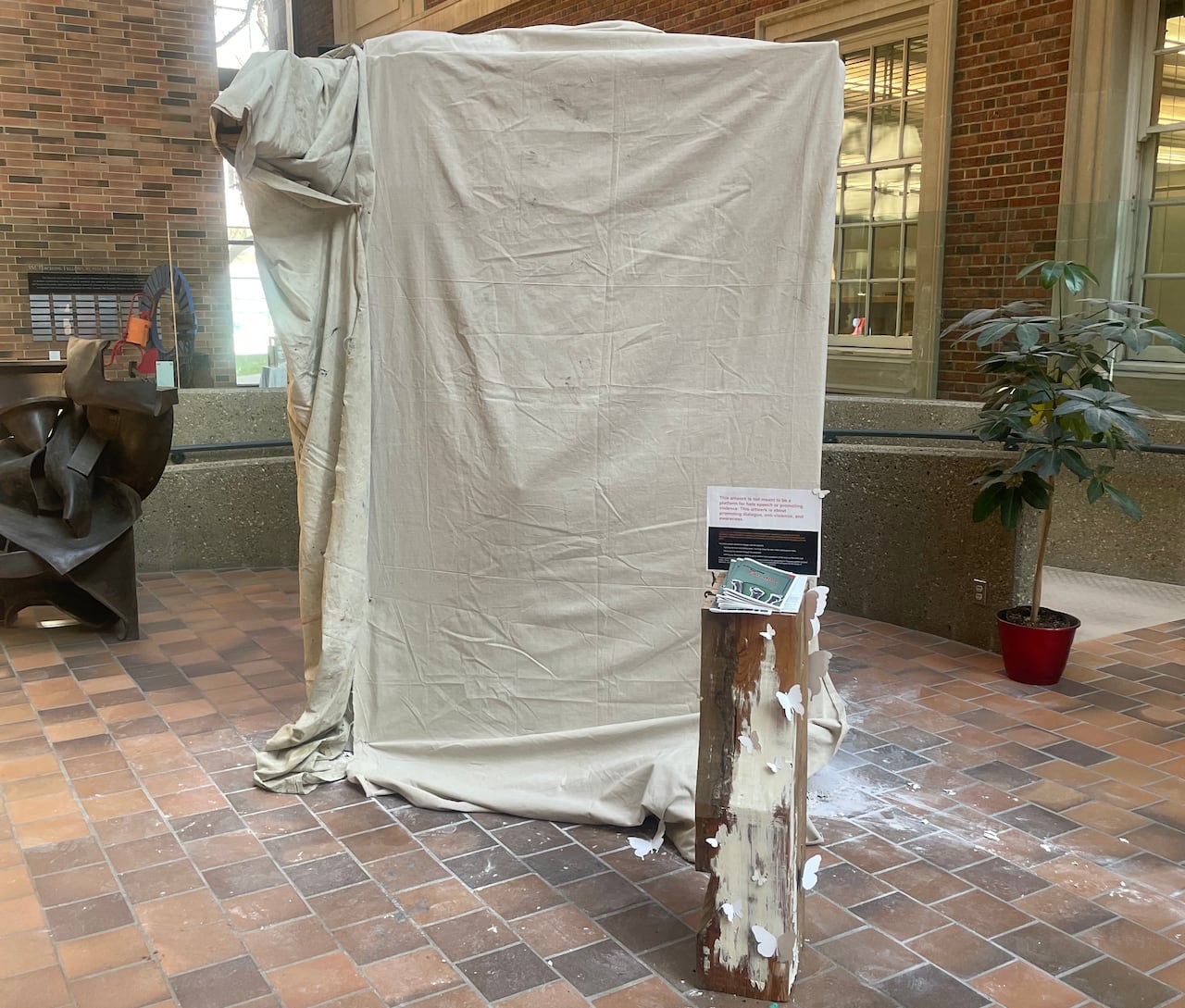 This art installation at the University of Alberta’s Rutherford Library was defaced in 2024 with a swastika, along with a message praising the Popular Front for the Liberation of Palestine, listed as a terror group by the Canadian government. (Submitted by Michael Cor)
This report was released on the same day as U.S.-based think-tank Jewish Tulsa garnered attention for pressuring U.S. President Donald Trump to offer refugee status to Jewish Canadians that feel threatened by rising antisemitism.
“With the urgency around the challenges and the inaction we see in Canada, an asylum pathway makes sense,” Jewish Tulsa’s executive director Joe Roberts told The Canadian Press.
Roberts was born in Ohio but moved to Canada in 2016 in part because he feared democratic backsliding under the Trump administration.
When antisemitic graffiti started popping up in his local park in 2023, Roberts said he decided to move to Tulsa.
Roberts said a group in Tulsa that helps Jewish people settle in the city has received inquiries from 800 to 900 Jewish Canadian families representing roughly 2,000 people who say they are considering leaving Canada.
Most of the Canadians able to make such a move either qualify for a visa under the North American trade agreement CUSMA or are eligible for American citizenship through family or marriage ties, Roberts said.