
Some municipalities haven’t spent money earmarked to combat addiction; other have squandered on unrelated purchases. Nevertheless, New York is taking a hands-off approach to how local governments spend settlement funds.

Chinazo Cunningham, commissioner of the Office of Addiction Services and Supports. Photo: NYS Office of Addiction Services and Supports.
Who will hold Buffalo accountable for spending thousands of dollars earmarked to combat opioid addiction on lawnmowers, snowblowers or speakers for a fireboat?
Not the state agency that has overseen the rollout of millions of New York’s opioid settlement funds.
“We don’t have the authority to tell local governments how to use those dollars,” Chinazo Cunningham, the commissioner of the state Office of Addiction Services and Supports, said at a town hall meeting held in Cheektowaga last week.
Opioid settlement funds are a once-in-a-lifetime source of funding to fight addiction and overdose deaths, won by the state attorney general — and attorney generals nationwide — in litigation against drug manufacturers and distributors for their role in the opioid epidemic.
The state has secured over $3 billion in settlement funds to be spent through 2040. To date, according to the agency, $454 million has been distributed statewide.
One meeting participant asked Cunningham why local municipalities had been permitted to spend on items with dubious utility for overdoses.
“I’ve never known a lawnmower or a snowblower to get a person into treatment,” Chris Harzynski, co-founder of Creative Restorations Inc., said, referring to lawnmowers bought by the former Acting Mayor Chris Scanlon administration for block clubs and a slew of other questionable purchases approved by the city’s finance department as late as January of this year.
“Were those lawnmowers used to cut the grass to see the dead bodies in empty lots?” Harzynski asked.
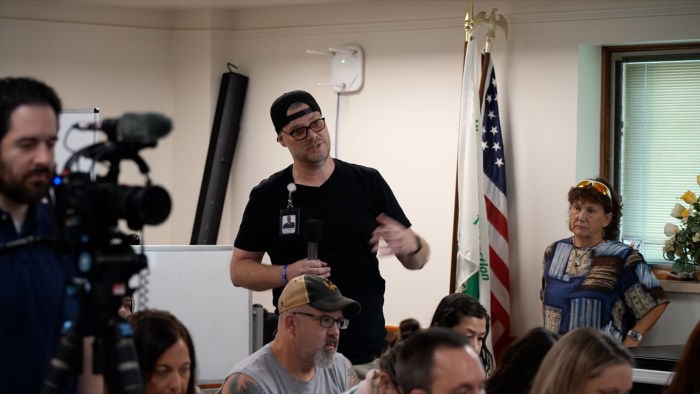
Chris Harzynski, co-founder of Creative Restorations Inc. Photo: WKBW, News 7.
Cunningham said more than half of opioid settlement dollars go from the attorney general through a “third party” to cities and counties. She said her agency has no control over how those funds are used. The Office of Addiction Services and Supports, she said, only has oversight of the service providers the agency contracts with directly.
However, the agency has some authority over the roughly $6 million that’s gone to Buffalo, $18 million to Erie County, and $417,990 to smaller Western New York municipalities — the amounts connected to the agency’s regional abatement funds — that Investigative Post has reported on extensively for the last year.
Recipients of these regional funds must report to the agency every August 1 how much they’ve spent. Purchases must abide by a schedule of approved uses relating to addiction treatment and prevention.
“That is oversight,” Aliya-Begum Jessa, policy research associate at Legal Action Center, told Investigative Post.
“There are multiple entities who should be doing some kind of oversight, but no one right now has stepped up except the state comptroller,” Jessa said, referring to a state audit of settlement funds currently underway. “And that kind of audit could take years to do.”
Subscribe to our free weekly newsletters
An Investigative Post reporter asked what the agency is doing as a response to Buffalo’s questionable use of funds. Cunningham responded that the agency is auditing local governments’ spending of opioid dollars, but did not confirm if Buffalo is part of that review.
The town hall in Cheektowaga was part of a statewide “listening tour” conducted by Cunningham through the end of September. Cunningham said a team will analyze recurring themes raised by speakers but did not indicate if policy action will take place as a result.
Amy Webster, a former employee of the now-shuttered Save the Michaels of the World, wondered why the agency hadn’t clawed back $500,000 in agency funding — money that went first from the agency in a regional abatement fund, then through the City of Buffalo — for Save the Michaels’ unopened East Side facility.
“We absolutely do have oversight over the contracts that we have with programs,” Cunningham reiterated. “We don’t tell local governments how to use those dollars.”
According to Open Book Buffalo, a public portal of city spending updated daily by the city comptroller’s office, 22 percent of the City of Buffalo’s opioid settlement spending to date has been approved to fund treatment or prevention programs in community-based organizations. However, that 22 percent includes payments made to Save the Michaels for the unopened East Side facility. Without Save the Michaels, that figure drops to less than 1 percent.
The only organizations recently earmarked to receive Buffalo’s settlement funds are the Prevention Council of Erie County for $8,561 and another with Preventionfocus Inc. for $6,268, according to Open Book Buffalo. Both will fund addiction prevention programs for teens through the Mayor’s Summer Youth Internship and Employment program.
Investigative Post previously reported in April that Catholic Health and Evergreen Health are set to receive opioid settlement dollars from the city for a counseling program at Sisters Hospital and technological upgrades at a Catholic Health methadone clinic, though no payments are reflected in the Open Book Buffalo system to date.
Amanda Szustak, who works with Harzynski at Creative Restorations, Inc., was also in attendance at the Cheektowaga meeting. She said she’s been emboldened by what she’s learned about local municipalities’ failure to spend dollars, particularly in her hometown of Lancaster.
Investigative Post previously reported in March that Lancaster had not spent any of the $40,000 it has received in the last three years to fight opioid addiction.
Szustak has scheduled a meeting with the Lancaster police chief. She and Harzynski have been planning a youth prevention program to introduce in schools.
“The reason Lancaster has that money is because my friends and classmates died,” Szustak told Investigative Post. “And Lancaster is not spending a penny of it. It’s a slap in the face.”
Szustak said it’s time for someone to enforce oversight of spending in Buffalo, Lancaster and elsewhere.
“Let’s say the opioid settlement funds are doing everything that they say they’re doing in other parts of the state. That’s amazing. But it’s not working in Buffalo.”

Stacy Schwab of the Midnight Marauding Mamas. Photo: NYS Office of Addiction Services and Supports.
Stacy Schwab is the founder of the Midnight Marauding Mamas, a small community-based mutual aid organization that provides drug users clean needles, food, clothes and a place to shower. She said her on-the-street team often arrives first to intervene in overdoses, before first responders like police or emergency medical services.
She attributes the state’s 43 percent decrease in overdose deaths to the dedication of hardscrabble organizations like her own.
“The 43 percent decrease is because of boots-on-the-ground work being done,” Schwab said.
Schwab said that what her organization really needs is a crisis counselor — a role she calls a “debriefer.”
“So that when somebody’s child dies in my arms, I have somebody to immediately debrief with.”
Adam Smith-Perez, who covers urban affairs for Investigative Post, is a Report For America corps member.
posted 35 minutes ago – August 7, 2026