
Family members and sailors say months at sea with no end in sight to a grueling Middle East deployment have intensified worries about mental health and the risk of self-harm aboard the USS Abraham Lincoln.
Those concerns were brought directly to Navy leadership Thursday, when family members spoke to Acting Secretary of the Navy Hung Cao and other senior officials during intense town hall meetings, according to two spouses who attended.
In one case, a spouse tearfully told officials that she received a message that same day from her husband saying “he hopes he doesn’t wake up tomorrow,” according to one of the estimated 200 attendees at the San Diego town hall meeting.
Officials presiding over the meeting didn’t directly respond to that or similar statements but stressed that sailors aboard the ship had access to mental health workers, as well as chaplains and doctors, the spouse said.
Those officials also said the service was working to send more mental health professionals to the ship, the spouse added.
The worries expressed at Thursday’s meetings echo those raised independently with Stars and Stripes by sailors and family members in recent weeks.
Interviews with active-duty sailors and family members, along with dozens of public social media comments and posts by crew members, describe sailors struggling with exhaustion and declining morale, including reports of suicidal thoughts and at least one instance where a crew member was prevented from jumping overboard.
The concerns come during an unusually demanding deployment — Lincoln sailors have supported 40 days of continuous combat operations in the U.S. 5th Fleet area of operations and logged 250 consecutive days at sea, according to Navy officials.

A sailor prepares an MH-60R Sea Hawk helicopter to take off from the flight deck of the aircraft carrier USS Abraham Lincoln, June 27, 2026. Families say the crew is worn down by months at sea with the carrier logging 250 consecutive days at sea. (U.S. Navy)
The aircraft carrier left San Diego in November for a Pacific deployment, was redirected to the Middle East and has now been deployed for more than eight months, including a record-breaking number of days at sea without a port stop.
Its crew has spent much of that time supporting U.S. combat operations against Iran, and the deployment, which was anticipated to end in May, has been extended with no publicly announced return date.
The Navy did not say exactly how it was responding to family members’ concerns about mental health and the potential for self-harm raised at Thursday’s meetings.
But the service did say the ship has a network of mental health support that includes counselors, chaplains, medical professionals and other services.
“Leadership is continuously conducting assessments to monitor and sustain the psychological readiness of every sailor,” the Navy said in a statement Monday.
Stars and Stripes agreed to withhold the identities of spouses, family members and active-duty sailors interviewed for this story due to fears of reprisal.
Family members and sailors say the roughly 5,000 service members aboard Lincoln have endured food and water shortages, disrupted mail service and long workdays with little time off.
Lincoln has gone much of the deployment without the regular port calls that typically give carrier crews a break from life at sea. Carriers generally pull into a port every 30 to 45 days to allow for replenishment, maintenance and crew rest.
“We’ve just been turning and burning the whole time we’ve deployed,” said one sailor, noting that crew morale was high at the beginning of deployment, with expectations of port visits and other breaks.
“Nothing to really look forward to at this point,” the sailor said, adding that crew morale now is so low that sailors and Marines aboard Lincoln would be willing to forgo any upcoming stops in favor of returning home as soon as possible. “All we want is a date home.”
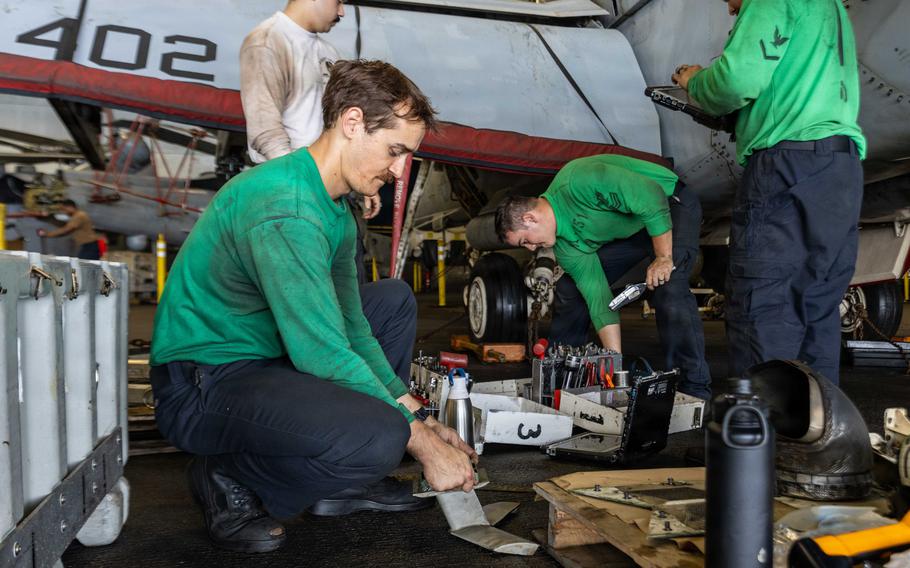
Sailors conduct maintenance on an F/A-18E Super Hornet in the hangar bay of the aircraft carrier USS Abraham Lincoln, Aug. 3, 2026. About 200 spouses and family members brought concerns about mental health and the risk of self-harm to senior Navy leaders in San Diego this week. Officials have given no return date for the carrier. (U.S. Navy)
Sailors and their families say they understand that long hours, separation and dangerous missions are part of military service. But many say Lincoln’s crew has continued carrying out combat operations under unusually difficult conditions without enough attention to the physical and mental toll.
“My son is currently on that ship and listening to him say that he and his shipmates constantly think about jumping off the ship just for relief is so hard to listen to,” one worried parent wrote to Stars and Stripes in July. “We are all tucked in at night in our beds at night meanwhile our loved ones are out there fighting with no understanding as to what they’re defending.”
Sailors aboard Lincoln separately described an incident in which a crew member was prevented from jumping from the ship.
“We already had an instance where watch standers had to stop someone from jumping,” one sailor said. The ship’s crew was informed about the incident, which occurred a few months ago, during a ship-wide announcement, sailors said.
The Navy did not respond directly to questions about the incident.
But in response to questions about mental health, the service said leadership was committed to “listening to our families, supporting our servicemembers, and ensuring the Abraham Lincoln Carrier Strike Group has the resources needed to safely and successfully accomplish its mission.”
The sailors, along with spouses and family members, also confirmed earlier problems aboard Lincoln that included food rationing, water shortages and a stretch of more than a week when service members could not do laundry.
Those problems largely have been resolved, and mail service continues to improve, they said.
A brief stop at a port in Oman in early July allowed the ship to resupply, including with fresh fruits and vegetables that one sailor said had not been available aboard Lincoln for several months. Many sailors were allowed off the ship but were restricted to a secure compound within the port.
The Lincoln also made a short visit to Guam in December, but many sailors aboard couldn’t get off the ship during that stop, the spouses said.
“It’s getting very, very hard to see that happening to your (sailor),” one spouse said about the lack of port calls, mail service and other needed support for service members aboard the ship. “I’m just actively watching my (sailor) kind of break down, like they’re losing hope and everything.”
In its response, the Navy pointed out that Lincoln is operating in a highly contested environment where traditional supply hubs in the Middle East were disrupted by combat actions.
That operating environment required changes in replenishment and resupply “to tackle any logistics challenges due to regional operations and geographic restraints,” the Navy said.
In doing that, the service prioritized mission-critical supplies, such as food first, then hygiene items and then mail.
“Current reports from the ship confirm continuous access to clean water, functional AC, and two protein options per meal,” the Navy said. “Logistical flow is actively improving.”

An F/A-18E Super Hornet launches from the flight deck of the aircraft carrier USS Abraham Lincoln, July 31, 2026. The carrier has flown combat missions throughout the war with Iran, including Operation Epic Fury and the blockade of the Strait of Hormuz. (U.S. Navy)
Thursday’s meetings, one in-person and one online, included Vice Adm. Douglas Verissimo, Naval Air Forces commander, and Vice Adm. Joseph Cahill, Naval Surface Forces commander, among other officials. Cao attended the in-person meeting but was not present for the video call.
One woman told Cao, Verissimo and Cahill that they had “broken trust between us and the leadership,” the spouse said.
Lincoln left its San Diego homeport Nov. 21 for a routine Pacific deployment, less than a year after returning from a 162-day deployment in December 2024, USNI News reported at the time.
The carrier was soon redirected to the Middle East, arriving there in January. Since then, Lincoln has remained on station in the Arabian Sea.
Citing operational security, officials at Thursday’s meetings would not say when Lincoln would return home, spouses said.

A sailor conducts maintenance on an MH-60R Sea Hawk helicopter in the hangar bay of the aircraft carrier USS Abraham Lincoln, July 26, 2026. Family members have raised concerns about mental health and living conditions aboard the ship. (U.S. Navy)
Research has identified several conditions described by Lincoln sailors and family members as significant sources of stress for sailors at sea.
A 2025 study published in the journal Military Medicine found that an inability to rest when needed and limited access to quality mental and physical health care ranked among the most distressing aspects of deployments.
The study, which surveyed 956 sailors serving aboard aircraft carriers, destroyers and amphibious ships, found that difficulty communicating with family and friends and a lack of opportunities to relieve stress also were significant concerns.
The uncertainty over when a deployment will end can take a significant toll on sailors, said Thomas Nutzmann, a retired Navy chief petty officer who served 20 years and deployed four times.
“There’s no Monday, Tuesday, Wednesday, it’s just a day,” Nutzmann said of being at sea for long stretches. “You try to maintain optimism to the best of your ability. The problem is when you’re out to sea for so long, you can only do so much to keep morale up before you hit a stalemate … and that’s where the deterioration is.”