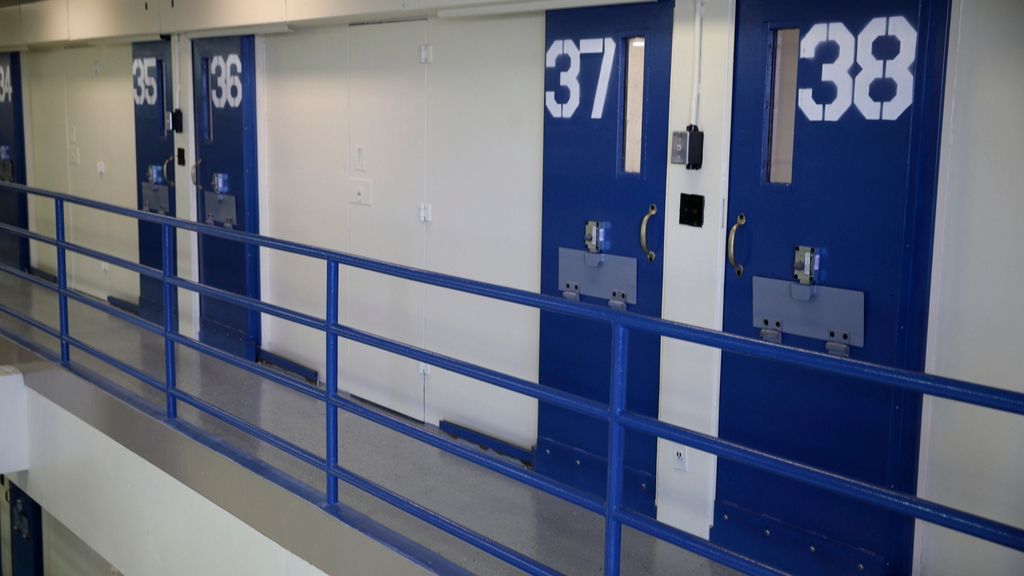
State lawmakers said Wednesday they remain adamantly against changing the law that limited the use of solitary confinement in state prisons with thousands of vacancies for correction officers.
Democratic lawmakers continue to defend the Humane Alternatives to Long-Term Solitary Confinement, or HALT Act, which prohibits an incarcerated person be held in solitary confinement housing for more than 15 consecutive days. Amending the law was a top demand for thousands of correction officers who participated in a wildcat strike in February and March.
Earlier this month, the state Department of Corrections and Community Supervision sent a list of potential reforms to the Legislature to give the department more flexibility to use segregated confinement for repeat offenders, sexual harassment, gang activity or other heinous misconduct.
“HALT does not need to be changed; it needs to be implemented by DOCCS,” said Sen. Julia Salazar, who sponsored the law that took effect in 2022.
Salazar, who chairs the Senate Crime Victims, Crime & Correction Committee, said the department has failed to fully implement the law in all state facilities since the law was passed.
“Fully implementing the HALT solitary confinement law is not only DOCCS’ legal obligation, but would also make New York’s prisons safer for staff, incarcerated individuals and the public,” the senator said.
The trial of three correction officers charged in last year’s death of Robert Brooks will start Monday. Brooks, an incarcerated man from Rochester, died last year after a violent encounter with multiple officers at Marcy Correctional Facility in Oneida County.
His death pushed mounting tension and violence in state prisons to a breaking point, but lawmakers say a persistent shortage of COs doesn’t mean HALT should be amended.
The state has openings for about 4,500 correction officers, or about 30% of 15,000 officers permitted in the budget. About 3,000 members of the National Guard are assigned to help staff prisons, with about 2,600 deployed in facilities.
The department is aggressively recruiting officers to fill the gap, including offering sign-on and retention bonuses, statewide advertising and marketing campaigns, and allowing out-of-staters to apply. This year’s budget included a change to allow 18-year-olds to apply for certain positions.
“As a result of these recruitment efforts, DOCCS has seen a 160% increase in individuals taking the CO exam,” according to the department. “As DOCCS continues to aggressively recruit the next generation of correctional leaders and rebuild our security staffing numbers, facilities will be able to resume more of its regular operations.”
More than 70 lawmakers on the state Black, Puerto Rican, Hispanic & Asian Legislative Caucus continue to push back against calls to amend the law.
Caucus chair Assemblywoman Michaelle Solages said ongoing staffing shortages have delayed the law’s implementation, which was designed to replace isolation with recreational programming to improve rehabilitation.
“We’re talking about a law that hasn’t been implemented, and we’re talking about rolling it back, and to me, it just doesn’t make sense,” Solages told Spectrum News 1 on Wednesday.
Prison violence has increased in recent years between incarcerated people and staff, and between people behind bars. Both correction officers and people in prison have told elected officials and advocates they fear for their safety.
Leaders with the state Correctional Officers & Police Benevolent Association have attributed the uptick to HALT. The state correction officers union was part of the committee that advised DOCCS how to reform the law and backs the department’s recommendations.
“We urge the state Legislature in the strongest possible terms to accept our recommendations,” NYSCOPBA spokesman Jimmy Miller said in a statement. “This was a good start toward making our members safer, as well as all others who live and work inside our correctional facilities. The state Legislature must make these changes a priority as early as possible in their next legislative session.”
But lawmakers said they want more data, instead of anecdotal evidence, to pursue legislative changes.
“The individuals who went and did the strike did it in defiance of the law, and we need to make sure that we’re not rewarding that,” Solages said.
The Correctional Association of New York released a report Monday showing the number of people in segregated confinement housing has increased since HALT took effect.
CANY Executive Director Jennifer Scaife said DOCCS must update its data collection systems so HALT is consistent across state facilities — delayed by too few staff to relocate people to be in compliance with the law.
“People are reporting to us that they’re not getting the full seven hours out of cell time that they are entitled to in a Rehabilitative Residential Unit, or that they’re not getting it as often as they should,” Scaife said. “Or that they aren’t finding the programs to be quite as helpful as the law might have anticipated.”
Solages said the state must increase sign-on or relocation bonuses, and recruit officers from marginalized communities. But state leaders must be creative with solutions next session.
“My concern there is that if they’re not able to run the programs that are therapeutic in nature and intended to get at those underlying issues, sending more people for more reasons to the RRU is just not going to address the bigger problems with violence,” Scaife said.
NYSCOPBA leaders said the union remains committed moving forward to work with DOCCS to retain officers and recruit new staff to bring the staffing levels up to appropriate levels to make the facility safe.
“Gov. Hochul has made it clear that the safety and security of everyone who enters our correctional facilities is a top priority and has implemented a number of new initiatives within DOCCS to begin making significant systemic changes following the murder of Robert Brooks,” a spokesperson with Hochul’s office said Wednesday. “This administration continues to focus on implementing these reforms that improve the well-being of every single person in a DOCCS facility — both employees and incarcerated individuals — and aggressively recruiting the next generation of correction officers to staff our facilities. We will review the recommendations and discuss them with our partners in the Legislature.”
The state has 33,239 incarcerated people to date.