I am constantly tinkering with my draft rankings throughout the season — not overreacting to a single game or performance (good or bad) but moving players around after they have enough of a sample size.
Are prospects playing up to expectations? Are they still struggling in certain areas? In some cases, players didn’t do anything wrong to “fall,” but another player at their position simply has played at a higher level (and, sometimes, comes out of nowhere to do so).
Rankings will continue to fluctuate, but as we’re almost midway through the college football season, this is a good chance to reset the positional rankings before my updated top 50 in a few weeks.
Quarterback1. Dante Moore, Oregon
2. LaNorris Sellers, South Carolina
3. Fernando Mendoza, Indiana
My evaluations of Sellers and Mendoza haven’t changed much since the summer. Sellers’ numbers aren’t eye-popping, but he makes plays on each tape that remind you how different he is. One more season in college for the 20-year-old QB’s continued development would be ideal, but he still belongs near the top of this year’s rankings.
After transferring from Cal to Indiana, Mendoza was a top-20 prospect on my summer board, and he hasn’t disappointed. His physical traits aren’t remarkable, but his accuracy and football IQ are evident every time I study his game.
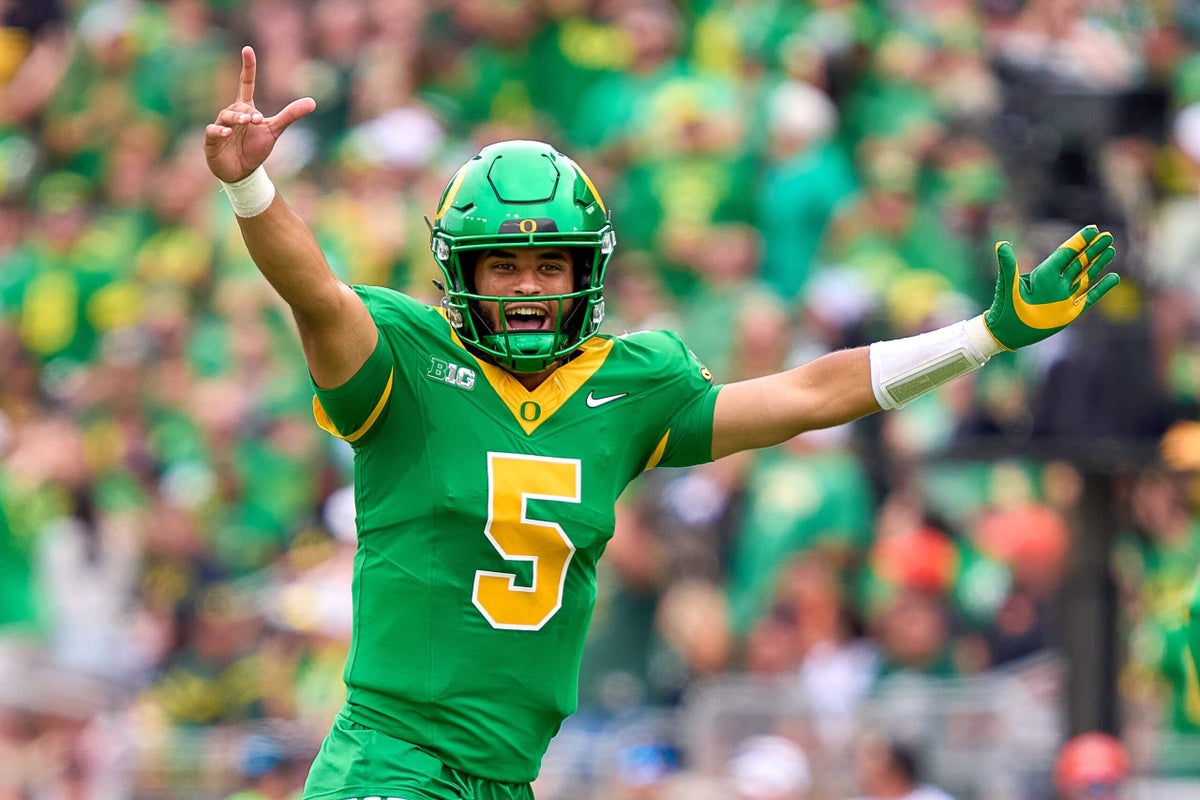
The newcomer here is at No. 1, despite having a smaller sample size. Based on his five starts in 2025, Moore is on a first-round trajectory with a 14-to-1 touchdown-to-interception ratio and numerous plays on tape that scream “NFL quarterback.” There were several times against Penn State when it fell to Moore to rescue his offense, either with his arm or legs.
I’m not bailing on LSU’s Garrett Nussmeier, but his eval is currently in limbo because of his injuries. Alabama’s Ty Simpson has only five career starts, but he might finish among the top three quarterbacks based on how he has played so far. And I didn’t grade Penn State’s Drew Allar or Clemson’s Cade Klubnik as first-rounders entering the season, so it should be no surprise neither was in consideration here.
Arch Manning should be viewed as a 2027 (or 2028) prospect at this point.
Running Back1. Jeremiyah Love, Notre Dame
2. Justice Haynes, Michigan
3. Jonah Coleman, Washington
Not much has changed at running back — there is a clear No. 1, then a handful of backs fighting for a spot in tier two.
In the eyes of scouts, both Haynes and Coleman have helped themselves over the first month of the season. They are built well for the position and rely on vision, balance and pad level to maximize each carry. It also helps that they don’t fumble and are reliable on passing downs, which matters a great deal when stacking the position.
Dude just always runs hard 😤
Look at @UW_Football‘s Jonah Coleman here 👀
📺: BTN pic.twitter.com/Tkv4VmpVjv
— Big Ten Network (@BigTenNetwork) September 7, 2025
Wide Receiver1. Jordyn Tyson, Arizona State
2. Makai Lemon, USC
3. Carnell Tate, Ohio State
I was somewhat underwhelmed by the draft-eligible wide receivers over the summer, but the position deserves a much more optimistic outlook six weeks into the season.
Tyson was the clear WR1 in the preseason and looks even better now as he continues to develop. His ability to create his own spacing and be a threat after the catch makes him such a weapon.
Lemon ranked in my preseason top 50, but he also has taken a noticeable jump in his development. He might be the Emeka Egbuka of this draft — an average size/speed profile but knows how to play the position at a high level. My favorite part of Lemon’s tape is all the hidden yards he accumulates, because he is rarely tackled where he makes the catch.
I’ve been high on Louisville’s Chris Bell since the summer, and I really like Alabama’s Germie Bernard, Tennessee’s Chris Brazzell and a few others. But the third spot has to belong to Tate, who currently leads the FBS with six catches of 40-plus yards. His long strides make him dangerous on one-cut routes or double moves, and his hand strength has been a discernible positive for him in 2025.
Tight End1. Kenyon Sadiq, Oregon
2. Joe Royer, Cincinnati
3. Michael Trigg, Baylor
Like at running back, there is a clear No. 1 at tight end, then a group of promising prospects competing for the next tier. Right now, I’ll give Royer and Trigg the edge after Sadiq, but this group is fluid. NC State’s Justin Joly, Texas’ Jack Endries and Ohio State’s Max Klare all have the talent to be in the tier below Sadiq.
Royer can be a playmaker in the passing game, and his blocking as an inline tight end continues to improve.
A basketball athlete on the football field, Trigg is easy to rank this high based on his speed, body control and ball skills. But the unknown will be whether teams trust his maturity.
Offensive Tackle1. Spencer Fano, Utah
2. Francis Mauigoa, Miami
3. Kadyn Proctor, Alabama
Not much change at offensive tackle, although the order is a tad different than it was in the summer. Proctor has been somewhat of an enigma. His Florida State tape was flat-out bad and his performance versus Wisconsin wasn’t much better, but he was outstanding against Georgia and did a nice job versus Vanderbilt, showing better consistency with his landmarks and execution.
Scouts want to see Proctor play with the same type of consistent urgency the rest of the season. We will learn a lot about him throughout October with Missouri (with edge Zion Young), Tennessee (with Joshua Josephs) and South Carolina (with Dylan Stewart) up next on the schedule for the Tide.
Penn State’s Drew Shelton is another confounding tackle prospect. The talent is there, but the consistency hasn’t been. A strong second half would do a lot to help his NFL projection.
Interior Offensive Line1. Connor Lew, Auburn
2. Vega Ioane, Penn State
3. Brian Parker II, Duke
Lew remains at the top of the interior line stack, although he has some work to do to convince NFL teams he is worthy of a top-50 pick.
Ioane has been the one consistent part of the Penn State offense, both as a run blocker and in pass protection, and is my clear No. 1 guard at this point in the process.
Parker lines up at right tackle for Duke, but he will move inside in the NFL, likely to center. He is undersized, and I worry about his lack of mass, but his technical refinement and football intelligence help him compensate for any shortcomings.
Edge Rusher1. Rueben Bain Jr., Miami
2. Keldric Faulk, Auburn
3. T.J. Parker, Clemson
Anyone who has watched the Hurricanes’ defense this season won’t be surprised to see Bain at the top of the edge rankings. He is an elite run defender and uses his power and bend as a pass rusher to consistently disrupt the quarterback.
The third spot came down to Parker and Texas Tech’s David Bailey, who currently leads the FBS in pressures (31). If you are looking for pass-rush juice, Bailey is your guy. But Parker is the better all-around player, so he gets the edge.
The most impressive defensive prospect for the 2026 NFL Draft that I’ve seen so far this season?
It’s not even close: Rueben Bain Jr. (22 pressures, elite run defender) pic.twitter.com/Rp8RWx3ErL
— Dane Brugler (@dpbrugler) September 22, 2025
Defensive Tackle1. Peter Woods, Clemson
2. A’Mauri Washington, Oregon
3. Caleb Banks, Florida
Though it’s fair to say Woods hasn’t lived up to lofty preseason expectations, he is still the top player at his position and one of the better defensive prospects in the class.
The order after Woods, however, depends on what type of defensive tackle you want. Iowa State’s Domonique Orange has the best nickname in the class (“Big Citrus”), and if a team is looking for a stout nose tackle, then he’s your guy. Georgia’s Christen Miller and Florida State’s Darrell Jackson are putting good things on tape. Ohio State’s Kayden McDonald has been consistently disruptive in his first year as a starter and should only get better as he figures things out.
But right now, I’m going with the upside of Washington and Banks, even though the latter is currently shelved with a left foot injury.
Linebacker1. Arvell Reese, Ohio State
2. CJ Allen, Georgia
3. Sonny Styles, Ohio State
Who else did you think I would have at No. 1? With his length, power and loose athleticism, Reese is a freaky talent who can blitz, spy, drop or chase down the run. I love his traits, but he is also a smart football player, which translates to the stat sheet — he currently leads the Buckeyes in both tackles and pass breakups.
Arvell Reese is a freak 🤩@CoachUrbanMeyer hits the film room to take a look at one of @OhioStateFB LB’s Week 5 highlights 👇 pic.twitter.com/ZLeXsG0PJs
— Big Ten Football (@B1Gfootball) October 3, 2025
Allen and Styles are also first-round possibilities, but the list of linebackers in the early-round discussion doesn’t end there. Both of LSU’s standout linebackers, Whit Weeks and Harold Perkins Jr., and Texas’ Anthony Hill are part of the next tier. So, too, is Cincinnati’s Jake Golday, who continues to climb because of his athletic tools and how he is impacting games.
Cornerback1. Jermod McCoy, Tennessee
2. Avieon Terrell, Clemson
3. Mansoor Delane, LSU
The top-two spots haven’t changed, even though McCoy hasn’t been medically cleared yet as he works back from an ACL injury. Terrell — and his competitive nature — has been one of the few bright spots for an inconsistent Clemson defense.
The third spot goes to Delane, who has a strong grasp on how to play the position. He will be nitpicked in the spring because of his shorter arms and mediocre speed, but he’s a smart football player with the route anticipation to be disruptive downfield.
Safety1. Caleb Downs, Ohio State
2. Emmanuel McNeil-Warren, Toledo
3. Kamari Ramsey, USC
Downs is still Downs — no surprise he’s No. 1.
McNeil-Warren is overdue for more attention. At 6 feet 3 1/2 and 210 pounds with 4.5 speed, he always had intriguing traits, but his read-react skills and anticipation are catching up to his physical talent.
Ramsey has been banged up and his absence was obvious in USC’s loss to Illinois, but he is expected back on the field against Michigan on Saturday.