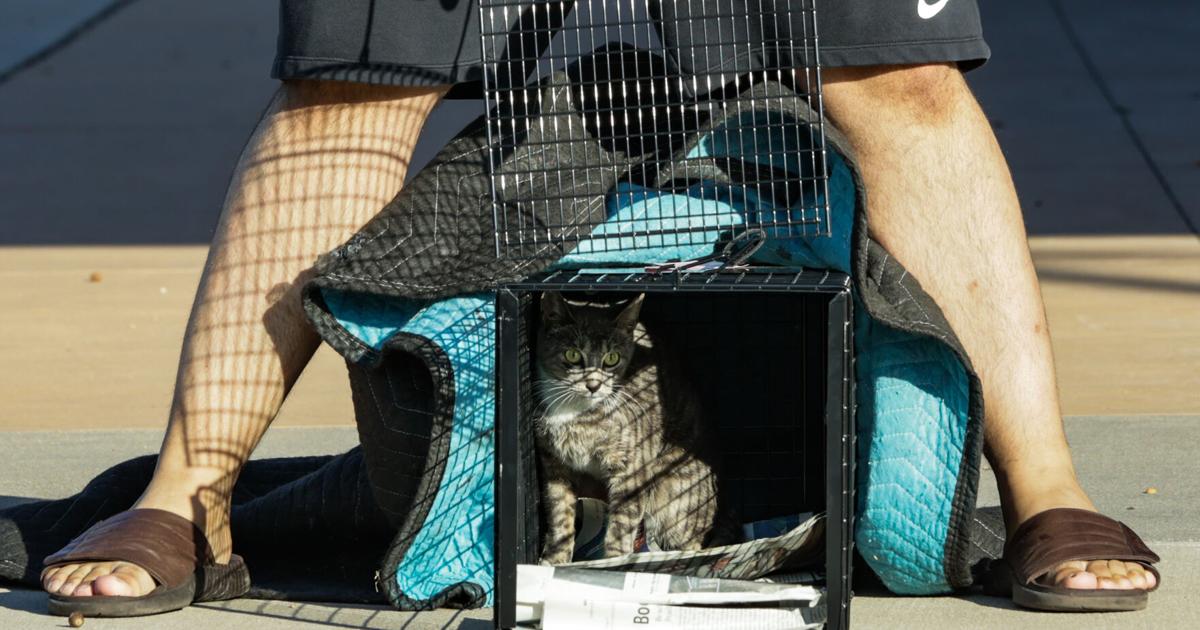

A member of the Campus Cat Coalition releases Atzi, a cat, during a trap-neuter-release program Oct. 17 at First Baptist Arlington. The coalition captures and releases cats, and provides shelters and foster care to cats on and around campus.
The Campus Cat Coalition is a large UTA student group that works to protect and care for over 150 cats on campus each year.
One of the many ways the group helps campus cats is through its trap-neuter-return program, and last Tuesday, they caught Atzi.
Atzi, a mother with kittens, is the third cat to go through the process this semester. Unspayed female cats with kittens are the top priority for the program, said Derek Fuentes, Campus Cat Coalition trap-neuter-return officer.
Alysa Potter, a social media manager for the coalition, takes part in socializing the cats that frequent the First Baptist Arlington parking lot across the street from the UTA Bookstore, where Atzi was residing with her kittens.
Potter said the coalition noticed Atzi, who is about a year old now, in January but didn’t get a good glimpse of her until April. She hissed and bolted at the sight of Potter in the beginning.
“She was very scared,” Potter said. “She was very, very feral. She was born outside, so she was not a big fan of people.”
Around the start of the fall semester, Atzi had kittens. As a result, she started warming up to Potter due to being a hungry, nursing mother.
“She’ll come up and I’ve pet her a couple times, which is really amazing. Especially when you first met her, you would have never believed that cat could’ve been calm,” Potter said.
However, Atzi’s status as an unspayed female cat put her at risk. According to Robert Knox, director of programs at the Texas Coalition for Animal Protection, if an unspayed female cat is left to her own devices, she could potentially have over 100 offspring in her lifetime.
Being pregnant and nursing can be very stressful for female cats struggling to survive. More than half of feral kittens can die due to malnutrition, according to the Texas Coalition for Animal Protection website.
This put Atzi on Fuentes’s radar. Last Tuesday, about 10 members of the coalition came together to try to trap Atzi and any other cats on their list.
The night started slowly, consisting of waiting around for the cats to fall for the trap. Fuentes said trapping the cats can feel like a Tom and Jerry-style game.
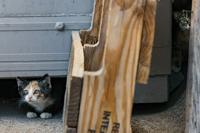
Itzel, left, and Temiquini peek out from a container during a trap-neuter-release program Oct. 17 at First Baptist Arlington. Itzel and Temiquini are kittens of Atzi, the third cat to go through the program this semester.
“It’s like a cardboard box with a stick and cheese,” he said. “We have one of those, pretty much. But it is made out of metal.”
Eventually, Atzi wandered over to eat the food in the trap. When she was safely inside, Fuentes pulled on a long string of yarn, which brought down the trap on Atzi.
She was immediately keen on escaping, and the coalition members placed a large blanket over the trap to calm her down. They transferred her to a smaller cage with 4 people holding down the trap to make sure the transfer went smoothly as she made it to the trunk of Fuentes’ car, since he would be fostering her.
Early the next morning, he took Atzi to the Texas Coalition for Animal Protection clinic in Arlington to be spayed. The clinic performs spaying and neutering procedures for free each day for the first 12 feral cats that are brought in.
Knox said there’s a massive population that wouldn’t be served if they didn’t make these surgeries free. He said feral cats can be like ghosts in the animal world, and it can go unnoticed just how many there are.
“There’s just people who just love taking care of animals, and they don’t want to see them reproducing, because that creates a lot of strain for the cats,” Knox said. “So we try and limit overpopulation by making this option available, because spay and neuter is the most humane way of curbing animal overpopulation.”
By 4 p.m., Atzi was back with Fuentes to recover for 48 hours before she could be released. Fuentes said it can be hard for cats who are not used to being inside to adjust.
“For them, it is like, ‘Oh, I’m in a big, scary, enclosed space and all these big creatures are doing things to me, and I don’t know where I am,’ stuff like that,” he said. “So the best we can do is to just provide them a space where they can feel as comfortable as possible.”
Fuentes said finding fosters can be an issue, and Potter said the coalition is working with around two foster homes currently.
“We provide everything,” Fuentes said. “So generally, all we’re looking for is someone to offer up that space and time.”
On Friday evening, Atzi was released back into the parking lot where she’d been trapped. She hesitated when the cage door opened, but when she realized she was free to leave, she ran directly for the sewers, disappearing for the time being.
Fuentes said it’s common for cats, including other campus cats, to be in sewers because they provide shelter and warmth.
“Atzi is not the only cat to do it,” he said. “Her kittens that we saw on Tuesday night were doing it. Microwave does it. Personally, the first interaction I’ve ever had with Twix, she came out of the sewers to greet me.”
Potter said it might take time for Atzi to trust them again because they were there when she was trapped, but eventually she’ll get used to Potter again.
“Safety for the cat comes first,” Potter said. “Even if they don’t realize it.”
@hud4qureshi