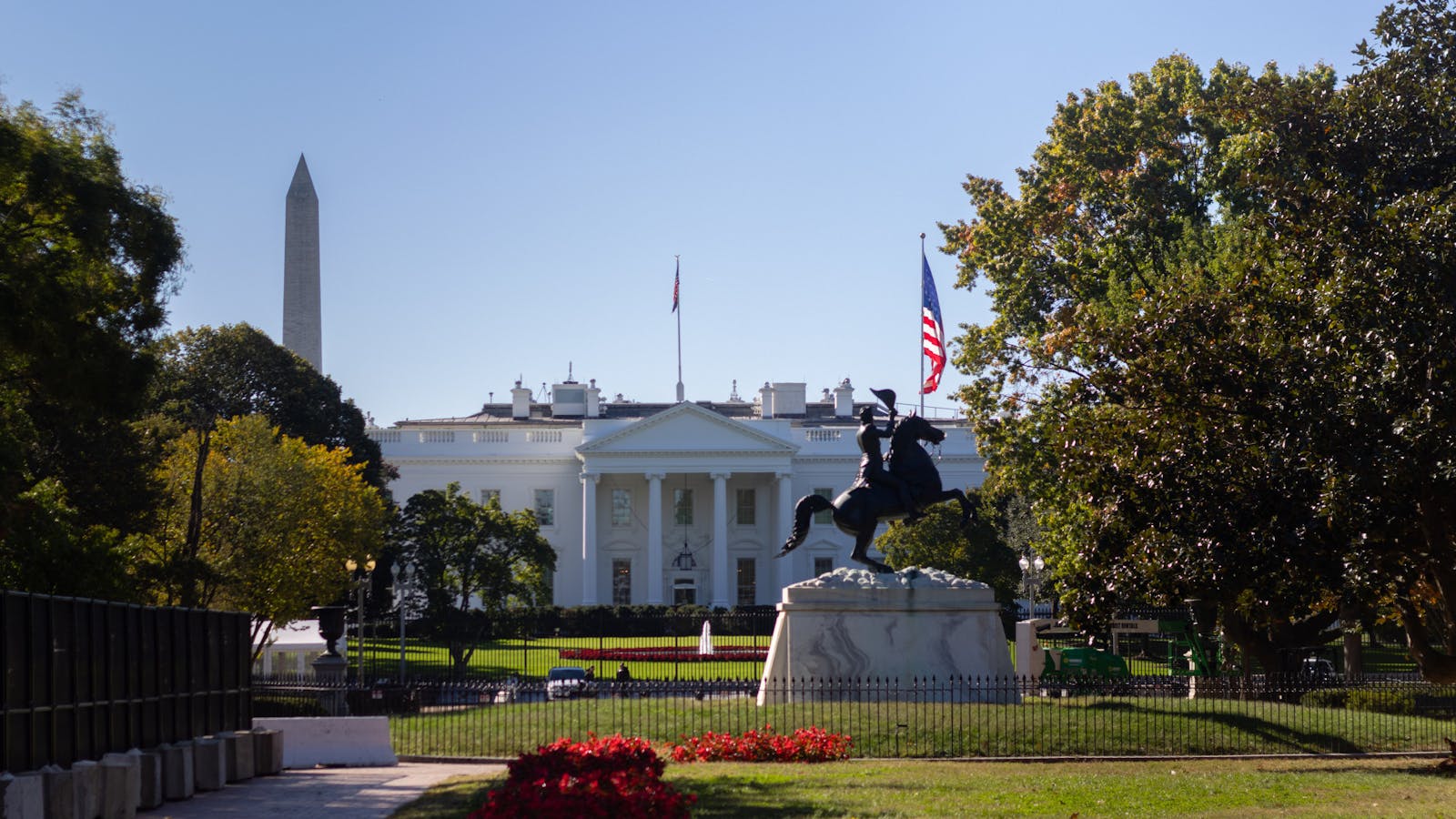
In an interview with The State Press on Oct. 24, ASU President Michael Crow said “there’s no reason to contemplate” signing the White House’s higher education proposal.
The “Compact for Academic Excellence in Higher Education” would offer advantageous federal funding access to schools that agree to the Trump administration’s terms. Invitations were sent to nine universities, including UA.
“I don’t think that’s any longer a viable thing,” Crow said about signing the compact, which has been rejected by seven universities. “I’ve been trying to guide people in a different direction.”
READ MORE: BREAKING: ASU ‘engaged in dialogue’ with White House amid higher education compact talks
Arizona legislators and University students have urged administrators to reject the deal.
Crow said ASU was not among those asked to sign the compact. However, federal officials asked him to provide input on the proposal, and the University is continuing discussions with the federal government on how to improve higher education and the workforce.
Democratic Reps. Greg Stanton and Yassamin Ansari each sent letters to Crow urging the University to reject any kind of offer from the White House.
“Such an approach risks pitting support for LGBTQ, minority, and international students against the resources needed for critical scientific and medical research,” Ansari’s letter said.
The terms of the compact include requiring institutions to define gender on the basis of “reproductive function and biological processes,” ban race and sex-based admissions policies and cap undergraduate international student enrollment at 15% for participants in the Student Visa Exchange Program .
Democratic Sen. Lauren Kuby and Rep. Brian Garcia, both of District 8 and ASU alumni, sent a letter to Crow on Oct. 21. In it they urged ASU to reject the compact, saying it “undermines the charter and academic freedom of the university.”
“I am not fond of entering into agreements that inherently violate our charter, inherently violate our values,” Garcia said.
Garcia said he feels somewhat betrayed that there have been important conversations happening behind closed doors, and that state leaders have not been included in those talks.
Troy Holderby, the president of College Republicans at ASU and a sophomore studying civic and economic thought and leadership, had a positive opinion on the compact.
“It’s a great compact by the Trump Administration to prioritize young Americans’ interests in education, ensuring tuition affordability, depolarization on campus, and realigning education to promote critical thinking, which will really help Gen Z in the workplace in the 21st century,” Holderby said in a written statement.
Several student organizations at the University expressed opposition to the compact, with some saying ASU has not been transparent enough about their talks with the White House.
Students for Justice in Palestine at ASU and Planned Parenthood Generation Action at ASU jointly posted on Instagram alongside other local organizations about their opposition to the compact.
Hayden Nguyen, a co-chair at SJP and a junior studying business and management, said the compact is meant to control students’ education and “crack down on free speech” for organizations like SJP.
“Universities have been places where the true meaning of democracy and the true meaning of the people and protests have really shined through,” Nguyen said.
Universities that sign the compact would have to implement measures to prevent demonstrators from heckling individual students or groups, disruptions to educational instruction or study, or obstructions to parts of campus because of a person’s race, ethnicity, nationality or religion.
Employees, in their capacity as university representatives, would also be banned from speaking or acting on “societal and political events” except as they directly affect the institution.
Participating universities would also commit to “transforming or abolishing institutional units that purposefully punish, belittle, and even spark violence against conservative ideas,” according to the compact.
Thomi Brown, the vice president of outreach and events at PPGEN and a sophomore studying philosophy and political science, is concerned that the vague language of that provision could be applied to student groups.
“PPGEN and other student organizations with similar messaging could also end up disappearing,” Brown said.
Young Democrats of Arizona and other Democratic Party-aligned student groups started their own petition against signing the compact. The petition has accumulated over 1,500 signatures.
Mikah Dyer, the coalition director for Young Democrats of Arizona and a sophomore studying secondary education, suggested that students who are against this proposal should contact their student governments and administrators to make it known that they do not want these restrictions in their classrooms.
“I want to see students and faculty and administration stand together to ensure ASU remains a place where learning is led by curiosity and not political pressure,” Dyer said.
Edited by Carsten Oyer, Senna James, Sophia Braccio and Pippa Fung.
Reach the reporter at apruiz@asu.edu and follow @andiruiz2405 on X.
Like The State Press on Facebook and follow @statepress on X.
Andi RuizPolitics Reporter
Andi Ruiz is a politics reporter at the State Press dedicated to serving her community with truth and honesty in her reporting. She has been working in broadcast and news since high school and was recently an anchor at The Cut Network during her first year at Cronkite. She is going into her second year at ASU as a Barrett Honors student studying journalism and mass communication with a minor in political science.
Continue supporting student journalism and donate to The State Press today.