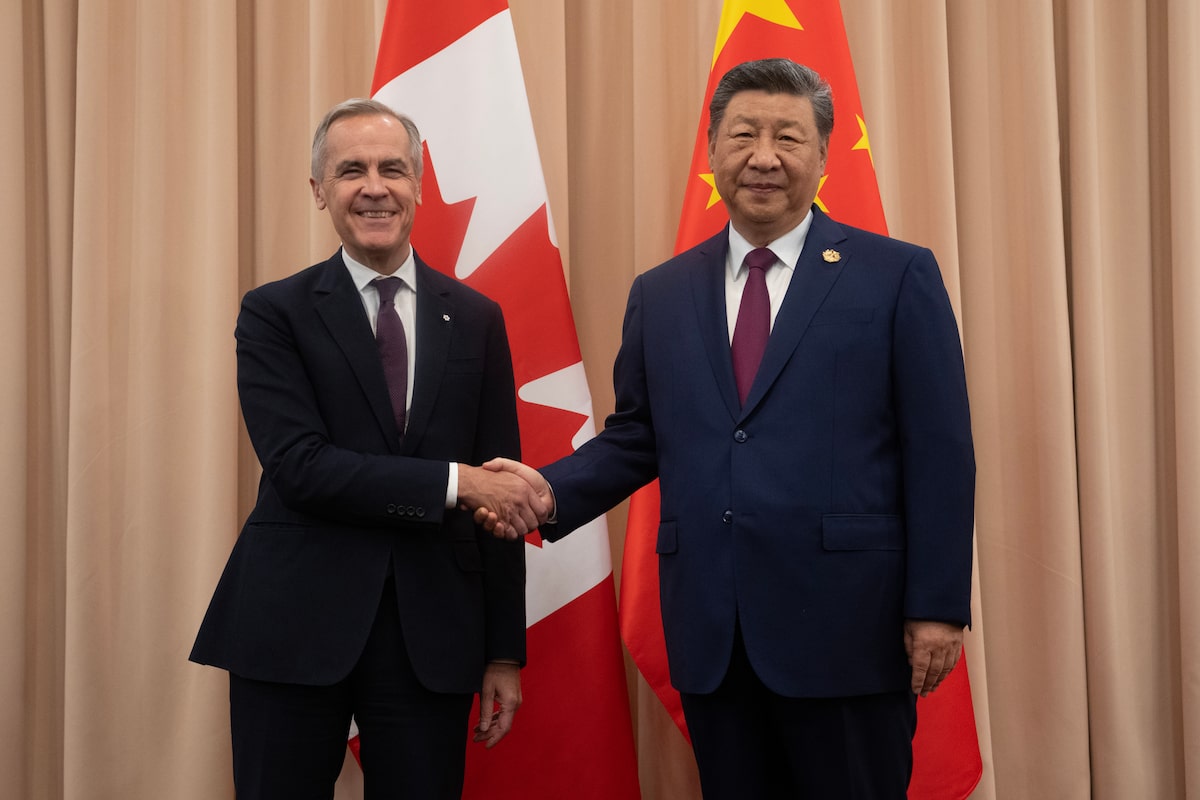
Prime Minister Mark Carney shakes hands with Chinese President Xi Jinping at the start of their meeting in Gyeongju, South Korea, Friday.Adrian Wyld/The Canadian Press
Mark Carney on Friday accepted an invitation from Xi Jinping to visit China as they sat down for the first formal meeting between a Canadian prime minister and the Chinese president since 2017.
The meeting, which lasted nearly 40 minutes, yielded no concrete results such as concessions in a punishing trade war between Canada and China that is hurting Canadian farmers and fishers.
The two leaders met on the sidelines of the Asia-Pacific Economic Cooperation summit in South Korea as Mr. Carney seeks new markets for exports to offset the economic damage that Donald Trump‘s tariffs are doing to Canada.
The encounter was far shorter than a Thursday meeting of U.S. President Donald Trump and Mr. Xi, also in South Korea, which lasted about 90 minutes.
In brief remarks to reporters, Mr. Carney said Canada and China have hit a “turning point” in relations that he said would pay dividends for Canadian families, businesses and workers. He said mended ties with Beijing create a “path to address current issues,” which include a trade war.
Carney said the world of rules-based liberalized trade and investment had passed as the global economy was going through one of the most profound changes since the fall of the Berlin Wall in 1989.
Reuters
By comparison, the Trump-Xi meeting Thursday yielded a mutual agreement by the United States and China to lower tariffs. China vowed to resume purchasing U.S. soybeans and Mr. Trump indicated he might cut tariffs on China that he imposed because of its role in the illegal production of the deadly opioid fentanyl.
Canada imposed a 100-per-cent Canadian tariff on Chinese electric vehicles last year in tandem with the former Biden administration, as well as a 25-per-cent levy on steel and aluminum from China. China retaliated with a100-per-cent tariff on Canadian canola oil, canola meal and peas and a 25-per-cent tariff on Canadian seafood and pork products. It ratcheted up the pressure in August by imposing a 75.8-per-cent duty on Canadian canola seed, a major crop in Alberta, Saskatchewan and Manitoba.
The South Korea encounter caps months of work by Mr. Carney and his new government to repair relations with major emerging markets such as China, which buys about 5 per cent of Canadian exports, as well as India, which purchases less than 1 per cent.
Opinion: Carney wants a China ‘reset.’ May he avoid the mistakes of the previous four
Canada-China relations entered a deep freeze after the Canadian government arrested a Chinese tech executive on a U.S. extradition request and Beijing retaliated by jailing two Canadians: Michael Kovrig and Michael Spavor.
An official readout published by the Canadian government following the meeting said both Mr. Carney and Mr. Xi “directed their officials to move quickly to resolve outstanding trade issues and irritants.” It said the two leaders during their meeting “discussed solutions to respective sensitivities regarding issues including agriculture and agri-food products, such as canola, as well as seafood and electric vehicles.”
Furthermore, the Canadian government said, Mr. Carney and Mr. Xi “also discussed a framework to deepen co-operation across a range of areas – from clean and conventional energy, to agriculture, manufacturing, climate change, and international finance.”
Mr. Carney, speaking in front of the cameras as he sat down with Mr. Xi Friday, lamented the eroded relationship and signalled he wants to remedy this.
How Canada can properly use China as a hedge against Trump
He noted 55 years had passed since Canada established diplomatic relations with the People’s Republic of China under the ruling Communist Party.
“In recent years, we have not been as engaged,” Mr. Carney told Mr. Xi. “Distance is not the way to solve problems – not the way to serve our people with people-centric growth, as you have advocated.”
He said he plans to visit China at the invitation of Mr. Xi. No details are available yet on when this might take place.
“I also welcome the invitation to come to China to further the dialogue, and I very much look forward to doing so, because it’s through this constructive and pragmatic dialogue that we will address a path for current issues, that we will establish a road to seize the many great opportunities between our countries,” the Prime Minister said.
Mr. Xi said he was delighted to meet Mr. Carney again, a reference to the fact that the former central banker travelled to China in 2024 before entering politics. At the time, Mr. Carney was Bloomberg board chair and came as part of a North American business delegation. The event was seen as a strategic effort by Beijing to restore confidence in China’s economy
The Chinese President said Canada-China ties “have achieved a recovery and positive development” thanks to the efforts of both sides.
He made a point of saying it was the “Canadian side” which has “expressed its willingness to promote bilateral relations in a pragmatic and constructive manner.”
Mr. Xi added: “I attach great importance to this.”
He said China is “willing to work together with Canada to push China-Canada relations back onto a healthy, stable, and sustainable correct track at an early date, so as to better benefit the peoples of our two countries.”
Mr. Carney’s courting of Mr. Xi is an abrupt change of course in Ottawa’s approach to China, a country Ottawa publicly characterized less than three years ago as an “increasingly disruptive” global power.
But Trump protectionism is driving U.S. allies to look far and wide for new markets, including those that countries such as Canada have often criticized for human-rights abuses.
It was just last year that former prime minister Justin Trudeau’s government followed Washington’s lead and imposed tariffs on Chinese electric vehicles..
Just prior to the Friday meeting with Mr. Xi, Kody Blois, the parliamentary secretary to the Prime Minister, flew to Beijing and, after meetings there, joined Mr. Carney at the APEC summit. Also in the Chinese capital this week was Agriculture Minister Heath MacDonald.
The rupture between China and Canada went far beyond Beijing’s detention of Mr. Kovrig and Mr. Spavor.
Under former prime minister Justin Trudeau, Canada, in tandem with other Western economies, also blocked flagship tech company Huawei from wireless networks, placed new restrictions on Chinese investment and sharply criticized Beijing’s conduct towards Hong Kong, Taiwan and the Uyghur minority in Xinjiang.
-With files from Alexandra Li in Beijing