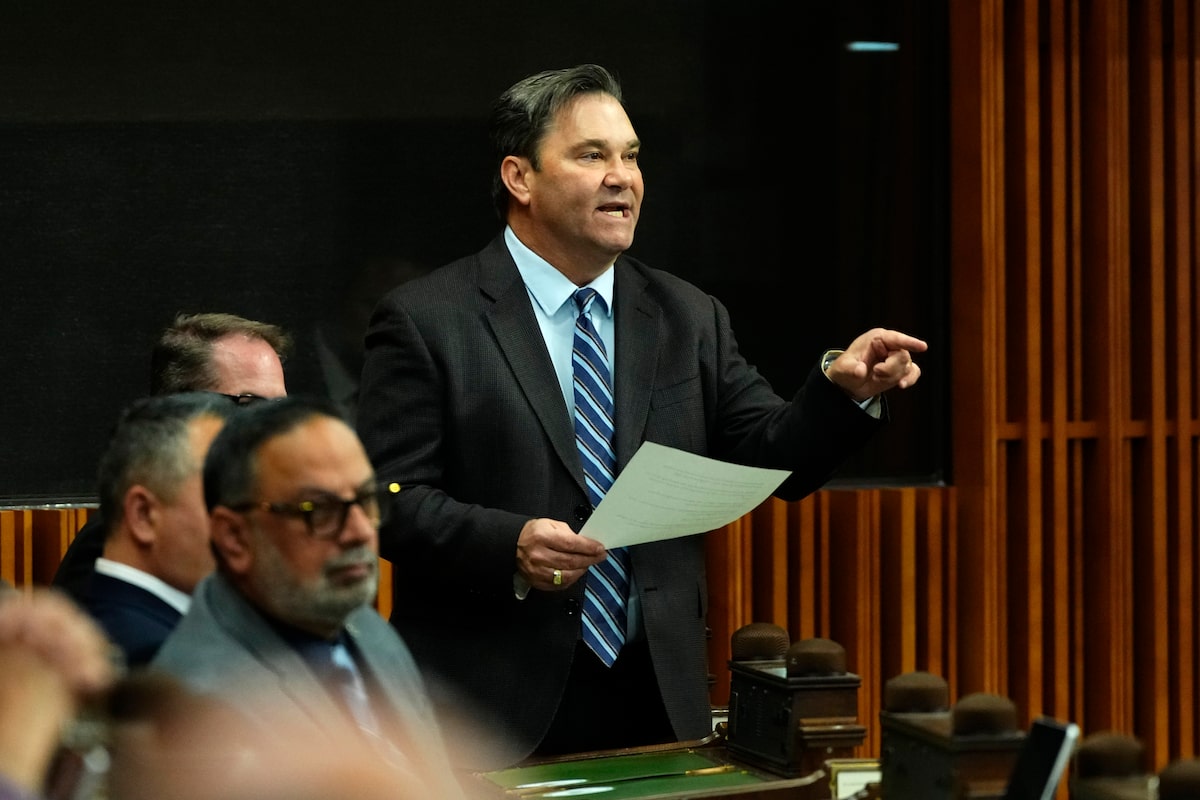
Interim NDP Leader Don Davies says his party will not support an austerity budget, but is looking for job-creating investments.Justin Tang/The Canadian Press
The NDP is not ruling out the possibility that some or all of its seven MPs could abstain when the minority Liberal government’s budget is put to a vote in the House of Commons.
The government has warned of the possibility of a snap election unless at least one other party steps forward to allow approval of the budget, which will be tabled Tuesday.
NDP Interim Leader Don Davies said it’s possible that some NDP MPs will opt to vote neither for nor against the budget.
“Abstentions are allowed,” he said during an interview with CBC News that aired Sunday. He stood by those comments in a later e-mail exchange with The Globe and Mail.
Mr. Davies has said that the NDP will not support an austerity budget, but also said the party is looking to see job-creating investments.
Opinion: Is Canada a serious country? The coming budget will tell us
The NDP caucus is scheduled to meet Tuesday night and Wednesday to discuss how they will respond to the budget. “We’ll make that decision together,” he said.
Conservative Leader Pierre Poilievre was asked at a news conference Sunday if his party has ruled out the option of abstaining. He did not directly answer the question.
“The reality is that we’re going to show up and do our jobs to fight for an affordable budget,” he replied, adding that: “I can’t tell you any more than that till I see the thing.”
The Bloc Québécois, which has 22 MPs, has previously ruled out abstaining on the budget vote. The party has laid out 18 budget demands, including six that they say are non-negotiable.
While the budget will be tabled Tuesday, the main budget votes won’t take place until later in the month. The House does not sit the week after it is tabled because of Remembrance Day.
Carney’s budget conundrum: How to unlock business investment during a trade war
Finance Minister François-Philippe Champagne is set to hold the traditional prebudget event of buying a new pair of shoes Monday at a shoe manufacturer in Saint-Tite, Que. The minister will “build his own uniquely Canadian shoes,” the government said in a news release Sunday.
Speaking to reporters at the Asia-Pacific Economic Co-operation summit in South Korea, Prime Minister Mark Carney on Saturday declined to say whether he is confident the budget will pass. He said he’s prepared to fight an election over the budget if necessary.
“I’m always prepared to stand up for the right thing,” he said.
In recent weeks, Mr. Carney has indicated that the budget will lay out a plan to spend billions more in areas such as port infrastructure and defence, while also including elements of sacrifice and austerity related to operational spending.
It is a dichotomy that has public-service unions warning of job cuts in the tens of thousands at the same time as economists say the deficit likely will be much larger than what the Liberals projected during the April election campaign.
Carney says he’s prepared to fight an election campaign if budget doesn’t pass
The deficit could be in the range of $70-billion to $100-billion, according to prebudget forecasts by various economists.
A new Nanos Research survey conducted for The Globe and Mail shows that Canadians want to see spending cuts in Tuesday’s budget.
The survey found that that three quarters of Canadians said it was either important (38 per cent) or somewhat important (36 per cent) when asked for their view on whether the government should make spending cuts to help manage the size of the deficit.
Given the choice between having any new revenues used to lower the deficit or lower corporate taxes, more than four in five said lower the deficit.
“What’s pretty clear from the polling is that the Liberals don’t have carte blanche to spend,” said Nanos Research pollster Nik Nanos in an interview.
“I don’t think anyone expects the deficit to be defeated, but managing the size of the deficit, not having it be larger than necessary, obviously, is a top priority for Canadians,” he said.
Public service braces for billions in spending cuts ahead of Tuesday’s budget
In response to another question, more than three in five Canadians said they think the Canadian economy will worsen (25 per cent) or somewhat worsen (39 per cent) over the next year.
Mr. Carney is the most trusted party leader to support economic growth, according to 59 per cent of poll respondents, which is essentially unchanged from responses to a similar question in March.
Mr. Poilievre was the choice of 23 per cent, which is down from 27 per cent in March.
The Canadian economy shrank in the second quarter. Forecasts suggest the economy may narrowly avoid a technical recession, which is two consecutive quarters of contraction.
A majority of Canadians said they would oppose (50 per cent) or somewhat oppose (13 per cent) having another federal election if Parliament does not pass the budget. In contrast, 25 per cent said they would support having an election and 11 per cent said they would somewhat support it.
Mr. Nanos said his current polling suggests an election at this time would produce similar results to the April campaign.
“I think that probably explains why Canadians are much more likely to be against the idea of having a snap federal election triggered by the budget,” he said.
The Nanos Research survey of 1,045 Canadian adults was conducted between Oct. 27 and 30 as part of an omnibus survey. It has a margin of error of plus or minus three percentage points, 19 times out of 20.
With a report from Steven Chase in Gyeongju, South Korea