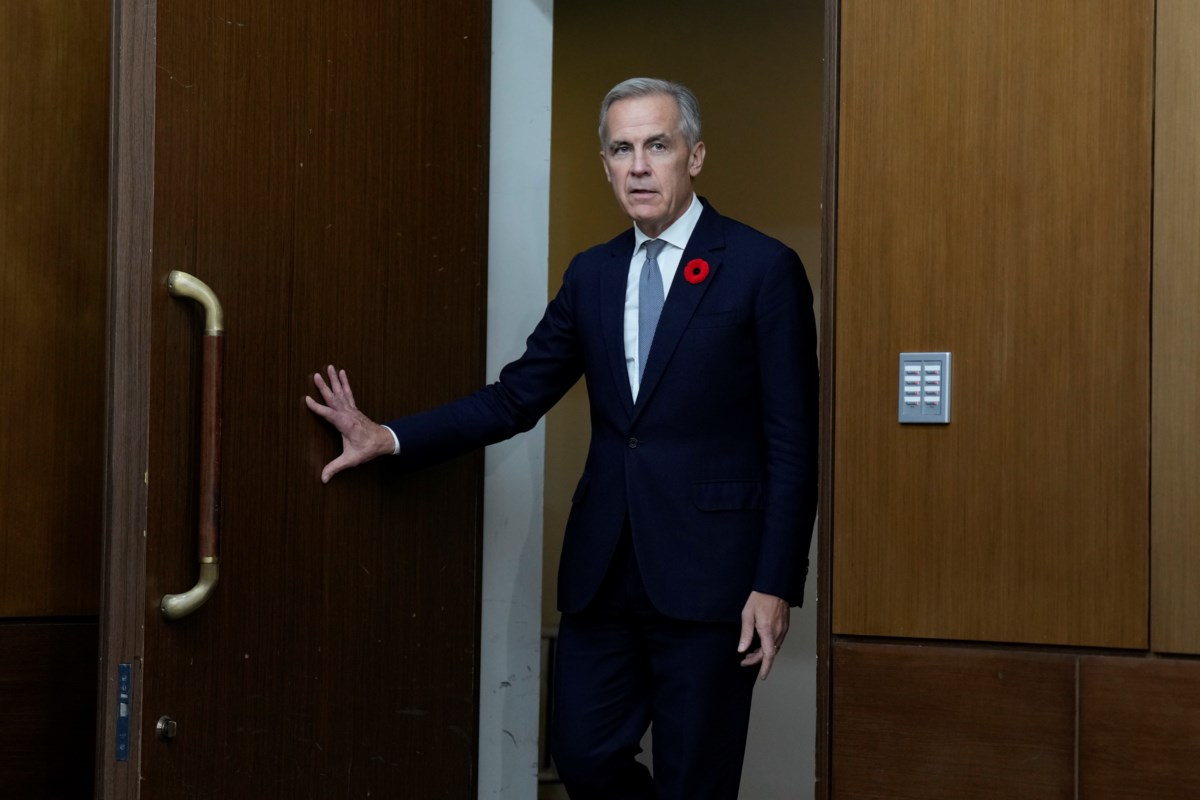
Carney confirmed that he apologized to Trump at a dinner in South Korea earlier last week
EDITOR’S NOTE: This article originally appeared in Parliament Today, a Village Media newsletter devoted to covering federal politics on Parliament Hill.
Prime Minister Mark Carney signalled that he’s willing to run in another election if this week’s hotly anticipated budget does not pass in Parliament, framing the document as his “next move” in the ongoing trade war with U.S. President Donald Trump.
Carney made the comments while wrapping up his weeklong trip to the Indo-Pacific region on Saturday, which saw him meet with Chilean President Gabriel Boric and freshly elected Japanese PM Takaichi Sanae. On Friday, the PM had his much-watched meeting with Chinese President Xi Jinping on the sidelines of the APEC Summit in South Korea, a gathering he framed as laying the groundwork for both nations to rekindle ties and iron out a suite of trade irritants.
Carney’s travels came as the minority Liberals prepare to table the PM’s first budget on Tuesday, a document that has yet to win the explicit backing of any opposition parties. He was asked about his level of confidence that it will pass and, if it does not, whether he’s prepared to hold another vote.
“I’m 100 per cent confident that this budget is the right budget for this country at this moment,” Carney said. “This is not a game; this is an important moment in the global economy, it’s a critical moment for our country.”
Vowing to use the document to pull Canada away from its overreliance on the U.S. and spur economic growth, he said that a failed confidence vote does not worry him because he’s “always prepared to stand up for the right thing.”
NDP interim leader Don Davies confirmed that his seven-member team will vote the same way on the budget, but told Rosemary Barton Live on a Sunday episode that it is possible some MPs could abstain or otherwise miss the vote.
CPC Leader Pierre Poilievre appeared to rule that out, telling Ottawa reporters that his team will “show up and do our jobs to fight for an affordable budget.”
“Our hand is still extended, and there’s still two days for Mr. Carney and the Liberals to reverse their costly promise-breaking ways,” he said Sunday.
Carney spent much of Saturday’s press conference teeing up the document, which is taking on a heightened importance after Trump suspended trade talks last month over an anti-tariff ad from Ontario Premier Doug Ford.
Carney confirmed that he apologized to Trump at a dinner in South Korea earlier last week, telling reporters that the premier’s ad blitz “is not something I would have done” and that only the feds are “responsible” for ties between both nations.
“Things happen. We take the good with the bad,” he added.
Asked about Ford’s suggestions that the PM reviewed the ad before it hit the airwaves, Carney said he advised Ford not to go forward with the campaign without specifying whether he’s upset with the premier’s decision to do so anyway. Pressed about a similar campaign planned by B.C. Premier David Eby for November, Carney downplayed suggestions that there are fractures emerging in a Team Canada approach to dealing with Trump, arguing premiers are entitled to their opinions.
“The next move is on Tuesday. The next move is the budget for this time, the budget the country needs, the budget that gives us control,” he added. “We can spend our time watching Truth Social, worrying about the reactions of individuals — we are staying calm.”
Poilievre accused Carney of wanting an election to help “distract” from what he argued are broken promises to negotiate a deal with Trump, griping that the PM is showing “weak leadership” and embarrassing the country by apologizing for Ford’s ad.
The comments came as the government pushes to shore up ties with other nations beyond the U.S. as part of Carney’s pledge to double Canada’s non-U.S. exports, with another trade mission taking place in Korea next year. The prime minister said he remains “ready” to resume trade talks with the White House when Trump is prepared, but in the meantime, the feds will continue to work on restarting ties with China.
“We have now unlocked a path forward to address current issues and to build the enormous opportunities between our two countries, including in agriculture, energy, clean technologies, tourism and cultural exchanges,” Carney said, adding he’s accepted Xi’s invitation to visit Beijing sometime in 2026.
A readout said the pair agreed to proceed with talks “in a pragmatic and constructive way” by hashing out irritants like canola, seafood and electric vehicle tariffs, though Carney remained mum on whether that approach could spur policy actions from Ottawa that are different from the former Justin Trudeau government.
He dismissed questions about whether he’s open to lifting investment and other restrictions on Beijing that were brought in under his predecessor, including a 100 per cent tariff on Chinese EVs that is now under review. Beijing has said it’s willing to back off on its nearly 76 per cent canola tariff if the feds ditch this Trudeau-era measure, even suggesting trade in some areas could triple if progress is made.
“What’s done is done, the past is the past, and the question is where you look moving forward,” Carney explained, adding that while there can be more energy co-operation between both countries, EV levies are part of broader talks that the government will “proceed carefully” on.
“Where we can find common ground, we’ll find common ground. Where we have differences, and there are big differences, in our societies and in our governments, we will respect those,” he added. “The point of having the relationship is, if you have a relationship, you see people multiple times. It’s not a one-and-done, and that’s where we’re at.”