For Democrats, it’s a chance to spoil President Donald Trump’s efforts to ensure loyalty from Congress. To Republicans, it’s a partisan power grab to undermine citizen control of electoral maps.
In the closing days of a special election on whether to remake California’s congressional districts, supporters and opponents of Proposition 50 have made a final push in San Diego County to sway voters on a ballot measure that could help decide control of Congress.
Voting wraps up Tuesday but has been underway for weeks. By Sunday, more than 870,000 county voters had cast their ballots, mostly by mail, putting turnout so far at 35%, election officials said Monday.
If passed, Proposition 50 would temporarily override California’s independent redistricting commission and let the Legislature redraw congressional districts, putting in place gerrymandered maps drawn by Democrats through the 2030 election.
Democrats hope the measure will offset similar Republican-led redistricting that has already created more GOP-leaning seats in Texas, Ohio, Missouri, Utah and North Carolina as President Donald Trump pushes such efforts.
With the stakes so high for Democrats, local voter turnout is lower than it was by this time in California’s most recent special election — the recall vote on Gov. Gavin Newsom in 2021. Two days before that Election Day, turnout in San Diego County stood at 43%, said Antonia Hutzell, a spokesperson for the county registrar.
But recent polling suggests voters are amenable to Democrats’ moves.
Statewide, 60% of likely voters support Proposition 50, a UC Berkeley poll cosponsored by the Los Angeles Times found. About 28% oppose it. That poll found an identical breakdown of support and opposition in San Diego County.
That’s a wider margin of support than was found weeks earlier in a poll conducted for The San Diego Union-Tribune earlier in October, when 51% said they supported the measure.
The campaign has been waged on a far tighter timetable than most in California, with the election set only in late August. But in the little over two months since, hundreds of millions of dollars have been spent for and against the measure — the vast majority of it in support.
Supporters blanketed television in political ads, tapping former President Barack Obama and other party stars to urge Californians to vote yes in spots that aired during the World Series.
Opponents enlisted high-profile Republicans like former Gov. Arnold Schwarzenegger, a longtime critic of both gerrymandering and of President Trump, and called the effort a scheme by Democrats to undo voters’ approval of the independent commission.
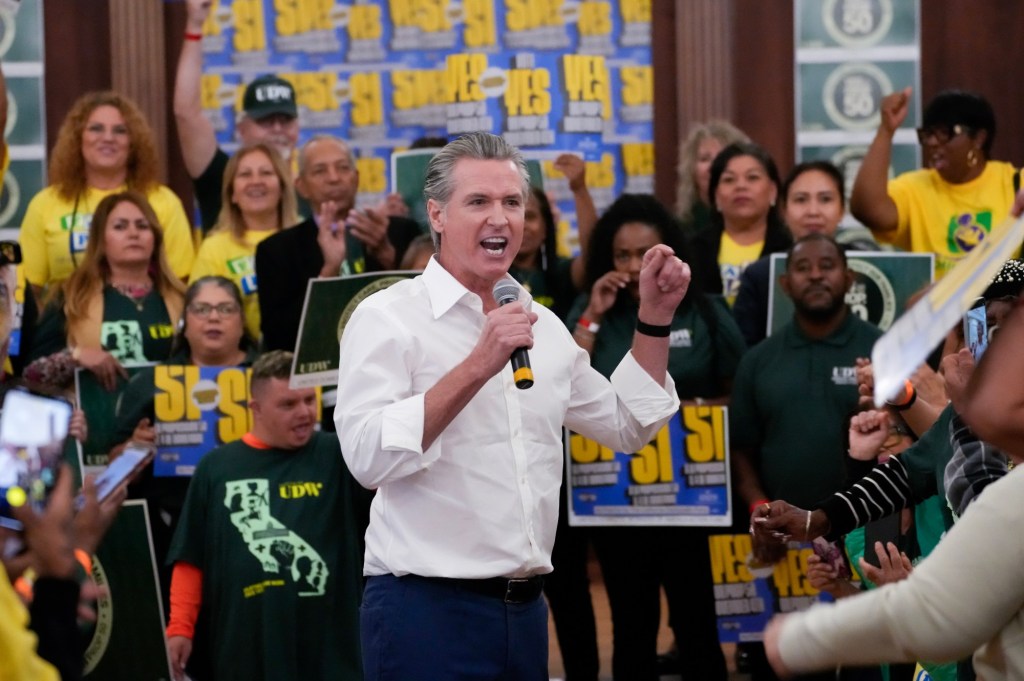
But the person who has drawn the most attention in the campaign over Proposition 50 is Gov. Gavin Newsom, the effort’s most vocal backer — attention that could help him in a 2028 presidential run he’s acknowledged considering.
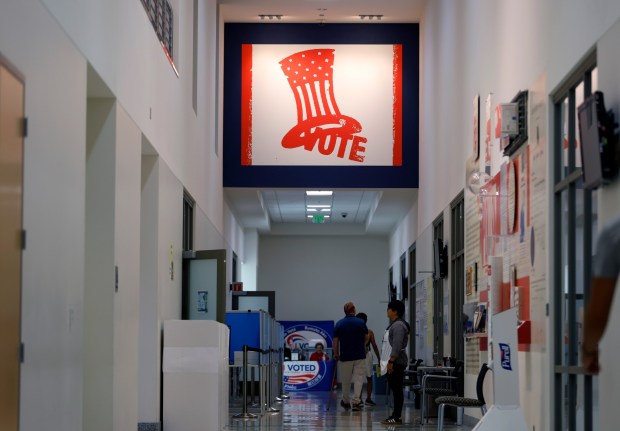 Voters drop off their Proposition 50 ballots at the Registrar of Voters on Oct. 27, 2025, in San Diego. (Photo by K.C. Alfred / The San Diego Union-Tribune)
Newsom was in San Diego on Saturday to make his pitch at a get-out-the-vote event with union workers in Rolando. And on Monday night, labor leaders and former congresswoman Katie Porter, a candidate for governor, held a rally on UC San Diego’s campus to galvanize the student vote.
“Everyone we’ve talked to has heard of Prop. 50, and it’s because of the work we’ve been doing on the ground,” said Sarah Van Dijk, a graduate student who’s led a canvassing effort on campus in support of the measure.
“If the margin ends up being small, I feel like our work here made a difference,” she added.
As the special election wraps up, San Diego Democratic leaders say they’re satisfied with their efforts.
Will Rodriguez-Kennedy, the chair of the local party, said hundreds of volunteers had knocked on doors and engaged with voters in North and East County. “We’re showing up in places you would not expect Democrats to show up,” he said.
On the Republican side, local Assemblymember Carl DeMaio has mobilized his conservative advocacy group Reform California in the campaign against Prop. 50.
About 17,000 volunteers had already been collecting signatures for a voter-ID ballot measure he’s pushing that would require voters to provide identification and prove their citizenship at the polls. It was easy to repackage that pitch with opposition to Proposition 50, DeMaio said.
“If you want fair elections, you need to have fair districts,” he added.
But the Republican, a longtime critic of his own party, also chided it for what he called a poorly-run No on 50 campaign. In recent days, the measure’s opponents have gone relatively quiet and turned down their spending to defeat it.
“It’s up to voters, one on one, to make the case to their neighbors, friends and family,” DeMaio said.