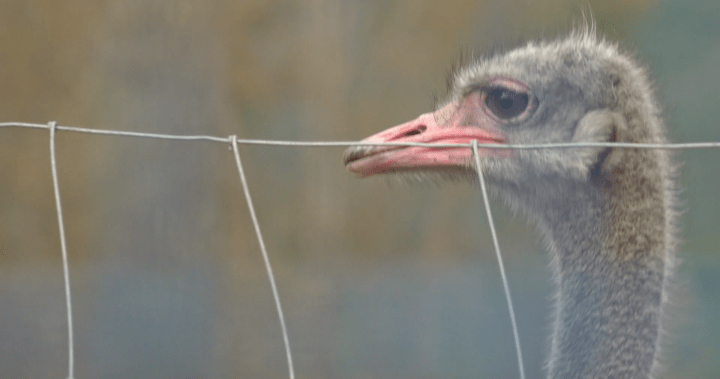
The Supreme Court of Canada has dismissed an application from a B.C. ostrich farm to hear an appeal to save its flock.

The court unanimously dismissed the applicant’s motion for new evidence and dismissed the farm owner’s appeal, finding that the Stamping-Out Policy, the Notice to Dispose and the Exemption Denial were all reasonable in accordance with the applicable case law.
“The Canadian Food Inspection Agency (CFIA) will be moving forward to complete depopulation and disposal measures as authorized by the Health of Animals Act and guided by the stamping out policy for highly pathogenic avian influenza (HPAI),” the CFIA said in a statement on Thursday morning.
The Universal Ostrich Farm, in Edgewood, B.C., challenged the Canadian Food Inspection Agency’s (CFIA) order to cull the flock after an outbreak of avian flu was detected last Dec. 31.
Story continues below advertisement
In an update posted to Facebook on Thursday morning, the daughter of the farm’s co-owner, Katie Pasitney, said, “This is what pain looks like, Canada,” holding back tears.
“She’s going to lose everything she’s ever loved for 35 years,” Pasitney added, referring to her mother, the farm’s co-owner, who could be seen crying in the background.
“That’s what pain looks like when the government fails you.”

Get daily National news
Get the day’s top news, political, economic, and current affairs headlines, delivered to your inbox once a day.
The CFIA said the farm owners failed to report the initial cases of illness and deaths when the herd was infected.
The CFIA has said the application of the avian flu stamping out policy for this farm has been upheld by the Federal Court of Canada and the Federal Court of Appeal, and is supported by scientific evidence.
2:01
Ostrich cull controversy continues
Previous Video
Next Video
Story continues below advertisement
The issue has been a contentious one on both sides, with the fate of the birds garnering international attention.
U.S. billionaire John Catsimatidis personally financed the farm’s legal defense and drew the attention of U.S. officials after learning of the case earlier this year.
The CFIA has faced increasing pushback from the farm and its supporters as the case made its way through the courts.
Trending Now
-

Carney is cutting the luxury tax. What else is getting axed in Budget 2025?
-

California Republicans sue over new U.S. House map approved by voters
The first decision, a Notice to Dispose, was issued on Dec. 31, 2024, and required the farm owners to dispose of all the ostriches on its farm by Feb.1, 2025, after laboratory testing confirmed infection of two dead ostriches with the H5N1 strain of highly pathogenic avian influenza
The second decision, an Exemption Denial dated Jan. 10, 2025, denied the farm owner’s request to exempt at least some of its ostrich flock from destruction.
“The two decisions were made under s. 48 of the Health of Animals Act, S.C. 1990, c. 21, and in accordance with the CFIA’s Stamping-Out Policy, which is operationalized through the CFIA’s Highly Pathogenic Avian Influenza 2022 Event Response Plan,” the Supreme Court of Canada said in a statement.
After 69 birds died of avian flu, the farm’s owners argued the surviving ostriches have “herd immunity” and wanted them tested.
The Federal Court of Canada stayed the Notice to Dispose, pending determination of the judicial review application in the Federal Court, and then a single judge of the Federal Court of Appeal stayed the decision pending disposition of the farm owner’s appeal before the Federal Court of Appeal.
Story continues below advertisement
“The Federal Court of Appeal unanimously dismissed the applicant’s motion for new evidence and dismissed the applicant’s appeal, finding that the Stamping-Out Policy, the Notice to Dispose and the Exemption Denial were all reasonable in accordance with the applicable case law,” the Supreme Court of Canada said.
The stamping-out policy is a measure implemented by the World Organization for Animal Health. It mandates that all animals in a flock are killed, even if avian flu is present in one bird.
-with files from The Canadian Press
© 2025 Global News, a division of Corus Entertainment Inc.