In the lead up and aftermath of Election Day, there has been much talk of the $400 million the city of Albany received as part of this year’s state budget, how Mayor-elect Dorcey Applyrs will leverage it and the challenges new mayors across the state face in turning around upstate New York’s struggling cities.
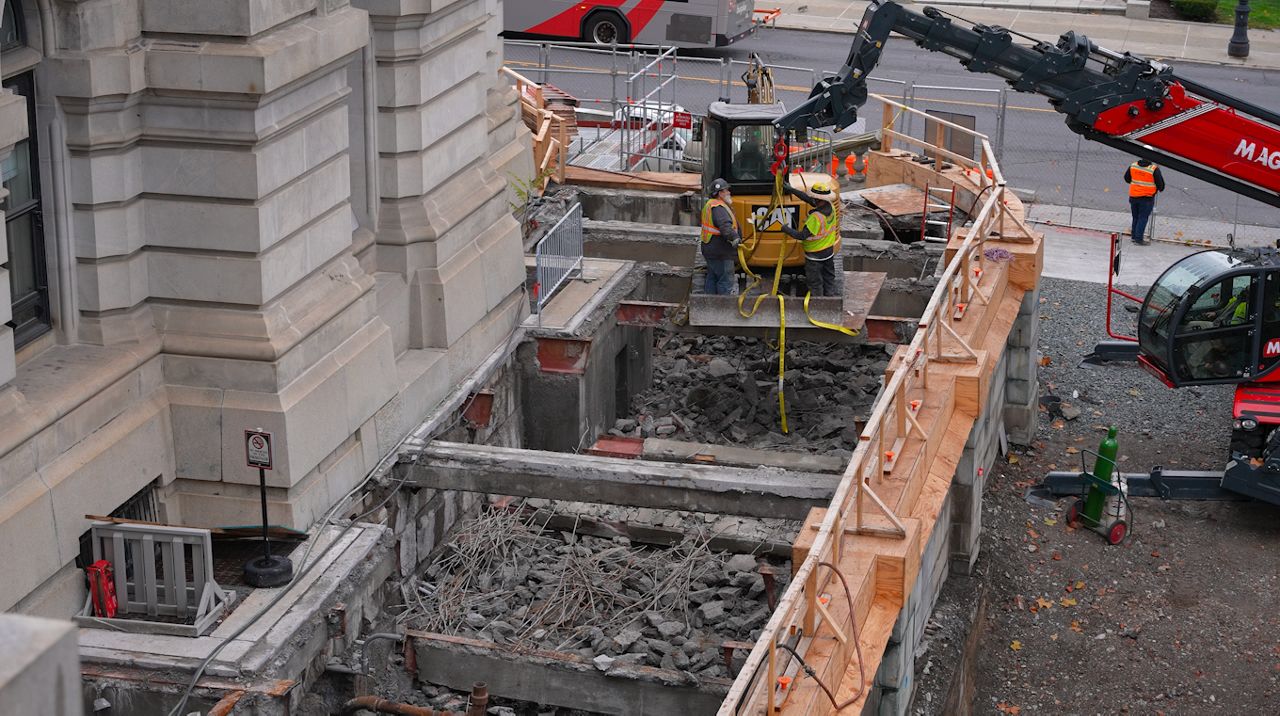
Amid all of those initiatives, there is a separate and highly visible project in Albany that is taking steps to put a welcoming face on one of the city’s most visible spots: the enormous and crumbling front stairs of the state Capitol. It’s the latest in a nearly 50-year parade of projects intended to restore the massive Victorian building, which began with the Senate Chamber in the late 1970s
Since their completion in the 1890s, the steps have hosted presidents, as well as countless demonstrations and family photographs — but not in years.
The stairs, which were one of the last completed pieces of a chaotic 40 year, multi-architect design and construction process to build the Capitol, have been suffering from intense water damage since at least the 1920s. Piecemeal repairs at that time and again in the 1950s provided some shoring up and structural work, but fell well short of what was needed to stave off the inevitable: in 2014 after years of listing and crumbling, they were finally declared unsafe and closed to the public.
Back in 2022 as part of her first state budget, Gov. Kathy Hochul got the ball rolling on initial appropriations for what would balloon to a $72 million contract to repair the stairs, underlying supports, promenades that wrap around to the Capitol’s side entrances and the driveway used by governors to access the building.
The kickoff of the project this spring ended years which the Eastern Approach has spent stuck in a tug of war between being a punchline for how state government can’t even keep up its own house on one hand, and fodder for not-my-tax-dollars cracks on the other, any time there was serious talk of repairing them.
Under the leadership of New York State Office of General Services Commissioner Jeanette Moy, the project is doing well when it comes to both time and budget.
“Our goal is to really bring back a little bit the majesty of this building, it’s been closed to public for too long, so we’re really looking forward to getting the stairs addressed,” she said.
Part of the reason for the massive price tag is the extensive damage and the comprehensive nature of the work.
“You’ve got water that’s infiltrating, it starts to push out a little bit of that stone and it starts to become unsafe for the structure itself,” she said. “Between 2014 and now, that deterioration has made the construction more complicated, and we’ve had to take on much more work than had we taken it on maybe two decades ago.”
Looking to avoid the bandage repairs of the past, the individual pieces of the staircase and surrounding architecture will be dismantled, though not entirely.
“The treads will be removed off the stairs where we have challenges in the balustrades and the railings, they’ll be removed,” she said. “We’ll make sure that there is no lean or tilt to any of these pieces and then we’ll be placing them right back.”
The idea of the staircase being deconstructed may sound unsettling if you’ve heard the Albany myth that the Eastern Approach was constructed to stop an unstable Capitol from sliding down state street into the Hudson River.
While the Capitol did have structural issues — including a cracks to the original stone vaulted ceiling over the Assembly Chamber, which led to its controversial replacement and the elimination of what was then known as the capitol’s “Golden Corridor,” Moy said the idea of the Capitol sliding down the hill, but for a giant granite staircase, is just that: a myth.
“It is not sliding,” she said. “When we talk about the balustrades and the railings, there were some challenges with the freeze thaw. We were seeing some tipping.”
In recent weeks, the work being conducted by company Allegrone has consisted of loosening 125-year-old individual carved pieces. The pieces are then numbered, cataloged and then repaired on site before being reassembled.
“Each one of these components when they get removed needs to be individually labeled so we’ve got a master database,” Moy said. “They are then placed over here in this location identified by a number, they are then categorizing each one of them, and we are also looking to restore them.”
Workers trained in historic restoration are already making those repairs to pieces ranging in weight from 100 to 13,000 pounds, work which includes carefully removing a rock solid 1960s epoxy that has damaged some of the stone.
One stone carver, Tyler, had recently done repair work on the Statue of Liberty. Another, Linda, told Spectrum News 1 her grandfather was a mason in Manhattan and she is following in his footsteps.
The stone cutters are working with original granite that was stored under the staircase for decades. Linda said having access to that stone is what is making a seamless repair possible.
“It’s crucial in making sure everything matches, making sure that it’s a seamless repair, because if you try and get stones that are newer, you’re never going to match,” she said. “That’s why it’s so important that we have those.”
Once the repairs are complete, the components will be waterproofed for the ages, so the staircase can return to its place in Albany legend.
“Like Teddy Roosevelt challenging reporters to race him up the stairs and if they beat him, then they would get an exclusive,” Moy said.
Asked if Hochul would challenge reporters to a race up the stairs for an exclusive should she still be in office when the work is complete, Moy told me that she thinks the “spry” Hochul would defeat this reporter.
“I would put my money on the governor,” she said.
By the time the project is complete, Moy hopes the stairs will once again serve as a venue for making sure the government is listening to the people.
“Hundreds of people standing on these stairs, an opportunity to both have a backdrop of government itself, and then also just have an opportunity to gather a massive number of individuals talking about the importance of whatever their issue may be,” she said.
Or to simply be appreciated for the architectural marvel that it is. In addition to its architectural features, the staircase also boasts carved faces and intricate patterns which will be repaired.
“As a Capital Region resident, maybe you’re going to come here to take some wedding photographs, maybe you’ll be here to take pictures for graduation,” she said.
Moy said the project is just part of a broader commitment from the Hochul administration to shore up the Capitol, where any sign of decline or deferred maintenance become grounds for ridicule.
Recently, the administration relaunched the Commission on the Restoration of the Capitol, which met in its newest form for the first time Monday. The commission will compile a report by December 2026.
Initiated in the late 1970s as a temporary commission, a master plan for the Capitol was developed in 1982 and featured a comprehensive list of recommendations to fully restore the building. Many projects, including the restoration of the three major interior staircases and their skylights, as well as the executive and legislative chambers and associated elevators, offices and lobbies, and the re-flooring of the central courtyard have all been completed. Original paint schemes and stencil patterns have been reinstated on the walls.
However, there were a multitude of other projects suggested that have not been undertaken. Among them, reintroducing the original Minton tile floors and Victorian chandeliers to the main lobbies, which were replaced by ‘inappropriate’ lighting fixtures and red terrazzo flooring in the 1950s.
Another Capitol myth is that an enormous dome and tower which were never constructed would have been built over what is now the central courtyard. Instead, the granite walls of what was once the tower’s partially completed, five-story rotunda can still be seen in the second floor War Room, the third floor Legislative Correspondents Association office, as well as the Senate and Assembly revision rooms on the fifth floor.
Believe it or not, the 1982 master plan included a passage recommending that the state either conduct a study to move forward with construction of the tower, or simply reestablish the rotunda.
Moy said the exact nature of the next steps in the Capitol’s restoration are still to be determined, but addressing deteriorated mid-century windows and improving energy efficiency are priorities.
The reconvened commission will review the master plan and the projects which have still not been completed in order to determine how to best move forward and which options are still realistic for completion, and what may need to be added.