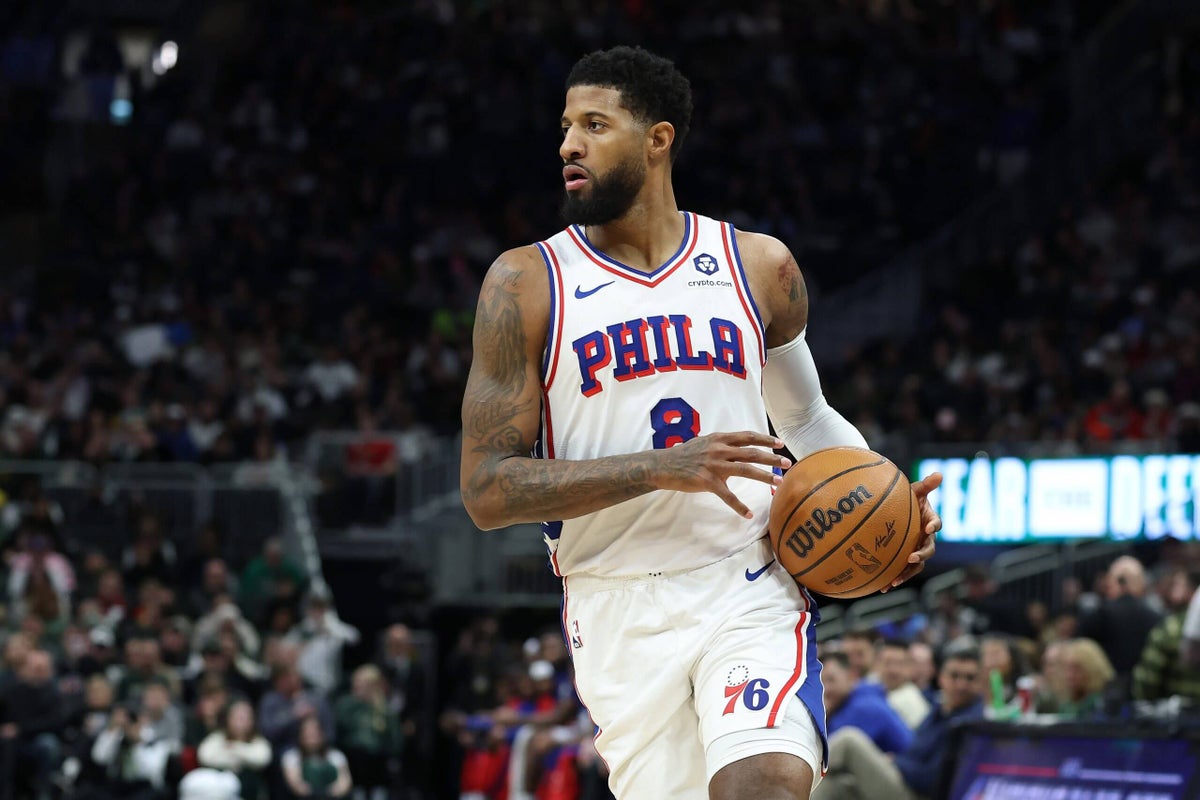
The Philadelphia 76ers have started the season 7-5 start despite a slew of injuries, absences and lineup shuffles.
Star center Joel Embiid began the year relatively healthy but has missed the last few games with knee soreness. Small forward Paul George hasn’t played yet after offseason knee surgery. A host of other Philadelphia players have been in and out of the lineup.
George could make his season debut on Monday night against the Los Angeles Clippers. He’s been officially upgraded to questionable, and word is he is more likely to play than not. Here are five reasons the 76ers need him back:
For Maxey’s sake
Tyrese Maxey is having an All-NBA start to the season. He’s averaging 32 points. He’s been a top-five scorer in the league, and he’s simply been electrifying.
He’s also playing 40 minutes per game. He has a usage rate of 30.9 percent, the highest of his career. And of late, he’s been the only Sixers player who can consistently generate a downhill advantage off the dribble.
This is the biggest reason why Philadelphia needs George back. The Sixers are running Maxey into the ground, and they need George to take some of the playmaking pressure off his plate. To be clear, the Sixers don’t have much recourse besides playing Maxey big minutes.
That’s clearly starting to affect the star guard. He has shot a combined 28 of 74 from the field over his last three games and is just 9 of 29 from 3-point range.. Having to create the offense and finish a lot of it is a heavy burden.
That’s why George needs to get on the floor and get back to himself. One of his strengths is his ability to handle the ball and create shots for himself and others.
If you are a Sixers fan, you probably and understandably question whether George can get back to this level after not playing well last season. But with Maxey playing like this, Philadelphia just needs George to be a secondary playmaker, not a primary one. He can certainly still do that.
The injury bug
The Sixers could lose Kelly Oubre Jr. for an extended period. He suffered an LCL injury in his left knee in Friday night’s loss to the Detroit Pistons and has been ruled out for Monday’s matchup against the Clippers.
If Oubre is forced to miss extended time, the Sixers will have one natural small forward on the roster other than George, and that’s Justin Edwards. Philadelphia coach Nick Nurse can do a few things to mix and match. He can play shooting guard Quentin Grimes at the position, which makes for small lineups. He can go bigger and play Trendon Watford there, utilizing Watford’s ballhandling and playmaking abilities. But that move would sacrifice shooting and point-of-attack defense.
George is the obvious and best answer the Sixers have at small forward. He has long been one of the best in the league at that position, and Philadelphia needs his positional skill set now more than ever, particularly because of the number of jumbo-sized guards and wings in the Eastern Conference. The Sixers have struggled to defend players like Paolo Banchero, Cade Cunningham and Jaylen Brown. George is the jumbo-sized wing the Sixers need.
Gathering data
George averaged 16 points per game last season. It broke a streak of nine consecutive seasons in which he averaged at least 20 points. His first step off the dribble, once so lethal, wasn’t there. His ability to separate and finish at the basket wasn’t there. His shot diet essentially regressed to 3-point attempts and contested midrange shots.
The Sixers need to know if last year was an aberration or if this is his new norm. It makes some sense to think it’s the latter. He’s 35 years old. Despite Kevin Durant, Stephen Curry, LeBron James and James Harden continuing to thrive, not every elder statesman’s game ages well. It also makes sense to hope that last season was a one-off. George is a West Coast dude who moved to the East Coast from Los Angeles. The Sixers’ fan base rightfully demands a bunch from him, considering his contract. And everything went wrong last season.
George’s game seems like it should age well, especially offensively. He’s one of the most skilled players of this era, a mixture of stunning ballhandling and shotmaking wrapped in a 6-foot-9 frame. If nothing else, the Sixers’ front office needs to know if last year was simply who he is now. They need to know how to proceed in the future.
Lineup balance
In the few minutes per game the Sixers play without Maxey, the offense runs through Grimes and rookie guard V.J. Edgecombe. Grimes is a terrific player, but he is more suited to finish plays than to start them. Edgecombe has been one of the best first-year players in the league and has real star potential. But he’s a rookie, and anchoring lineups shouldn’t be on his plate yet.
Embiid exists, in theory. But as he battles his knee troubles, there’s no way to predict how much he’ll play. George is far from the most durable player either. But if he can stay healthy, he can lead a lineup for 10-15 minutes per game as the primary offensive engine.
Creating synergy
One of the best things George did last year was develop an impressive chemistry with Jared McCain. The two are from the Los Angeles area and bonded on and off the court. McCain has struggled to gain a rhythm after coming off a pair of surgeries in the past year.
George’s ability to command gravity with his shooting and prowess off the dribble, combined with McCain’s shooting and ability to move without the ball, worked well together. More importantly, George is the kind of contested shotmaker the Philadelphia lineup needs. If Embiid were healthy, he would fill this role as well. The NBA is all about making shots when contested by a good defense, and for years, George was capable of doing that with the best of them. The Sixers need that kind of shooting if they are going to build on their solid start.
George shot 43 percent from the field last season and 35 percent from 3-point range. The year before? Those percentages were 47 and 41. That’s what the Sixers need from him.