Illinois’ multimillionaires are a paradoxical group. Beginning in 2009, they helped resuscitate the Better Government Association with sizable contributions while, at the same time, they were vigorously fighting city and state efforts to raise taxes they could easily afford to pay because they didn’t trust the politicians who’d be spending their money.
And that is the conundrum that epitomizes the permanent battle between progressive Democrats and their activist base, whose mantra is “tax the rich,” and conservative Republicans and their wealthy donors who categorically reject higher taxes.
It’s not about greedy rich people hoarding their dollars; in reality, they’re extraordinarily generous philanthropists who donate billions to civic, social and humanitarian causes they believe are admirable and well-managed.
But not to what they consider inefficient, bloated, self-serving city and state governments that simply don’t pass their smell test.
So is there a way to entice wealthy Chicagoans to voluntarily support a few valuable and necessary city programs that might, as a collateral benefit, temper the debate over anti-business taxes? I think it’s possible.
Let’s start with billionaire Ken Griffin, founder of financial giant Citadel and Florida’s most famous Illinois expat. He left Chicago with his company a few years back, angry over what he called a “dysfunctional” political climate, punishingly high taxes and violent crime.
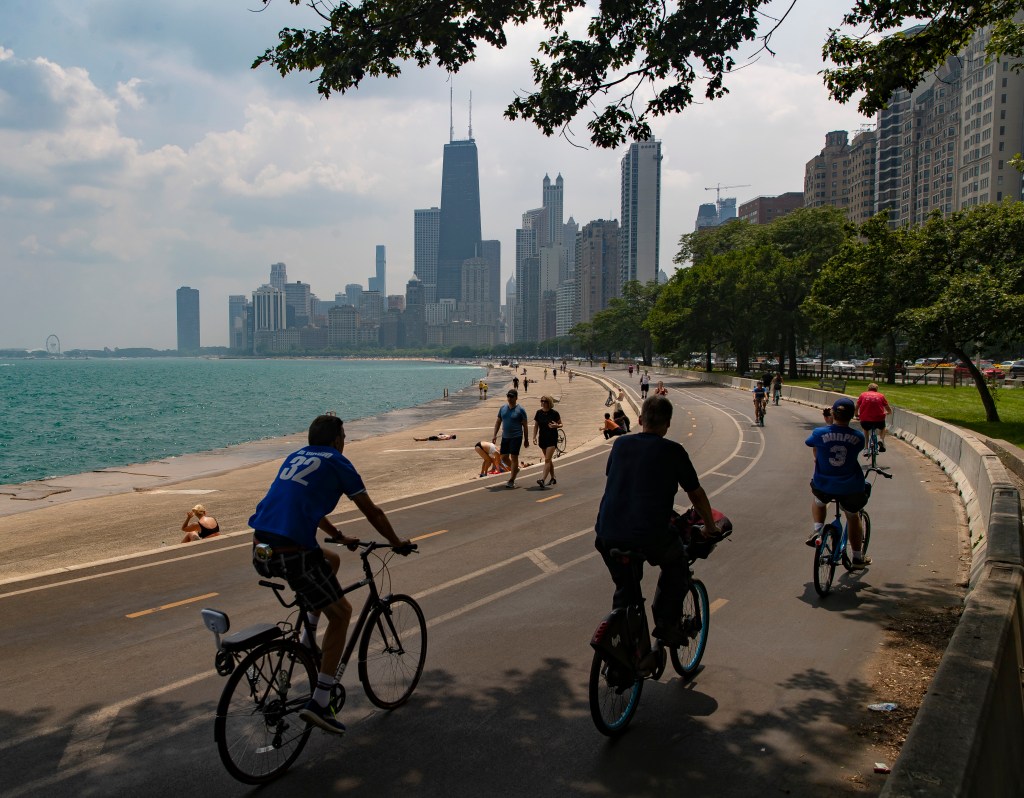
He poured tens of millions into campaigns to block progressive tax proposals and elect officials who promised to hold the line on “confiscatory” levies. But when he was solicited by then-Chicago Mayor Rahm Emanuel, Griffin willingly donated almost $12 million to improve the entire Lakefront Trail that covers the 18-mile ribbon of concrete and scenery along Chicago’s most valuable natural resource.
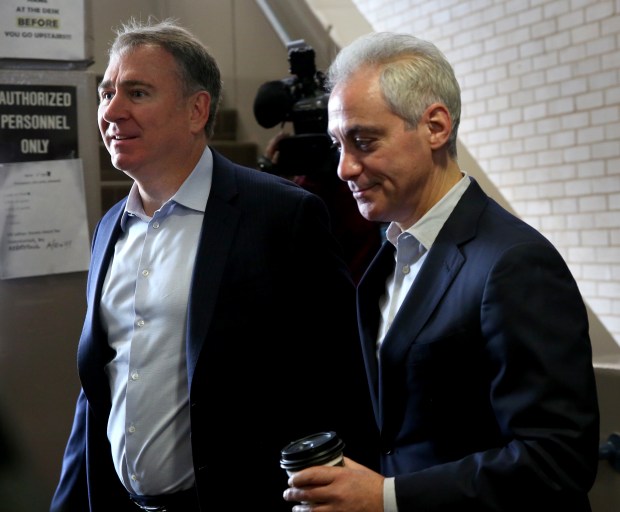 Ken Griffin, left, and then-Chicago Mayor Rahm Emanuel arrive at a Chicago Police Department Strategic Decisions Support Center on April 11, 2018. (Nancy Stone/Chicago Tribune)
That contribution to Emanuel’s Park District, a unit of government, is Chicago in a nutshell: billionaires battling taxes but bankrolling public parks; loathing “big confiscatory government” but loving big civic and even a few targeted government projects as long as they can write the check to a specific, well-defined initiative and, yes, frequently slap their name on it.
Griffin’s generosity isn’t in doubt. His gifts have improved the Art Institute, the Museum of Science and Industry, the University of Chicago and now the city’s prized bike path.
Chicago’s cultural and educational institutions are far better off for his largesse. But his charitable impulses raise an enduring civic riddle: Why do so many of our wealthiest citizens have so little trust in government that they’ll only occasionally fund its work when they know where every dime is going?
The answer lies in a deeply American conundrum — one that’s especially sharp in Illinois — where the words “government” and “trust” have rarely appeared in the same sentence without irony.
Griffin and his wealthy peers are hardly alone in thinking Springfield and City Hall are black holes for tax dollars.
Illinois’ sorry record of corruption and mismanagement has given them plenty of ammunition. We’ve seen pension crises, patronage armies, insider contracts and tax increment financing deals that made developers rich while neighborhoods languished.
Every time another clouted relative lands a six-figure job or another public project runs billions over budget, a rich donor somewhere mutters, “And they want me to pay more for this?”
And every time a Michael Madigan or an Edward Burke is convicted in a corruption scandal, their skepticism and cynicism deepen.
So they do what they’ve always done best — take matters into their own hands. They endow a new hospital wing, underwrite a scholarship program, rebuild a park or museum, or in Griffin’s case, bankroll a smoother stretch of asphalt for cyclists and joggers. It’s civic pride on their own terms: targeted, tangible and relatively free of bureaucracy.
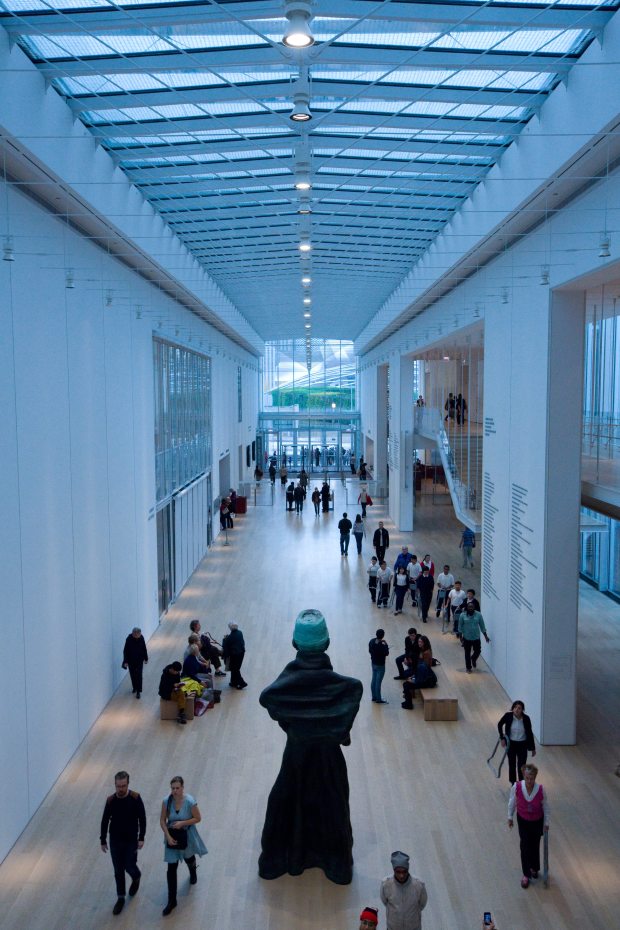 The Kenneth and Anne Griffin Court at the Modern Wing of the Art Institute of Chicago in 2012. (Alex Garcia/Chicago Tribune)
And in fairness, who can blame them? When a billionaire writes a check to the Chicago Park District, he gets a visible result and a thank you note. When he writes a bigger one to the Illinois Department of Revenue, it disappears into a fiscal fog bank.
Philanthropy fills some noble gaps, but it can’t patch the structural holes that taxes are meant to fill. Bike paths are wonderful, but they don’t pay teachers, fix bridges, or keep police and firefighters on the job.
Private generosity makes a city more livable, but public investment makes it workable. And when too many of the city’s biggest benefactors decide government is irredeemable and move their residencies and business addresses to tax- and regulation-friendly states such as Florida, we’re left with fewer tax and philanthropic dollars and more empty offices.
Rebuilding trust in a transparent, efficient, accountable government is the real long-term project Illinois can’t afford to outsource. It’s the real road to recovery. And unlike a bike trail, it starts not with a billionaire’s donation but with a collective decision to demand better government — and to believe it’s still possible.
But that’s a long-term project many view as more rhetoric than reality — dubious at best.
So in the meantime, here’s a thought Mayor Brandon Johnson and the City Council might consider as they try to fill a billion-dollar budget hole without raising taxes that make the business climate worse than our winter weather and the citizen environment more inhospitable than a toxic waste dump.
Settle on five of the most important programs, projects and initiatives that need funding. Maybe more low-income housing, aid for people who are unhoused, affordable day care, community safety, job training and economic development, just to name a few worthy objectives.
Then, and this is the key, provide a realistic detailed game plan for each one: overall cost, personnel requirements, execution and evaluation strategy, efficiency and accountability guidelines, oversight, implementation timetable and deliverables.
And finally, ask the city’s major philanthropists to commit the necessary dollars to their favorite projects — to put skin in the game without feeling scalped.
Perhaps this is Pollyanna-ish, but some pipe dreams, including Emanuel’s Griffin gambit, produce valuable results — Millennium Park is another example — so it’s worth raising the issue to see if it has as much traction as the new lakefront lanes.
Andy Shaw is a semi-retired Chicago journalist, good government watchdog and inveterate dreamer.
Submit a letter, of no more than 400 words, to the editor here or email letters@chicagotribune.com.