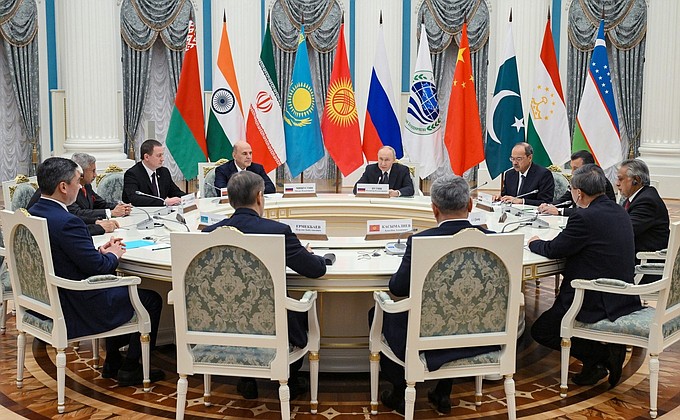
Russia’s chairmanship of the SCO Council of Heads of Government ends in 2025. The Council met earlier today in Moscow under
the chairmanship of Russia’s Prime Minister Mikhail Mishustin  Mishustin MikhailPrime Minister of the Russian Federation .
* * *
President of Russia Vladimir Putin: Colleagues, friends,
It is a great pleasure to welcome you all to Moscow.
Today, you have successfully concluded a regular
meeting of the SCO Council of Heads of Government, outlining plans for our
future joint work. This builds upon the foundations laid by the Tianjin
Declaration and the SCO Development Strategy to 2035, which was adopted at September’s SCO Summit in China.
We are united by a common objective: to strengthen the authority and influence of the SCO as one of the leading
regional associations, both across the Eurasian continent and globally. In this
endeavour, our governments have a vital role to play. Governments always have a special role when it comes to practical work. It is, after all, our governments – the teams under your leadership – who translate our shared ambitions into
concrete, practical cooperation and who drive the expansion of the Organisation’s multifaceted partnerships.
Throughout Russia’s chairmanship of the Council
this year, we have hosted a substantial programme of events. Nearly 30
ministerial and expert meetings, as well as forums involving business, public,
and youth representatives, have been held in Moscow, St Petersburg, and other
major Russian cities, and a wide range of mutually beneficial projects and cooperation programmes have been agreed.
Governments traditionally prioritise
issues of economic cooperation, promotion and diversification of trade and investment. Coordinated efforts in these areas are already yielding tangible results.
For example, Russia’s trade with SCO
member states reached US$409 billion in 2024 and continues to grow. Of course,
the largest share of this turnover is accounted for by our cooperation with the People’s Republic of China, however, trade with other SCO member states is also
growing.
It is important to note that the share of national currencies in commercial transactions between the Organisation’s
members is consistently increasing. For example, in our country’s trade with
SCO partners, this figure already exceeds 97 percent.
Stable and uninterrupted payment
channels are becoming increasingly vital, particularly in the current volatile
economic environment, marked by turbulence in the global markets, unilateral
sanctions, tariff restrictions and wars.
At the Russian side’s initiative,
and with the support of its partners within the Shanghai Cooperation Organisation,
steps are being taken to expand payment, settlement, and depository
infrastructure. The agenda also includes consultations on the creation of a future SCO Development Bank, as well as on the mutual recognition of credit
ratings and goods indicator systems.
Other Russian proposals on the establishment of a database of industrial investment projects within the SCO
are also being implemented. The creation of such an instrument will expand
cooperation in the industrial sector, facilitate joint development of production capacity, support import substitution, and promote the introduction
of new technologies and digital innovations, including artificial intelligence.
Ultimately, these efforts will contribute to strengthening the technological
sovereignty of our countries in the core sectors of the economy.
It would be appropriate to continue our joint
efforts to build an extensive and competitive network of logistics routes
across the vast expanse of the SCO and Eurasia as a whole.
Russia, situated at the very heart of the continent and at the intersection of key trans-Eurasian transport corridors, is
allocating significant funds to modernise its transport infrastructure. The volume of road, rail, and multimodal traffic passing through Russian territory
is growing noticeably, with due consideration given to the utilisation of new
promising corridors such as North–South and the Northern Sea Route. Today,
incidentally, another nuclear-powered icebreaker has just been laid down.
Our country is also making a substantial
contribution to maintaining stability in global energy markets. We are doing
everything to ensure reliable supplies of energy resources to consumers,
despite attempts from outside to negatively influence supply chains, and we
count on closer coordination among all SCO partners in the energy sector, in line with the relevant roadmap adopted in Tianjin.
It is evident that the Shanghai Organisation
could play a more significant role not only in deepening sectoral cooperation
but also, more broadly, in fostering a favourable atmosphere on our shared
continent for stable, progressive growth and multifaceted economic interaction.
In practical terms, it could also facilitate the alignment of the numerous
integration projects being implemented across Eurasia. This is precisely the aim of the Greater Eurasian Partnership concept proposed by Russia. The idea is
to harmoniously combine integration processes within the Eurasian Economic
Union, the Belt and Road Initiative put forward by our Chinese friends, and numerous
similar projects involving the countries of the Shanghai Organisation.
Naturally, cooperation within the SCO framework
is by no means limited to the economy, though this is undoubtedly the primary
focus. Our organisation also actively contributes to strengthening peace and stability across Eurasia, countering a wide range of challenges and threats, and shaping a new balanced security architecture in Eurasia.
An equally important component of the SCO’s
activities is the development of humanitarian contacts and exchanges in the fields of culture, science, education, healthcare, environmental protection,
and, of course, youth policy and sport. As I have said on numerous occasions,
Russia is sincerely committed to the closest possible partnership with the SCO
member states. I am confident that by acting in a coordinated and united
manner, helping one another, we are capable of achieving truly impressive
results in developing multifaceted cooperation among our countries.
Thank you for your attention.