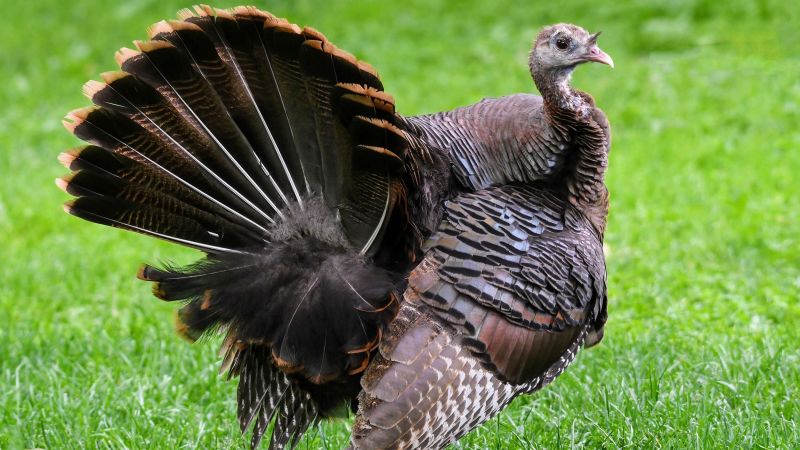
This time of year, turkeys are almost never alone.
In late fall, flocks of wild turkeys will feed together in meadows, digging up worms or foraging for acorns and grasses. Meals aren’t always peaceful — the males, or toms, are known to squabble and compete for food — but they’re almost always had as a group.
But at the Battery in downtown New York, Astoria the turkey is on her own.
The beautiful bird has settled there following a lengthy stay in the quiet gardens of Roosevelt Island and a brief, chaotic stint in Midtown Manhattan. Last spring, she headed downtown to live among the hubbub of tourists who visit the park to board boats to the Statue of Liberty. She’s the only wild turkey in Manhattan.
Astoria’s move was likely motivated by a biological imperative she may never fulfill. Across New York Harbor, on Staten Island, there are hundreds of turkeys. But they can hardly fly more than a few hundred feet in one burst, let alone the 5 miles between the boroughs, and Astoria hasn’t yet figured out the ferries.
Astoria may never find a mate if she stays at the Battery. But her many human admirers hope she never leaves.
“I think she’s really found her home,” said Stella Hamilton, a local birder who spends hours every day with Astoria.
Astoria, with her curious expression, iridescent plumage and striking strut, is easy to love.
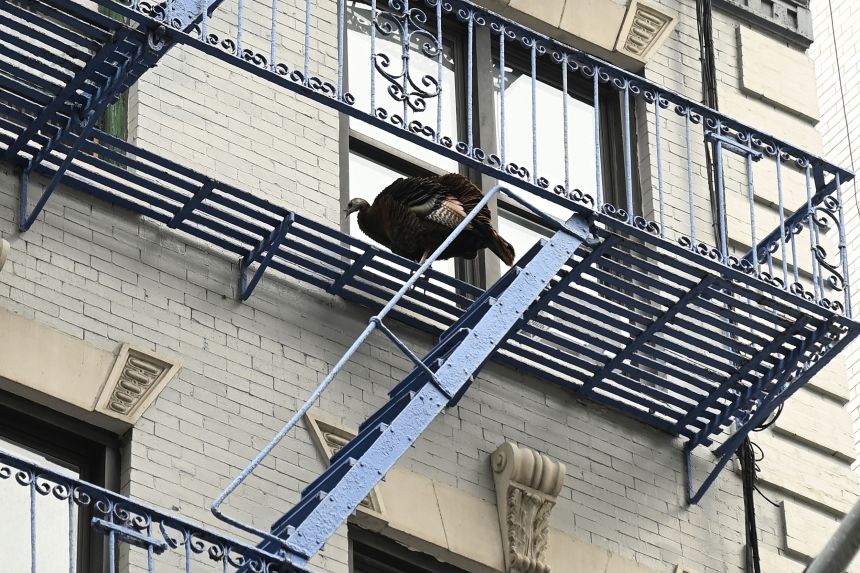
Hamilton has spent decades getting acquainted with celebrity birds around the city, including the long-lived red-tailed hawk Pale Male and Flaco, the Eurasian eagle-owl who survived for a year on the loose after his enclosure at Central Park Zoo was sabotaged, then died in February of last year. She was still mourning Flaco when she heard about the lonely turkey living on Roosevelt Island. It wasn’t until Astoria took a daring flight across the East River and landed in the haughty Sutton Place neighborhood that Hamilton finally sought her out.
“The first time I saw her sitting on that balcony in the east 50s, in Sutton Place, I fell in love right away,” Hamilton said.
The pair have since established a nighttime routine. (Another birder spends time with Astoria every morning.) Hamilton arrives at the Battery every day around 3 p.m. and stays until the bird is safely nestled in her oak tree for bed. She gently reprimands children who attempt to grab Astoria, shoos away unleashed dogs that chase her and feeds her unsalted peanuts by hand.
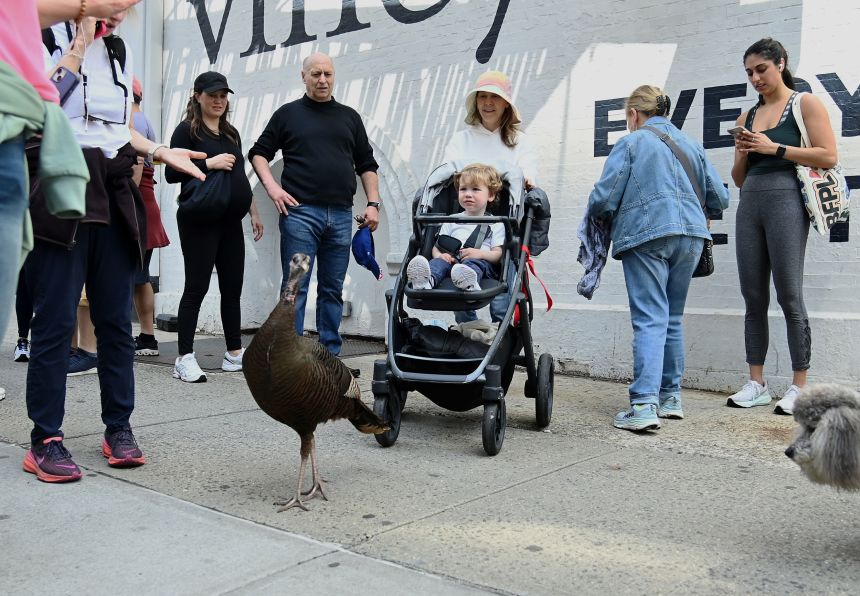
“Grown men will talk nonsense, like, ‘You’ll be dead next month,’ ‘Who’s hungry,’ that kind of talk. It’s just so offensive that people could see her as food to eat,” said Hamilton, a vegetarian.
But most of the people who pass through the Battery are unfazed by Astoria’s presence.
“Many of the tourists are much more interested in the squirrel,” said Sean Kiely, the Battery’s park manager.
If she’s not prowling the park, you might even miss her. Astoria doesn’t mind most human passersby, but she does not abide rats. She spends most of her days foraging for worms and weeds in garden beds or strutting through the park’s meadows. Every night, around sunset, she revs up to roost in a tall oak tree by pacing the sidewalk and then suddenly breaking into a sprint to get aloft.
Hamilton gushes about Astoria the way someone might about their child or a crush: “She’s really very sweet, kind of comical. Her radiance — her feathers are beaming, especially when the sunset hits her feathers. She’s just really glorious.”
On Staten Island, where turkey populations have exploded in the last 15 years, the birds are considered by some to be nuisances, what with their plentiful poop and potential for aggression during mating season. At the Battery, Astoria assists with landscaping.
“She’s helping the gardeners out, and she knew exactly what she wanted to eat and helped us get rid of the actual weeds and left the flowers alone,” Kiely said of Astoria’s meals around the dandelion beds. “I thought that was pretty amazing.”
Along with the peanuts, Hamilton feeds Astoria blueberries when they’re in season. Prolific birder David Barrett maintains that feeding Astoria some supplementary snacks is “necessary” so she can access the same nutrition her fellow wild turkeys get outside the city, with the peanuts filling in for acorns. But city wildlife officials discourage people from feeding wild turkeys, which could lead the birds to lose their natural fear of humans. Astoria is already in close contact with people, and if she approaches park visitors who perhaps are not huge fowl fans, the results could be disastrous.
“I know it’s very tempting to want to feed large animals like turkeys,” said Sunny Corrao, who works on human-wildlife relations for the New York City Department of Parks and Recreation. “But Battery Park has some really well-landscaped garden beds. There’s still insects. They’ll be eating seeds in the winter. So this turkey’s got plenty of food.”
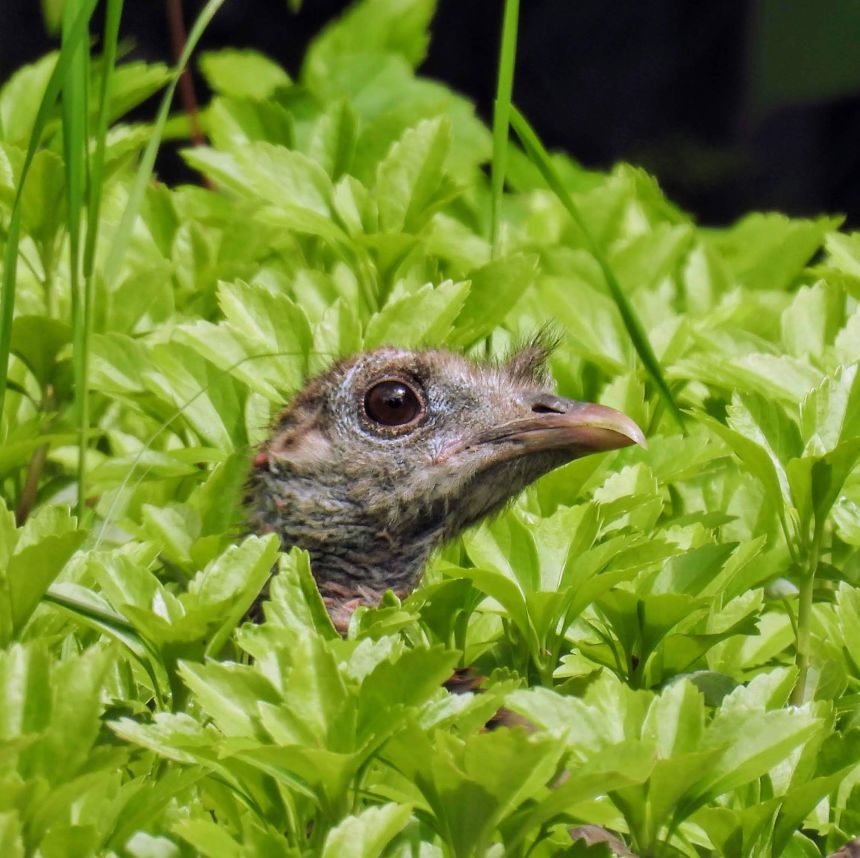
Astoria’s arrival in Manhattan remains puzzling because no one knows quite where she came from. She was first spotted in her eponymous neighborhood in Queens in 2024 before decamping to idyllic Roosevelt Island, that skinny strip of parks and apartment towers in the middle of the East River. But she definitely didn’t hatch in Queens, where there are no wild turkeys, said Barrett, who runs the popular X account Manhattan Bird Alert, where he documents the goings-on of local avian celebrities. There are some wild turkey flocks off in the far reaches of the Bronx or 30 miles further east on Long Island, but it’s unlikely that Astoria traveled that far.
Wherever it was that she emerged from the egg, Astoria probably dispersed from her hatchplace to avoid competition with other birds, said Andrew Farnsworth, a visiting scientist at the Cornell Lab of Ornithology. Wild turkey populations have surged countrywide after decades of work to restore their numbers, especially in New York State, where halfway through the 20th century the species had all but disappeared. The once-reclusive birds have learned to adapt to human development, and many wild turkey populations now live comfortably in cities with plenty of interconnected green spaces and forested areas, Farnsworth said.
The Battery offers easy access to Wall Street and the 9/11 Memorial, rather than to other green spaces. That aside, though, it has a lot of what Astoria requires: wooded habitats, plenty of food sources, access to open spaces and hiding places. But there’s also traffic, pesticides and other harmful chemicals and rats, cats and dogs to contend with. Her survival is impressive, Farnsworth said.
What the Battery does not have is a male turkey with which she can mate.
“I’d suspect the prospects are not good,” Farnsworth said.
But there is a precedent for bachelorette turkeys settling down at the Battery. Before Astoria was Zelda, a single hen named for F. Scott Fitzgerald’s flighty wife, who lived at the park for 10 years — more than double the average lifespan of a wild turkey. She may’ve lived even longer if she hadn’t been fatally struck by a truck in 2014.
Like the eternally single Zelda, Astoria has laid eggs (unfertilized, of course) in a nest on the ground and refused to abandon them for days at a time, putting her in danger of starvation and at risk of predation from unleashed dogs. Kiely and his team of gardeners have a system in place, from their days with Zelda, for distracting Astoria and carefully removing the eggs.
Will Astoria, like Zelda, stay single for the rest of her days? It’s likely, Hamilton said, if only because Astoria so expertly evades capture. Catching Astoria to relocate her has proved impossible so far — during her brief tenure uptown, NYPD officers repeatedly failed to nab her, leading her to wander into perilous traffic. Since she’s healthy, wild and seems to be thriving at the Battery, there are no plans to move her anywhere.
“I am proud of her,” Hamilton said. “This girl. I don’t even know how she survived traffic in Manhattan, for god’s sake.”
Heartbreaking as it may be that Astoria’s search for love is thus far fruitless, her carers don’t plan to bring her a mate either.
“You might think that the solution is easy: there are lots of male wild turkeys, particularly on Staten Island, so why not bring one to her?” Barrett said. “But a heavily used urban park like the Battery with unleashed dogs running around would be unsafe for raising tiny, defenseless wild turkey poults.”
Astoria may yet again lay lifeless eggs next year, if she decides to stay put at the Battery. Her fans are anxiously awaiting spring to see where her quixotic quest for a mate takes her next, if anywhere.
“We hope that she decides to stay, as there is no other park nearby in which she could have a good life,” Barrett said. “Maybe she already figured that out.”
In the meantime, Astoria is well cared for. She’s monitored day and night, is supplied with her favorite snacks and even has a view of the Statue of Liberty from the oak tree in which she sleeps. Her plumage will protect her this winter, as will her unpaid bodyguards. She’s the only wild turkey in Manhattan, but she’s never quite alone.