Four-way chess mixed with big-money poker, anyone?
After complex “high stakes” strategizing and last-minute negotiations, one thing is clear after Scottsdale City Council’s Nov. 17 meeting:
Axon stays.
A deal has been reached that apparently – though there is some dispute over this – satisfies multiple parties: Axon, city leaders, state lawmakers and the group suing the city and state on the Axon issue.
Thus, after years of threats to leave Scottsdale due to challenges of its expansion plan, Axon will remain in North Scottsdale. At an inconspicuous office there, the maker of Taser stun guns and police body cameras has flourished – now approaching $3 billion in worldwide sales.
Axon agrees to reduce its “worldwide campus” expansion plans from 1,882 apartments to 600 apartments and 600 condos. The site remains 74 acres of undeveloped, former state land bordered by the Loop 101, Hayden Road and Axon Way (formerly known as Mayo Boulevard).
After intense public debate and private wheeling and dealings, a 4-3 vote reduces the scope of Axon’s project by more than a third.
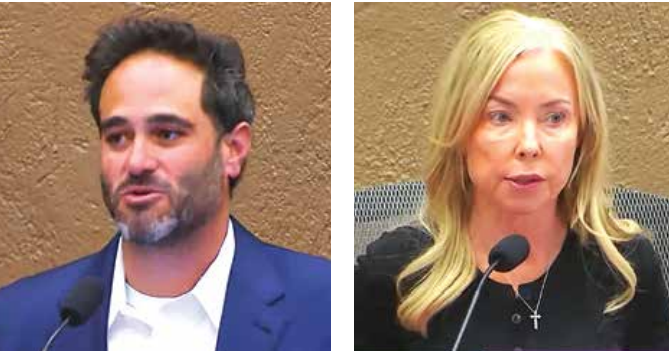
The vote happened after Josh Isner, Axon’s president, called out “misinformation” from Mayor Lisa Borowsky regarding negotiations.
Isner displayed a text saying “can u guys agree to 500 now & 200 in next 60 months” – which, Isner stressed, “I can prove to you was from TAAAZE.”
Shortly after Isner’s comments, the mayor called a :recess.”
Returning to public after an extensive delay, Borowsky apologized to a packed – mostly with Axon employees – Council Chambers.
“We’ve been busy in very serious discussions about how we can resolve this,” the first-term mayor said.
With a negotiated deal on the table, Borowsky was the crucial “swing vote.”
Councilman Adam Kwasman, a key player in the negotiations, and fellow representatives Solange Whitehead and Maryann McAllen expressed strong support for the deal.
Outspoken against the deal were representatives Barry Graham, Jan Dubauskas and Kathy Littlefield. The latter is the wife of former Councilman Bob Littlefield, leader of a group trying to block Axon’s original plan.
Kathy Littlefield and Graham – who questioned the new plan’s details before declaring the agreement “weakens requirements … such as waiving water requirements” – voted against Axon’s original plan last year. Whitehead voted for the rezoning allowing up to 1,882 apartments at the end of 2024.
Hours before last week’s meeting, Borowsky said she would vote against a Kwasman-brokered plan for 750 apartments and 750 condos.
But new numbers were apparently proposed during the private meeting, and Borowsky changed her tune.
“Going from nearly 1,900 apartments down to 600, I think, is a positive result – especially with all the other moving parts,” Borowsky said before her tide-shifting vote.
She noted a pending referendum was nullified by a newly crafted law allowing Axon to move forward.
“Even with the election, no matter the outcome, under the state law, (Axon) can do the 1,900 units or more.”
The negotiated deal – Borowsky implied the group Taxpayers Against Awful Apartment Exemptions agreed to drop a lawsuit challenging the state law – “creates finality on this issue,” Borowsky declared.
“It gets the conversation moving in a direction of, let’s break ground and start construction and let’s go build a great project.”
Bob Littlefield, however, told the Progress he did not support the deal. “It’s still too many” apartments, he insisted.
“My bottom line is no apartments without voter approval,” Littlefield said the morning after the council vote.
“TAAZE isn’t agreeing to anything. Our lawsuit is still alive.”
Bob Littlefield said Axon is afraid of what voters would decide.
“If this gets to the vote,” he predicted, “it’s going to go down.”
The deal
According to a city release hours after the vote, the memorandum of understanding (MOU) reduces previously-approved residential density from 1,882 units to 1,200—split evenly between 600 apartments and 600 condominiums.
“Axon must also construct supporting infrastructure, including road improvements, water and sewer upgrades, a public dog park and a 1-mile pedestrian and bicycle trail encircling the campus,” according to Holly Peralta, a city spokeswoman.
Axon also will give Scottsdale “five years of no-cost access to a Real-Time Crime Center, offering advanced video, mapping and analytics technology to support public safety operations.”
By the same 4-3 votes, Council approved several related ordinances, including “a new permitting option that allows qualified architects and engineers to certify building plans and inspections for large international headquarters campuses.”
Though bypassing the typical Planning Commission/Development Review Board process, the ordinance “maintains city oversight through audit and enforcement authority,” according to the release.
Council also voted to repeal the zoning ordinance a very different council approved last year – which TAAAZE is challenging.
Background
The matter of an “international campus” with a North Scottsdale office – designed to look like a spaceship, to underscore the futuristic vision – surrounded by apartment buildings and a hotel is complex, to say the least.
Clearance for Axon’s plan of some 1,900 apartments by the 2024 Scottsdale City Council hardly proved lasting.
The five “aye” votes were still echoing when Bob Littlefield and TAAAZE launched a successful signature drive that forced the issue to the ballot – to be decided not by elected leaders, but Scottsdale’s general voters.
After months of compromise meetings with newly-elected city leaders failed, Axon found more willing ears at the state level, crafting and winning passage of a law that allowed its job-rich plans – and rendering the pending referendum moot.
Bob Littlefield and his Taxpayers Against Awful Apartment Zoning Exemptions took one look at the law and said “sue that!”
Challenging the Arizona constitutionality of “the Axon law,” the lawsuit thus became the board for the four-way chess game, involving Axon, TAAAZE, Council and the state.
State leaders have been quiet observers.
In the days leading up to the Nov. 17 City Council meeting, intense meetings took place with Isner and other Axon representatives, Kwasman, Borowsky and representatives of TAAAZE.
“I wasn’t part of any negotiations,” Bob Littlefield insisted.
As Borowsky put it, she met with “the anonymous funders of Taxpayers Against Awful Apartment Zoning Exemptions (TAAAZE) to agree to a further reduction of apartments totaling 500 units with an agreement not to seek a referendum on the deal.”
Luis Santaella, the interim city attorney who was called on several times during the Nov. 17 meeting, responded to several requests for clarification from the Progress.
His responses:
- “TAAAZE is not a party to the Axon-city Memorandum of Understanding (MOU).”
- “The repeal of the 2024 Axon land rezoning ordinance effectively nullifies the referendum. Since the underlying ordinance is no longer in effect, there is no longer a measure to refer to the voters.”
- “There is no handshake agreement between the city and TAAAZE regarding the lawsuit. TAAAZE is not affiliated with the city and continues to pursue litigation against both the state and the city, challenging the constitutionality of SB1543.”
Feedback
The agenda packet included dozens of emails.
Susan McGarry, a leader of Axon neighbor Stonebrook’s HOA, complained via email the last-minute meeting did not allow “time for us to organize a gathering at the Council meeting.”
Betsy Marks predicted the revised plan would be “suicide for all of you and us. Please restrain from allowing this to pass, and find a way to have the Scottsdale voters let you know what they really want.”
Pat Shaler asked Council to “support the citizens of Scottsdale and join the lawsuit against the Axon Bill.”
Bob Littlefield repeated many of his earlier points to City Council, adding, “it appears a few of you may be on the take from Axon.”
Ryan Sherman’s blunt emailed prayer: “Please don’t deny us our God-given rights as Scottsdale citizens.”
“Let’s remember the referendum … and not just jam Axon thru,” Dennis Pullaro wrote to the council.
Others warned of water, traffic, congestion and safety concerns if City Council approved the Axon deal.
“Take note!” resident and business owner Baron Benham warned.
“The voters are not in a good mood over this!”
At the meeting, Isner was not the only one pushing for the deal.
Several citizens spoke in favor of the modified Axon plan, which is expected to bring thousands of jobs here.