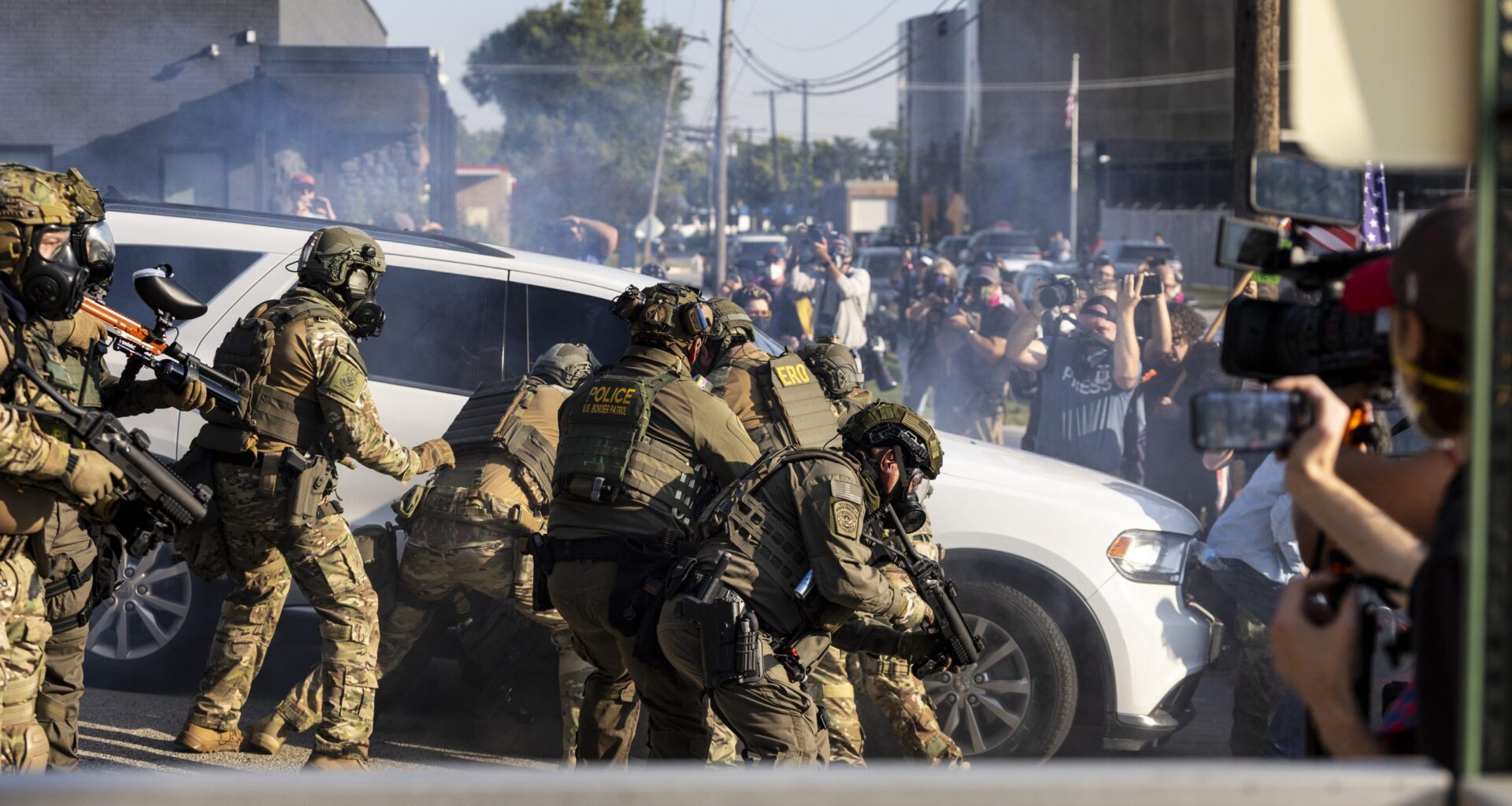
CHICAGO — For two months, federal immigration agents unleashed “indiscriminate” force on peaceful protesters and others across the Chicago area — and the federal government defended the aggressive tactics by repeatedly lying, deceiving the public and making claims disproven by their own evidence, according to a federal judge’s scathing ruling.
Last week, U.S. District Judge Sara Ellis issued a sweeping, 233-page written opinion in the use of force lawsuit filed on behalf of Block Club Chicago, other media groups representing journalists, protesters and clergy.
In her ruling, Ellis calls attention to a pattern of federal immigration agents using unnecessary force against peaceful protesters and others in neighborhoods across the Chicago area since Operation Midway Blitz began in early September. But the federal judge spent at least as much time highlighting lies and distortions by immigration authorities in press releases, social media posts and their own internal reports.
The federal government has said agents have used justified force to respond to “rioters,” “agitators” and violence. But Ellis said she couldn’t find any evidence of “violent rioters” in Chicago in the 500 hours of body camera footage and videos provided by government attorneys.
ICE officials said a protest on Sept. 27 outside of the ICE processing facility in suburban Broadview escalated when protesters shot fireworks toward agents. But federal authorities later admitted they weren’t fireworks — they were flash bang grenades deployed by agents on the scene, according to Ellis’ ruling.
In another example, Russell Hott, then a field director for ICE, said a Broadview protester ripped off an agent’s beard and demonstrators broke a downspout at the ICE facility. But later in a deposition, Hott “acknowledged that he did not even know if it was a person that caused the damage to the downspout, much less a protester, and that he did not have proof that the agent’s beard was actually ripped off his face,” the ruling said.
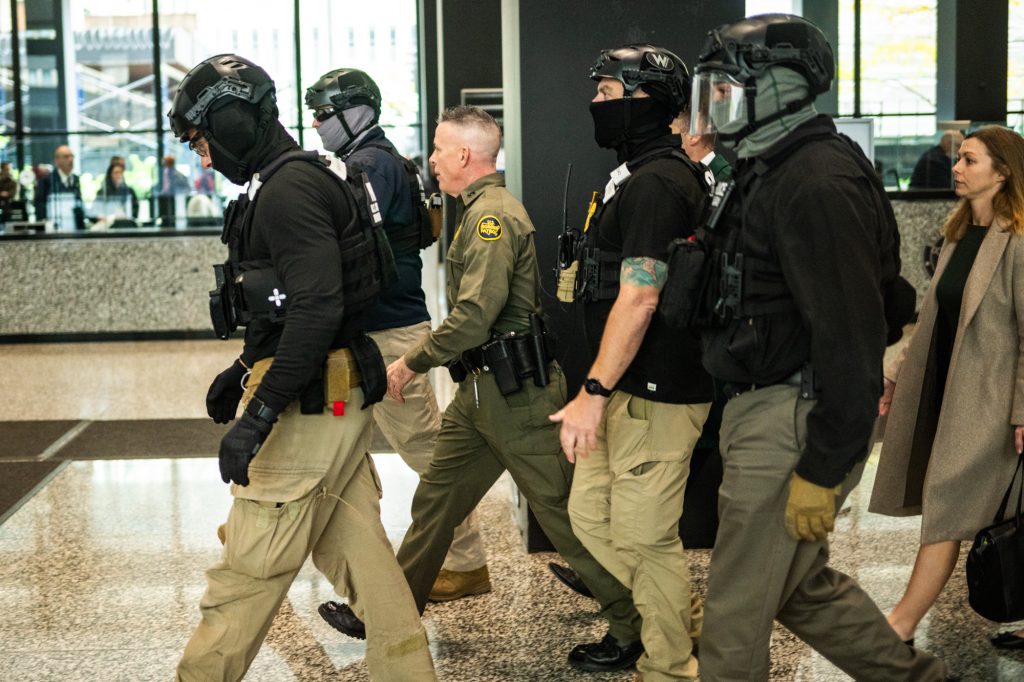 Border Patrol chief Gregory Bovino arrives at the Federal Building in the Loop on Oct. 28, 2025. Credit: Colin Boyle/Block Club Chicago
Ellis wrote that she repeatedly found testimony by Border Patrol chief Greg Bovino, the on-the-ground leader of Operation Midway Blitz, not credible. Bovino was evasive, either giving “cute” answers to attorney’s questions or outright lying, the judge said in her ruling.
Bovino admitted in his deposition that he lied “multiple times” about the events before he threw tear gas at protesters during a standoff with neighbors in Little Village on Oct. 23, according to the ruling. For instance, he initially testified that he tear-gassed the crowd after a protester threw a rock at him, but he later admitted that he was “mistaken” and he actually deployed the gas before a rock was thrown at him.
RELATED: Border Patrol Boss Bovino Tear-Gasses Chicago Crowd, Violating Judge’s Order, Lawyers Say
The Border Patrol veteran testified that members of the Latin Kings gang wearing maroon hoodies were seen taking weapons out of a car during a tense protest in Little Village on Oct. 23. Yet video footage shows only a few people in the area were dressed in maroon, including Pilsen Ald. Byron Sigcho Lopez (25th). Bovino’s broader theory — that maroon hoodies signify Latin Kings membership — “strains credulity,” Ellis wrote.
Bovino also denied that a federal agent shot pepper balls at Rev. David Black and that he tackled protester Steve Blackburn despite clear video evidence of both incidents, according to the ruling.
Of videos and other evidence the federal government submitted to justify its use of force, Ellis said, “a review of them shows the opposite—supporting Plaintiffs’ claims and undermining all of Defendants claims.”
“Overall, after reviewing all the evidence, the Court finds that Defendants’ widespread misrepresentations call into question everything that Defendants say they are doing in their characterization of what is happening at the Broadview facility or out in the streets of the Chicagoland area during law enforcement activities,” the judge wrote.
Ellis issued her written opinion last week. It expounds on the decision she read aloud in court on Nov. 7 extending restrictions on federal immigration agents’ use of force in the Chicago area.
That preliminary injunction — built on what Ellis described in her written ruling as “a mountain of evidence” — limits agents’ use of tear gas, riot-control weapons and other kinds of force against journalists, peaceful protesters and bystanders. It also mandates that agents wear badges or display other visible identification, and it requires that most agents use body cameras.
Ellis set a trial date for March — before another possible immigration crackdown in the spring.
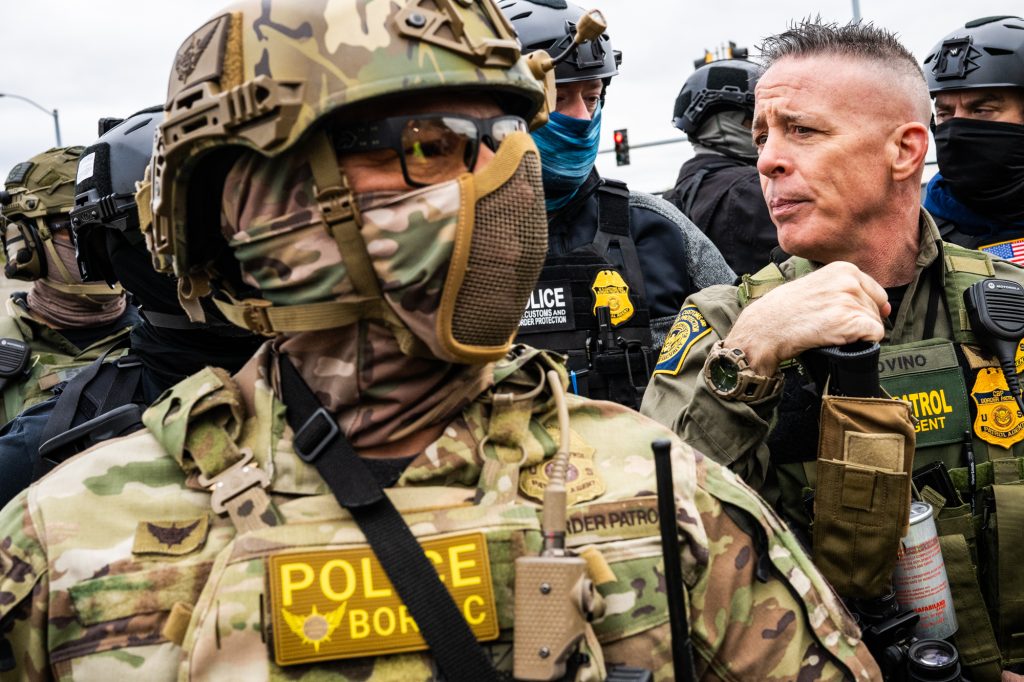 Border Patrol chief Greg Bovino stands at the front as dozens of neighbors confront federal agents in Cicero just outside Little Village as the agents conduct immigration raids in the area on Oct. 22, 2025. Credit: Colin Boyle/Block Club Chicago
Three days after Ellis read her order in court, the Trump administration filed an emergency motion asking the appellate court to stop the order immediately, arguing the “overbroad and unworkable injunction has no basis in law, threatens the safety of federal officers, and violates the separation of powers.” Last week, a federal appellate court paused Ellis’ order, calling it an “overbroad” encroachment on the powers of the federal executive branch.
Still, the appellate court cautioned that its brief ruling was not the end of the matter, noting “voluminous and robust factual findings” about First Amendment violations.
“Those findings may support entry of a more tailored and appropriate preliminary injunction that directly addresses the First and Fourth Amendment claims raised by these plaintiffs,” the appellate ruling stated.
Ellis’ written opinion is the latest development in the lawsuit. Experts say it is “extraordinary” on a few levels: It’s extremely detailed and lengthy, and it emphasizes that federal immigration authorities lied and misrepresented the truth throughout the deportation campaign.
“It wasn’t like she caught one key witness lying about one thing; they were lying about incidents all across the Chicago area,” said former Cook County prosecutor Thomas Needham, who runs a criminal defense law firm.
Richard Kling, a clinical professor at the Chicago-Kent College of Law, said judges rarely have the benefit of comparing live, in-court testimony against a large volume of video evidence.
“It’s one of those things that’s going to go down in history,” Kling said. “I’ve been practicing 50 years, I’ve never seen anything like this in my life, where you have essentially the feds sending in storm troopers who are fighting the state.”
Read the opinion:
Mick Dumke contributed to this report.
Listen to the Block Club Chicago podcast: