Chicago-area industrial heated up in 2025 following a pair of years that couldn’t quite reach the meteoric highs of the pandemic era.
Investor competition for industrial properties, particularly shallow bay space, is on the rise, and leasing activity has continued at a healthy pace, panelists said at Bisnow’s Midwest Industrial Summit, held at Innovation Park in Libertyville.
Underwriting remains conservative and equity capital can be hard to come by, but Chicago industrial pros’ prevailing sentiment at the event was that the market is looking more attractive by the day.

Bisnow/Ryan Wangman
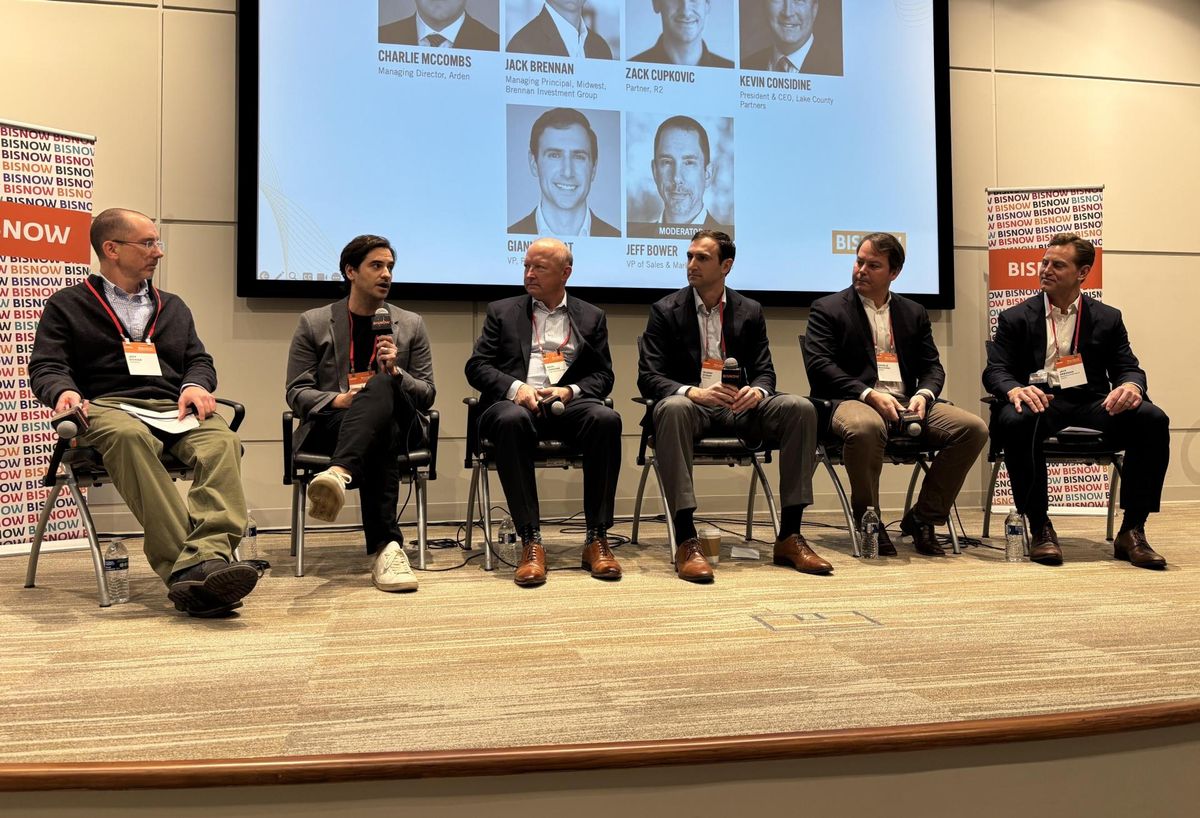
Aggreko’s Jeff Bower, R2’s Zack Cupkovic, Lake County Partners’ Kevin Considine, Realterm’s Gianni Vissat, Arden’s Charlie McCombs and Brennan Investment Group’s Jack Brennan.
“We’re starting to see some real FOMO from a lot of investors in Chicago, where deals that might have had one or two bids on them a year ago have eight to 10 now,” said Zack Cupkovic, partner at R2 Cos. “The pricing is still a little depressed, but the interest level is getting higher and higher, and ultimately, that’s going to lead to better transactions.”
Robin Stolberg, managing director at Clear Height Properties, said he’s also seen a double-digit number of bids on certain properties he’s looking to buy, which can make it a bit of a challenge to win the deal. Still, he acknowledged that the competition is healthy for the market and investors’ exits.
Though capital markets activity in Chicago’s industrial sector is still below historic norms, year-to-date sales have reached nearly $2.4B, a 4.8% increase over the same period last year, according to a Q3 Newmark industrial report.
Jack Brennan, managing principal over the Midwest at Brennan Investment Group, said the company has stayed busy on the acquisitions front, focusing on assets in proven locations that can attract a wide range of users. This year, the company has been the most active in the small bay space.
“We like the stickiness of those tenants, and also, just historically, they’ve retained their occupancy much better than some of our larger units,” Brennan said.
Bisnow/Ryan Wangman
Liston & Tsantilis’ Peter Tsantilis, Mapletree’s Richard Prokup, NAI Hiffman’s Kelly Disser, Clear Height Properties’ Robin Stolberg, Legacy Investing’s Daniel English and The Missner Group’s Barry Missner.
The rising appeal of shallow bay properties for investment and leasing has attracted a lot of new entrants to the space, Mapletree U.S. CEO Richard Prokup said. These players don’t always have their own capital and are trying to hold deals while they go out and find financing for them.
While many of those groups are capable investors, some of the new entrants don’t comprehend the intricacies of operating spaces with multiple small tenants, Stolberg said.
“There are some that are jumping in and don’t fully understand the complications of the operating component of having a 100K SF building with 20 5K SF tenants,” Stolberg said. “We have been a beneficiary of some of those falling out of diligence, getting that first call.”
Bisnow/Ryan Wangman
CBRE’s Steve Livaditis, Keeley Construction’s Sean Keeley, Saxum Real Estate’s Sean Gilbert and Karis Cold’s Ken Verne.
Deal flow in the industrial sector has been uplifted by office’s pain, Cupkovic said.
Institutional funds with a directive to invest a certain percentage in property used to divide that up among office, industrial and multifamily, but now the money is split between just industrial and multifamily, he said.
The debt component of the capital stack has been easier to piece together for deals over the past six to eight months, The Missner Group CEO Barry Missner said. Still, it’s been harder to get equity partners on board to capitalize certain acquisitions.
Missner said equity partners “might be listening” but that the equity environment doesn’t feel materially different than it did at the beginning of the year.
“Even if you have a high conviction development that the math all works, which is very hard to achieve, even that level does not guarantee that your project can get capitalized, or that you’re not going to run into challenges on the equity side,” Missner said.
However, the difficult market to raise capital does present an opportunity to acquire great buildings at attractive prices if you are able to pull off the financing component, Cupkovic said. It’s an opportunity he doesn’t think will last very long.
Bisnow/Ryan Wangman
Liston & Tsantilis’ Brian Liston, Nexamp’s Brion Fitzpatrick, Champion Realty Advisors’ J.D. Salazar, Hillwood’s Rachel Agba-Novak, Range Group’s Jared Rubin and Arco/Murray’s Brent Jordan.
Underwriting standards have also shifted this year.
Charlie McCombs, managing director at Arden, said the company is trying to be a lot more conservative around underwriting rent growth. Rental rates have increased substantially over the past several years, as have insurance rates and real estate taxes, so McCombs is cognizant that tenants have “stomached a lot” and is careful about the overall occupancy cost for tenants.
The underwriting for speculative developments has also gotten a lot more conservative, Brennan said. The company is baking in more downtime or lease-up periods, less aggressive rental escalations, more tenant improvements and additional months of free rent.
Because of this climate, Brennan Investment Group hasn’t been as active in spec development as it was in recent years.
“We’re finding other investment opportunities that are less risky right now than going spec that yield the same kind of returns,” Brennan said.
Leasing activity for Brennan Investment Group has been strong this year, with progress made despite economic and political headwinds, Brennan said. The company started at the beginning of 2025 with about 2.1M SF of vacant spec space across the Midwest. Year to date, 75% of that has been leased on a long-term basis, with an additional 15% occupied on a month-to-month basis.
Bisnow/Ryan Wangman
Village of Libertyville’s Mary Oshana, Pivot Energy’s Remi Mignott, Stream Realty Partners’ Brian Duffy, TradeLane’s Brendan Sheahan and Faropoint’s Kiefer Price.
From a broader market perspective, new leasing activity in the third quarter totaled 9.9M SF, lowering the vacancy rate 7 basis points from the previous quarter to 4.6%, according to a Colliers Q3 industrial report.
“There’s definitely light at the end of the tunnel,” Brennan said.
On the whole, Brennan said his biggest takeaway from the year is that the Chicago industrial market is improving. His company plans to buy more multitenant, small bay portfolios in 2026, as well as industrial outdoor storage.
Prokup also sees continued investment in 2026 following the uptick in leasing activity.
“It’s been shocking how well Chicago has held up over the last few years,” he said. “I’ve been in this market for 35 years, and I’ve never seen it perform as well in a down cycle as it has this time. And that hasn’t gone unnoticed.”