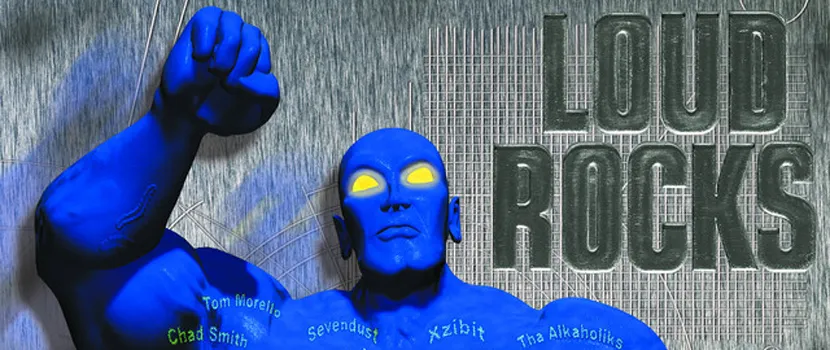
On paper, the 2000 collaborative album “Loud Rocks” certainly looked like a surefire hit. Arriving at an opportune time, it capitalized on the cross-pollination of rap & metal that had been feverishly brewing as nü-metal rose to prominence. Steve Rifkind, head of hip-hop label Loud Records, was initially inspired to put together that compilation after catching a show played by Rage Against The Machine and Wu-Tang Clan.
While an ambitious undertaking, it wasn’t exactly novel. Back in 1993, Immortal Records co-founder Happy Walters pursued the idea of pairing established artists from the worlds of rap, metal and rock on the highly-regarded ‘Judgment Night‘ soundtrack. While the film itself underdelivered, its innovative soundtrack that paired Slayer with Ice-T, Pearl Jam with Cypress Hill, Helmet with House Of Pain , among numerous other collaborations, remains memorable to this day.
In 1997, Walters took that vision in a different direction with the soundtrack to the 1997 film adaptation of ‘Spawn‘. Instead of rap, that record leaned into pairing heavy artists like Slayer, Korn, Marilyn Manson and more with the then flourishing artists in the EDM and trip-hop scene.
As for Rifkind, with a powerhouse stable of hip-hop stars already at his fingertips via his aforementioned label, he set out with his own attempt at further bridging the once disparate genres into a cohesive blend, while also building up his in-house talent. Unlike the two soundtracks mentioned above, “Loud Rocks” had its stakes set a bit lower though.
While “Judgment Night” and “Spawn” served up all-new collaborative tracks, “Loud Rocks” instead saw metal and rock artists coming in to beef up already released tracks from the likes of Wu-Tang, Big Pun, Mobb Deep and more. This made for some jarring collaborations, some of which would probably not fly today. First up, there’s characteristically animated System Of A Down dropping n-bombs alongside Wu-Tang Clan on “Shame” — a remake of the Wu-Tang Clan‘s 1993 song, “Shame On A Ni**a“.
Shoehorning in metal royalty like Black Sabbath‘s Ozzy Osbourne & Tony Iommi on a ramped up version of Wu-Tang Clan‘s “For Heavens Sake” also delivered uneven results. Ultimately, an admitted lack of star power from the metal side involved on “Loud Rocks” also made for a rocky experience overall. Still, “Loud Rocks” did serve up some memorable listening experiences.
Incubus‘ additions to the Big Pun track “Still Not A Player” produced a fun, notable standout. Dead Prez‘s “Hip-Hop” getting an industrialized edge courtesy of Static-X was also an interesting take, as was Sick Of It All adding some NYHC flare to Mobb Deep‘s “Survival Of The Fittest“.
As recently noted by Louder, Rifkind appeared on the Bootleg Kev podcast this past June. During that interview, he discussed the inception and fate of ‘Loud Rocks‘. He started by saying that he initially went into the project with very high hopes, stating [transcribed by theprp.com]:
“That was my favorite. I thought that was going to be the biggest album of my career. Dead Prez, System Of A Down, right? Crazy Town did ‘Only When I’m Drunk‘ [with the Alkaholiks.] …I mean I hired somebody to do it, but I really thought that… That was literally my idea, and I really thought this is before the Jay-Z/Linkin Park thing. Yeah I thought this was going to be the biggest album of my career. I really did.”
When asked if “Loud Rocks” was expensive to make, Rifkind responded, “It wasn’t expensive. The problem was we couldn’t get f*cking clearance anywhere [from other artists labels.]” As for if System Of A Down were the biggest band involved, Rifkind went on to say that Big Pun was likely the most popular artist involved on the album at the time.
Rifkind was also asked if there was any pushback from getting his hip hop stars to sign on to work with metal and rock artists, to which he said, “No, they did it in two seconds.” Their lack of hesitation isn’t surprising, given that the likes of Korn, Limp Bizkit and more had already begun working and touring with established rap artists like Ice Cube and Wu-Tang Clan‘s own Method Man by the mid to late 90s,.
The early 2000s proved to be a fertile time for crossovers of that nature. Outside of “Loud Rocks“, that turn of the century also saw the release of “Take a Bite Outta Rhyme: A Rock Tribute to Rap“. That project was released through Republic/Universal Records just a month after “Loud Rocks” and largely saw artists from the nü-metal world reinvent previously released rap tracks. Members of Limp Bizkit, Sevendust, Insane Clown Posse and Factory 81, among countless others, took part in that record.
2001 saw another crossover venture in a similar vein, with the release of “Too Legit For The Pit: Hardcore Takes The Rap“. That record found artists from the hardcore, metalcore and post-hardcore scenes covering various rap classics, including Throwdown taking on Sir Mix-A-Alot‘s smash hit “Baby Got Back“, E.Town Concrete doing their rendition of Nas‘ “The World Is Yours” and Candiria scuffing up the seminal Dr. Dre and Snoop Dogg collab “Deep Cover“. You can imagine how some of that was received by hardcore elitists and gatekeepers at the time.
Of all those collaborative affairs listed above, it was “Judgment Night” and “Spawn” that left the most lasting mark, each going gold in the United States. Still, “Loud Rocks” hasn’t completely been forgotten.
In 2024, The Alkaholiks revisited their ramped up version of “Make Room“ from it, replacing Sugar Ray‘s contributions with new parts from Spookybands. This past spring, Red Hot Chili Peppers drummer Chad Smith also revisited his collaborative track with Wu-Tang Clan and Rage Against The Machine” from that “Loud Rocks“, performing it live in the studio.