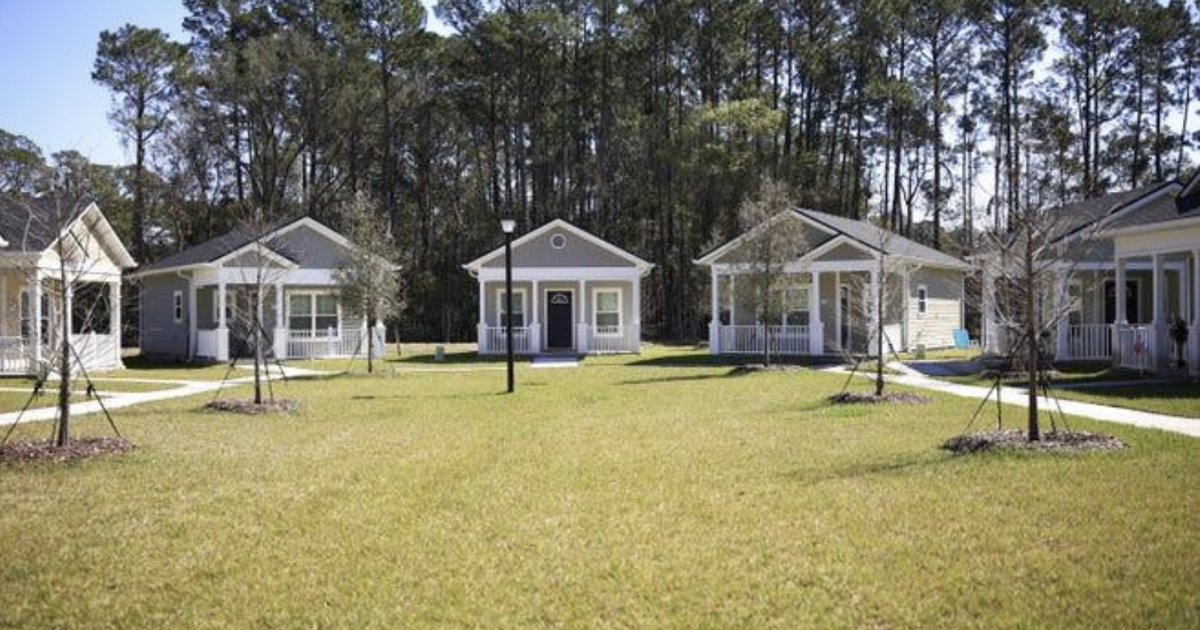
Loudoun’s Affordable Dwelling Unit Advisory Board says the challenge of finding affordable living spaces could potentially be addressed in part by tiny homes, after the Board of Supervisors this year commissioned a study of the issue.
As housing prices increase, supervisors are hoping there might be a way to use tiny homes to address the concern. According to the county staff, in 2025 the average price for one-bedroom unit in the county is $348,650, while a two-bedroom unit is $464,335.
The county government already offers various attainable housing programs including the Affordable Dwelling Unit Purchase Program, but that has a waitlist of 434 households, and it can take over three years for a family to be offered a unit.
In their recently published white paper on tiny homes, ADUAB members said tiny homes could be a helpful tool, but that a series of challenges also come with them.
Tiny homes are divided into two categories, according to the report – mobile and permanent.
Mobile tiny homes are built on wheels and are specifically designed to be easily transported and are often custom built, according to the report. These cannot meet building and residential code requirements so are considered a type of recreational vehicle.
The maximum size allowed for a tiny house on a trailer according to the Department of Motor Vehicles is 8.6 feet wide, 40 feet long and 13.6 feet, high which equates to approximately 320 square feet of livable space. Under the Virginia Uniform Statewide Building Code, units built solely to RV standards are typically limited to RV parks, or temporary uses unless given permission in local zoning ordinances.
Permanent tiny homes are designed for a fixed foundation and may be modular, manufactured, shopping containers, 3D printed or custom built, according to the report. They must meet building and residential code and may be used as accessory dwelling units or primary residences.
The size can range from 80 square feet to 800 square feet, but typically smaller than 600 square feet. However, the International Residential Code adopted in Virginia, defines a tiny home as less than 400 square feet, excluding lofts, which tiny homes sometimes include.
Costs vary dramatically, according to the report, depending on size, design and construction method. The report cites an average price of $67,000, but found that on a square-foot basis, tiny homes are 38% more expensive than full-sized homes.
Tiny homes are used across the country in a variety of ways including as transitional housing, rental housing and for market-rate homeownership. In Texas, homebuilder Lennar has developed tiny home community with prices averaged at $140,000 for 661 square feet.
“For tiny homes to be feasible as an attainable homeownership option in Loudoun County, based on cost research, land would need to be available at reduced or no cost. This position is based on current ADU pricing of $155,025 for a one-bedroom unit. If land were available at no cost, construction and site work could be completed for approximately $150,000 per unit,” according to the white paper.
There are a variety of ways to finance a tiny home, including personal loans, RV loans, traditional mortgages, contractor financing, cash, credit card and land trusts, according to the report.
Land use considerations must also be taken into account, according to the report. Tiny homes must comply with site requirements, building standards and zoning.
A condominium type structure could potentially address some of those considerations.
“A condominium structure could enable multiple homes on a shared parcel, enhancing affordability and sustainability. A condominium structure could also make it possible to minimize yards and setbacks while maximizing density quality open space, and community amenities,” according to the report.
To understand what could work in Loudoun, ADUAB members compared a potential scenario with an approved public land and affordable housing partnership being developed in the county currently, where the former park and ride lot in Ashburn is located. Of the 4.86 acre parcel, 3.72 acres are developable and according to the current proposal 131 affordable rental units and eight ownership units will be built.
The board estimates that if that same parcel were developed into a tiny home community, 40 to 50 tiny homes would need to be developed to make the project financially feasible.
“By using a ground lease, the county can maintain land ownership and provide financial support to keep the homes affordable. Additionally, having more units can help with site costs and infrastructure improvements,” according to the report.
Using the existing proposal as a cost and assuming a cost of $125,000 per unit with a $1 million ground lease payment, the development of 45 tiny homes for ownership could cost $6.7 million. The approved proposal for 131 rental units and eight ownership units is expected at $4.5 million.
This cost also does not take into account additional expenditures for a rezoning, if that would be needed.
“Based on the research, ADUAB believes tiny homes could be a helpful tool as part of the county’s housing toolbox to address homelessness and housing needs. Tiny homes may also offer a way to provide attainable homeownership depending upon the design, financing and ownership structure,” according to the report.
The Board of Supervisors is expected to receive a summary of the white paper during its Dec. 2 meeting.