
This story was produced with support from the Education Writers Association Reporting Fellowship program.
Ronald King knows he’s an outlier as he pursues becoming a doctor.
Few Black and Latino men enter the medical field, national and Texas data shows. Lack of opportunities, access and finances are among challenges deterring would-be health professionals, according to students, medical leaders and researchers.
Physicians and others in medicine often don’t reflect the demographics of their communities, impacting the quality of care residents receive, experts told the Fort Worth Report. Meanwhile, local hospitals and clinics face worker shortages as North Texas booms, state data shows.
King wants to change that. His community faces some of the worst health outcomes — rising prediabetes rates, high maternal mortality and low life expectancy. He knows people need a doctor who will listen and ease their feelings of distrust, he said. Their health depends on it.
“Being able to be somebody who’s actually going to listen to them and get them effective care is important to me,” King said.
In May, King graduated from Fort Worth ISD’s Texas Academy of Biomedical Sciences with a high school diploma and an associate degree. He is now a freshman at Texas Christian University, where he is a biology major on the pre-med track.
He’s entering a field teeming with jobs.
North Texas is estimated to be short more than 3,000 doctors this year, according to estimates from the Texas Department of State Health Services. By 2036, nearly half of the region’s primary care needs could go unmet, according to state projections.
Texas now ranks 42nd in the country in direct patient care physicians per 100,000 residents, according to a recent report from the Texas Medical Association. Meanwhile, the state’s population is growing at a faster rate than most others and more doctors are nearing retirement, the association reports.
window.addEventListener(“message”,function(a){if(void 0!==a.data[“datawrapper-height”]){var e=document.querySelectorAll(“iframe”);for(var t in a.data[“datawrapper-height”])for(var r,i=0;r=e[i];i++)if(r.contentWindow===a.source){var d=a.data[“datawrapper-height”][t]+”px”;r.style.height=d}}});
window.addEventListener(“message”,function(a){if(void 0!==a.data[“datawrapper-height”]){var e=document.querySelectorAll(“iframe”);for(var t in a.data[“datawrapper-height”])for(var r,i=0;r=e[i];i++)if(r.contentWindow===a.source){var d=a.data[“datawrapper-height”][t]+”px”;r.style.height=d}}});
window.addEventListener(“message”,function(a){if(void 0!==a.data[“datawrapper-height”]){var e=document.querySelectorAll(“iframe”);for(var t in a.data[“datawrapper-height”])for(var r,i=0;r=e[i];i++)if(r.contentWindow===a.source){var d=a.data[“datawrapper-height”][t]+”px”;r.style.height=d}}});
Few men, even fewer Black and Latino men, become doctors
In Texas, the physician workforce does not reflect its patients.
Among physicians in Texas, Texas Medical Association data shows only 11.3% are Latino and 6.3% Black, even though Hispanic residents make up 40% of the state’s population and Black residents around 18%, according to census data.
Students like King sit at the thin end of that pipeline. And the pathway narrows early. In Fort Worth classrooms, Black and Latino boys account for a large share of students, but many never reach higher education. A recent report from the Fort Worth Education Partnership showed about 1 in 5 students in Fort Worth don’t graduate from high school — and fewer than a fifth of those who do go on to earn their associate or bachelor’s degree.
Texas medical schools saw more than 68,000 applicants last year, according to data from the Association of American Medical Colleges. Only 1,916 applicants enrolled. Men represented less than 46% of both applicants and new medical school students.
window.addEventListener(“message”,function(a){if(void 0!==a.data[“datawrapper-height”]){var e=document.querySelectorAll(“iframe”);for(var t in a.data[“datawrapper-height”])for(var r,i=0;r=e[i];i++)if(r.contentWindow===a.source){var d=a.data[“datawrapper-height”][t]+”px”;r.style.height=d}}});
An even smaller group of men actually graduate from medical school.
Latino men represented less than 3% of applications to major Texas medical schools. Black men were no more than 1.2%, according to the association.
window.addEventListener(“message”,function(a){if(void 0!==a.data[“datawrapper-height”]){var e=document.querySelectorAll(“iframe”);for(var t in a.data[“datawrapper-height”])for(var r,i=0;r=e[i];i++)if(r.contentWindow===a.source){var d=a.data[“datawrapper-height”][t]+”px”;r.style.height=d}}});
In 2023, Black men made up 2.5% of medical school graduates across the United States, data from the Association of American Medical Colleges shows. Latino men accounted for just under 3%.
The gap persists even as medical jobs are among the most in demand as Texas grows.
‘Hard to be what you can’t see’
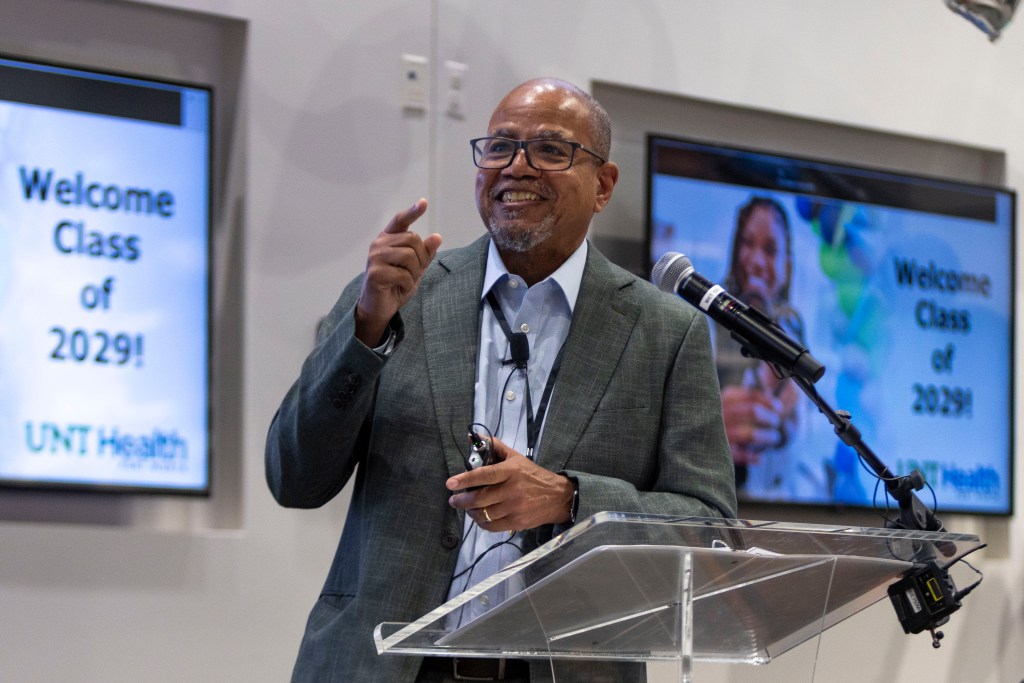 Dr. Kirk Calhoun speaks during a stethoscope ceremony July 23, 2025, at the UNTHSC Medical Education & Training building in Fort Worth. (Mary Abby Goss | Fort Worth Report)
Dr. Kirk Calhoun, president of UNT Health Fort Worth, was the first member of his family to attend college. His parents pushed him and his brother to focus on academics.
The tenacity his parents instilled in Calhoun fueled his college experience and, eventually, pushed him toward becoming a doctor of internal medicine, he said.
But Calhoun acknowledged such encouragement has its limits.
“It’s hard to be what you can’t see,” he said.
That obstacle applies across demographic groups, according to research by Victoria Allen. The Belmont University doctoral nursing candidate designed a one-day immersion program for 28 seventh-grade boys in the Nashville area. She brought in Black male nurses and clinicians — a nurse practitioner, a new graduate intensive care unit nurse and a respiratory therapist-turned-nurse — to talk students through the work and pay expectations of different health careers.
Allen collected pre- and post-tests from the students and found a statistically significant increase in interest and understanding of nursing after just six hours of exposure.
“When you see someone who looks like you, you believe you can do it,” Allen said.
Early exposure to possibilities matters, her research found.
Middle school — not high school — is when students start deciding whether science careers are something they are interested in, she said.
Texas middle schoolers pick a specialization for their high school diploma. To access advanced science and math courses in high school, students must take Algebra I by eighth grade — an indicator of success in college and the workforce, according to national research.
These choices make college more accessible for students from low-income families, said Natalie Young Williams, former president and CEO of the Tarrant To & Through Partnership. They lower the cost. They also allow some students to begin working immediately after high school graduation, a concern for many first-generation college students who help support their families.
The number of choices, though, can be overwhelming.
“How do parents and students understand the opportunities available to them, connect to a passion they have starting as early as middle school and give them the opportunity to complete by the time they graduate high school?” Williams said.
Growing up in Chicago, UNT Health’s Calhoun was bedridden as a result of his severe asthma. On the advice of a friend, his mother recommended he see an allergist. It was the first time he saw a doctor who looked like him — and knew how to fix his ailment.
“I got to see those doctors and nurses providing care to me, and it was a strong motivator for me to pursue a health care career,” Calhoun said.
Today, he oversees a university trying to widen that pipeline. Since 2016, the Texas College of Osteopathic Medicine at UNT Health has grown from 17 to 40 Black students and from 108 to 128 Hispanic students, Provost Christopher Ray said.
Mentoring programs, summer research opportunities and extra support for students after college help more young people make it into — and through — medical school, Ray said.
‘I just want to be the first option’
 Fort Worth ISD student Noah Fernandez identifies pharmacy supplies at the Texas Academy of Biomedical Sciences on Nov. 19, 2025. (Maria Crane | Fort Worth Report/CatchLight Local/Report for America)
King, the TCU student, wants to be an OB-GYN. He doesn’t have family in the medical field, although his mother once aspired to be a doctor. His experiences at FWISD’s Texas Academy of Biomedical Sciences inspired him, he said.
“We have doctors and nurses for teachers. That was a great help for what we’re getting into,” King said.
Others in his class, like Omar Mohamed, are charting their own paths in the medical field as well.
Mohamed plans to become a radiology technician — a shorter, more direct route into health care. For him, the draw is being rooted in a community that looks to him for trust.
“I just want to be the first option,” Mohamed said. “I’m Muslim, and when Muslims hear that another Muslim is a doctor, they always say, ‘This guy’s Muslim. We got to go.’ I want to help as many people as possible, especially people like me.”
Representation matters close to home
Research shows that when clinicians come from, or can relate to, the communities they serve, outcomes improve.
King thinks about that often.
“Help is not always consistent when given to women of color,” he said of obstetrics and gynecology. “Being able to be somebody that’s actually going to listen to them and get some effective care matters.”
It especially matters close to home. Tarrant County has one of the highest maternal mortality rates for Black women in Texas — a distinction King hopes to help erase. He knows trust is built appointment by appointment, by a doctor who looks you in the eye and doesn’t rush the answer.
Getting more young men of color to that exam room will take earlier exposure, focused coaching and affordable routes through college and beyond, experts said.
It will also take persistence, from students, schools and systems, to keep the pipeline from leaking talent at every turn, Allen said.
The goal, Calhoun added, is simple but far-reaching.
“We do not want to see any community go underserved because of a lack of providers,” he said.
Jacob Sanchez is education editor for the Fort Worth Report. Contact him at jacob.sanchez@fortworthreport.org or @_jacob_sanchez.
Matthew Sgroi is an education reporter for the Fort Worth Report. Contact him at matthew.sgroi@fortworthreport.org or @matthewsgroi1.
At the Fort Worth Report, news decisions are made independently of our board members and financial supporters. Read more about our editorial independence policy here.
This <a target=”_blank” href=”https://fortworthreport.org/2025/11/30/few-black-latino-men-enter-medicine-as-north-texas-demand-soars/”>article</a> first appeared on <a target=”_blank” href=”https://fortworthreport.org”>Fort Worth Report</a> and is republished here under a <a target=”_blank” href=”https://creativecommons.org/licenses/by-nd/4.0/”>Creative Commons Attribution-NoDerivatives 4.0 International License</a>.<img src=”https://i0.wp.com/fortworthreport.org/wp-content/uploads/2021/04/cropped-favicon.png?resize=150%2C150&quality=80&ssl=1″ style=”width:1em;height:1em;margin-left:10px;”><img id=”republication-tracker-tool-source” src=”https://fortworthreport.org/?republication-pixel=true&post=318931&ga4=2820184429″ style=”width:1px;height:1px;”><script> PARSELY = { autotrack: false, onload: function() { PARSELY.beacon.trackPageView({ url: “https://fortworthreport.org/2025/11/30/few-black-latino-men-enter-medicine-as-north-texas-demand-soars/”, urlref: window.location.href }); } } </script> <script id=”parsely-cfg” src=”//cdn.parsely.com/keys/fortworthreport.org/p.js”></script>