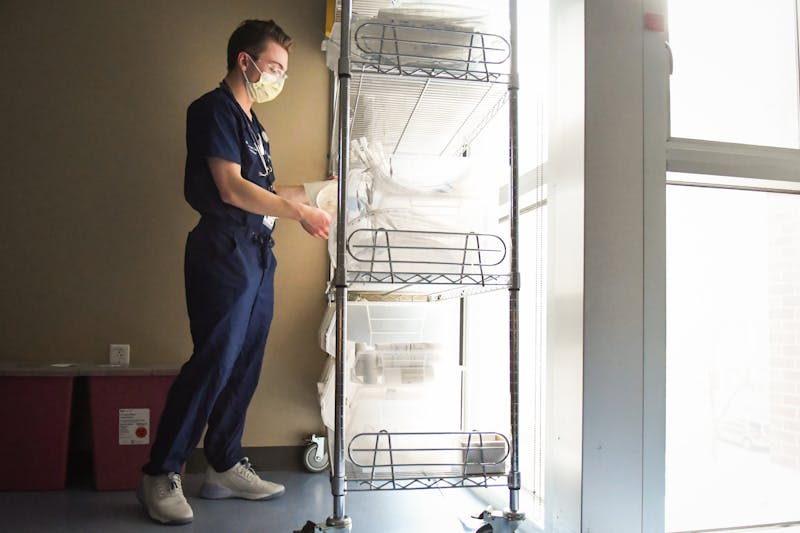
Penn Nursing Dean Antonia Villarruel warned against the Department of Education’s reclassification of professional degrees, which now excludes nursing education.
The new definition — which was approved by the federal agency earlier this month and is set to take effect on July 1, 2026 — limits nursing and other graduate students to an annual borrowing cap of $20,500, while granting other degrees a higher annual cap of $50,000. In a statement to The Daily Pennsylvanian, Villarruel wrote that the changes are likely to discourage applicants from pursuing professional education in the nursing field.
A Nov. 6 press release from the Education Department attributed the changes to the One Big Beautiful Bill.
“Under President Trump’s OBBBA, the Department’s rulemaking will eliminate the Grad PLUS program, which has fueled unsustainable student loan borrowing,” the press release stated.
In place of the Grad PLUS program, which allowed graduate students to borrow up to the full cost of their degree, the Education Department has set caps on student loans for graduate programs in an effort to ensure borrowers will not face “insurmountable debt to finance degrees that do not pay off.”
The caps are dependent on whether a degree is classified as “professional,” which — according to the new definition — includes only select degrees, such as medicine, law, pharmacy, dentistry, and theology.
“These limits – will for many – deter students in enrolling in graduate school – particularly in health professions – including nursing, social work, as well as others – such as education,” Villarruel wrote to the DP.
She added that the changes will similarly impact “all students seeking advanced degrees by placing both yearly and overall caps for borrowing.”
“At Penn Nursing, we are concerned about ANY barriers to enrolling in our programs and we will need to see what impact the proposed ruling will have on admissions for our programs,” Villarruel wrote.
While acknowledging the value of “generous” donations — including a $125 million gift from 1954 Wharton graduate Leonard Lauder in 2022 — Villarruel cautioned that individual contributions fail to “reach all those that are interested,” and stated that “additional private and public investments in nursing are needed to meet the growing demand of our population.”
“Importantly, decreasing the quality and quantity of providers affects access to health and healthcare services in every area of the country, both urban and rural,” Villarruel wrote. “This lack of access will also affect the preparation of nursing faculty and nursing science.”
On Nov. 7, the American Association of Colleges of Nursing released an article condemning the Education Department’s new definition. AACN wrote that the exclusion of nursing “disregards decades of progress towards parity” across the healthcare fields, adding that including graduate nursing programs in the list of “professional” degrees is a critical step for strengthening the nation’s nursing workforce.
The borrowing cap could also exacerbate the nationwide nursing shortage by creating obstacles to entering the field, according to Johns Hopkins School of Nursing professor Olga Yakusheva.
“It’s going to limit the ability of nurses to apply for graduate school, and on the back end, it will limit the number of nurses available in primary care settings and in hospitals,” Yakusheva told CBS News. “Communities with shortages of physicians will feel this the most.”
In a Nov. 24 press release titled “Myth vs. Fact: The Definition of Professional Degrees,” the Education Department stated that “95% of nursing students borrow below the annual loan limit and therefore are not affected by the new caps.”
The Education Department emphasized that the cap would “push” graduate nursing programs to reduce their costs and minimize student loan debt, adding that the new professional degree definition “is not a value judgment about the importance of programs.” The press release also clarified that “undergraduate students are generally not affected by the new lending limits.”
Still, Villarruel described the far-reaching consequences of excluding nursing from the list of professional degrees.
“It is not nursing that loses here – it is our entire country,” she wrote.