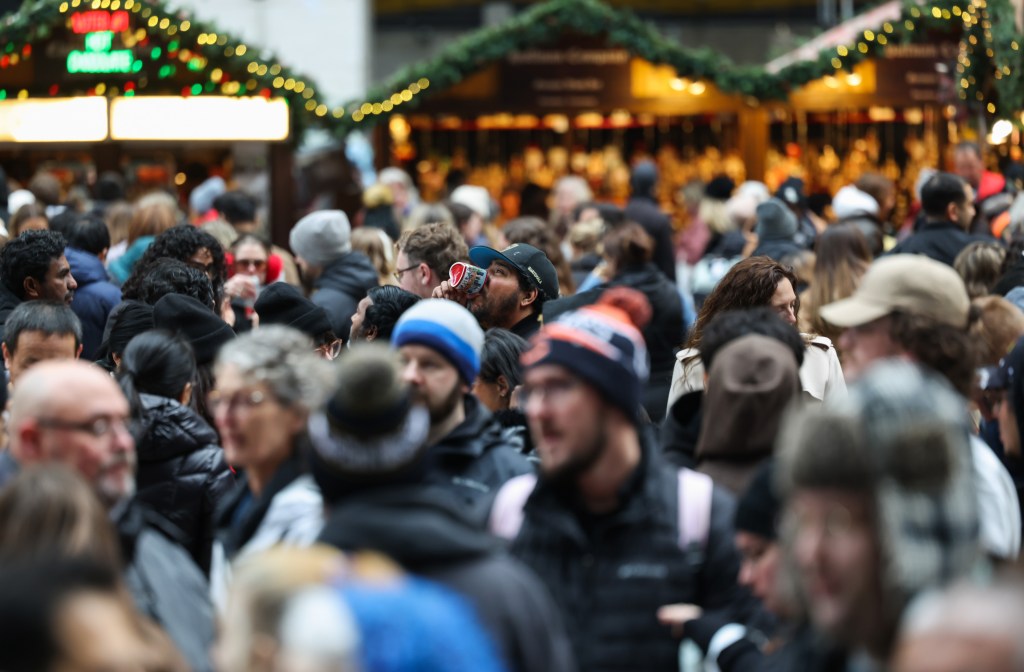
After pushback from organizers and vendors, city officials have decided to let up — to a degree — on the contentious capacity limit at Daley Plaza’s 29th annual Christkindlmarket, a development organizers say is a step in the right direction but still not sustainable for the beloved holiday tradition.
The city on Monday agreed to increase the event’s space restriction by nearly 1,000, bringing the amended capacity limit up to 2,500 people, according to Mark Tomkins, the president and CEO of the German American Chamber of Commerce, which runs Christkindlmarket.
In a statement to the Tribune, Mayor Brandon Johnson’s office said the city was working with organizers to “increase capacity in a safe and organized manner” in response to concerns raised.
“The enormous success of Christkindlmarket has pushed the limits of the capacity thresholds for Daley Plaza,” Johnson spokesperson Cassio Mendoza said.
City officials had initially capped capacity this year to 1,553 market-goers at any given time. Tomkins has stated previously that he was told the reason for the limitation was the municipal code, but that neither the layout of the Christkindlmarket nor the municipal code has changed, while the interpretation of the code has.
Tomkins told the Tribune Monday afternoon that easing the limit was “positive” but maintained that vendors still stand to be hampered if more strides aren’t made.
Organizers say the capacity limits are straining vendors’ ability to make a profit after paying rental fees and expenses. And they fear that visitors seeing long entrance lines will give up and stop attending. They also note that other big-attendance events in the city, such as Lollapalooza, do not have similar space limits.
The inaugural Christkindlmarket was held at Pioneer Court in 1996, and then the event moved to Daley Plaza, its longtime home, the following year. In recent years, it expanded to satellite sites at RiverEdge Park in Aurora and Gallagher Way in Wrigleyville.
Preparing for Christkindlmarket takes months, and orders are placed based on previous years. At a news conference on Friday, vendor Wolfgang Poennighaus said he’s heard the new restriction has been cutting other vendors’ sales by up to 40%.
“So many of our vendors … (are) long-term vendors that love coming to Chicago,” Tomkins said. “And (they) stayed with us for COVID, stayed with us through all these ups and downs. And this will likely be their worst year ever.”
The only other capacity limit the Christkindlmarket has had was during the coronavirus pandemic, when it was set at 3,494 people.
Tomkins said Monday’s change came after more than 10 days of discussion with the city. Last week, event operators sent a letter to Johnson’s office and mayoral aides asking them to reconsider the restrictions.
“This is the first time in the market’s 29-year history that such severe limits have been imposed,” the letter read. Organizers went on to note that international vendors, particularly those from Germany, are questioning whether they can return next year amid the restrictions.
“Without relief,” the letter read, “the future of Chicago’s largest winter tourist attraction — and the Loop’s holiday vibrancy — is at risk.”
Organizers requested that the mayor’s office restore previously approved pandemic-era capacity levels.
In its statement Monday, the mayor’s office said the city would “continue to make adjustments as needed.”
“The city will continue to work with the organizers to manage the flow of visitors so that the volume meets the needs of the vendor,” Mendoza, the office spokesperson, said, adding that the Chicago Fire Department will be on hand to offer additional training to event security, so they’re prepared to manage higher traffic flow.
Mendoza also stated that the city was working with organizers to “evaluate possible alternative locations for next year.”
Tomkins said discussion continues. While no one wants a safe market more than organizers, he said, they hope to reach a compromise that keeps vendors out of the red.
“We’re doing everything we can to find whatever solutions are out there,” he said.
The Tribune’s Alice Yin, Rick Pearson and Cam’ron Hardy contributed.