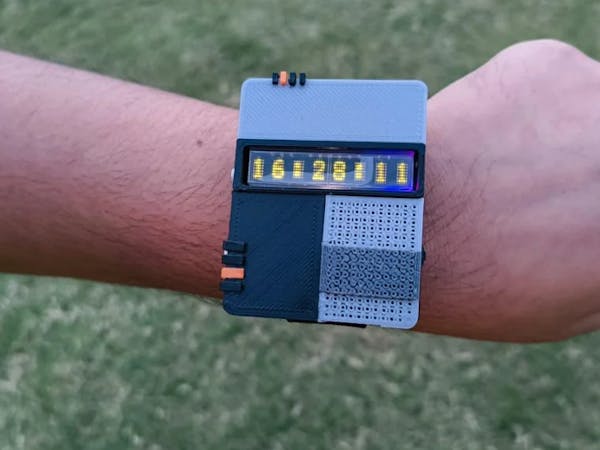
Electrical engineering undergrad Ashutosh Dash had designed a retro-styled smartwatch powered by an Espressif ESP32-S3, and built around a classic CMOS bitmap alphanumeric display.
“I’ve always been fascinated by ’80s technology, amber LEDs, simple character displays, and minimalistic design, so I naturally wanted something that captured that retro feel,” Dash explains. “OLEDs were an option, but they didn’t match the look I had in mind. Color LCDs also didn’t fit that aesthetic. [ePaper] displays were interesting, but their refresh rates were too slow for a responsive watch interface. At first, I considered using 0.2″ seven-segment displays, four of them arranged in a matrix. That idea stayed with me for a while, until a few months ago, when I was searching for seven-segment modules and came across the HCMS-2971: a high performance CMOS 5×7 alphanumeric display. The moment I saw it, everything clicked. It had the perfect retro glow, the right size, and exactly the kind of visual character I wanted for my wristwatch.”
Don’t be fooled by its retro looks: the H-CUBE packs in a wealth of modern functionality. (📹: Ashutosh Dash)
With the eight-character display picked, Dash was left to put together the rest of the hardware required for the project. An Espressif ESP32-S3 microcontroller was chosen as the driving force, linked to an Analog Devices DS3231 real-time clock (RTC) for timekeeping. An additional 128Mb (16MB) of flash storage was added, plus some extras to make it a truly smart smartwatch: a Bosch Sensortec BMI270 inertial measurement unit (IMU), an Ai-Thinker GP‑02 Global Navigation Satellite System (GNSS) receiver, a buzzer, three-way navigation switch plus an extra tactile switch, and everything required to handle a single-cell battery.
The finished watch hides a lot of functionality behind its vintage display: as well as telling the time and date, as you’d expect of a watch, it can lock on to the user’s GPS coordinates, read out the environmental temperature, monitor the battery health, set a stopwatch, activate alarms, control an RGB LED, and link over Bluetooth to the user’s phone or Wi-Fi to a wider network. The cost, of course, comes in the battery life: thanks to a space-efficient single cell and the constantly-lit display, the watch runs out of charge in around eight to 12 hours of use.
Prototyping was performed on a breadboard, and the design then shrunk down to a custom four-layer PCB. (📷: Ashutosh Dash)
“Over the past two months, I’ve learned a lot, especially about four-layer PCB stack-ups, CAD design, impedance control, and matching circuits,” Dash notes. “It has been a challenging but rewarding journey. Component selection alone took nearly two weeks, as I carefully studied each datasheet to ensure every part was suitable for the design. There were a few mistakes in the initial PCB layout as well, but they were corrected with a bit of creativity and improvisation. The board can definitely be made smaller in the next revision, and there’s room to add more features, such as biosensors for SpO₂ and other health metrics.”
The project is documented in full on Instructables, along with source code, STLs for printing the housing, schematics, and design PDFs for the PCB.