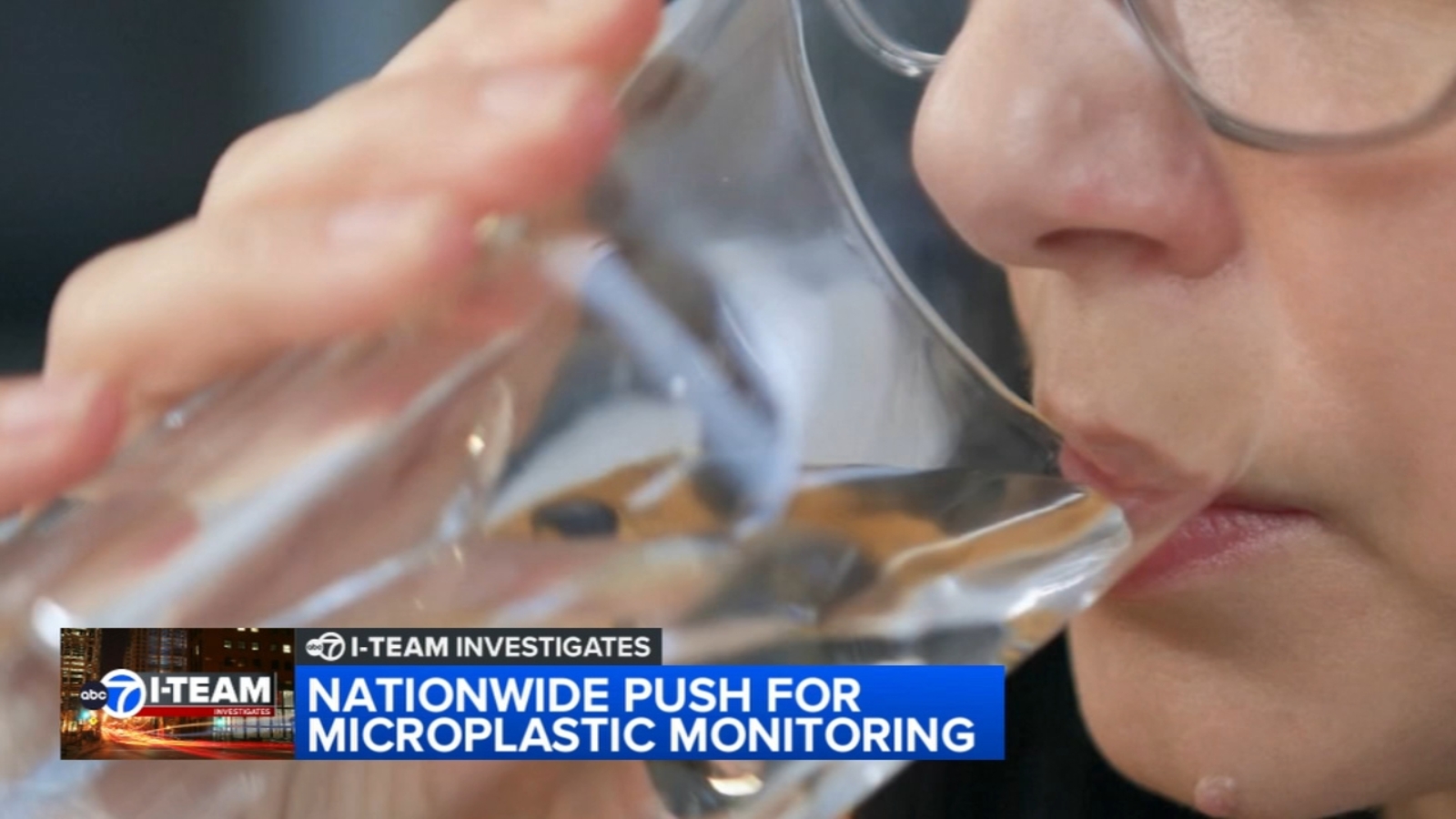
CHICAGO (WLS) — There is a new and major push to understand the level of microplastics in drinking water in Chicago and throughout the country.
Politicians, advocacy groups, and governors, including Illinois Governor JB Pritzker, are calling on the U.S. Environmental Protection Agency to jump start a water monitoring program to track the microplastics in drinking water.
Researchers are telling the ABC7 I-Team the exact levels in drinking water are unknown because there is no program to measure them on the federal or local level. That is concerning, as scientists say their magnitude in the environment has sharply increased.
ABC7 Chicago is now streaming 24/7. Click here to watch
Tiny plastic bits and filaments are so small they can barely be seen with the naked eye.
They’re small enough for people to ingest if they’re in water, in food, or floating in the air, which Loyola biologist and microplastics researcher Tim Hoellein says they are.
The I-Team has been following the rise of microplastics and human exposure to them for nearly a decade.
Hoellien says microplastics in the environment have been increasing exponentially since the mid-1900s.
“We were able to go to the Field Museum and pick out some fish specimens that had been collected from local rivers over the past 100 years, and what we found was there was no microplastic in their guts before, about the 1950s,” Hoellien said. “After that we saw the microplastic and it increased in an accelerating fashion.”
RELATED | Brain tissue may have higher amounts of microplastics than other organs, study finds
But while scientific researchers are witnessing the widespread proliferation of microplastics in the environment, there is still no Illinois or federal surveillance program to track levels in drinking water. The advocacy group Food and Water Watch sent a petition signed by seven governors from across the U.S., including Illinois, urging the Environmental Protection Agency to add microplastics to pollution monitoring rules under the Safe Drinking Water Act.
“We’re seeing increasing amounts of micro plastics and other chemical contaminants in our drinking water, in our Great Lakes, and it’s of substantial concern. Unfortunately, right now, we don’t have a uniform methodology or standards that all the states are using, or even the federal government is using,” said Andrea Densham, the senior policy advisor with Alliance for the Great Lakes.
Densham says creating a program to measure microplastic levels in the water we drink is vital to public health.
“We’re finding in human brains, lungs and in the bloodstream that that is really concerning, and it’s concerning for young people and infants as well as everyday folks and for the elderly. I mean, I think what we have is an emerging crisis,” she said.
There is growing scientific evidence that ingesting plastics may be linked to health problems.
Hoellien says they can mimic hormones, and some may even cause cancer, but he says surveillance is a tall order because the plastic particles are so complex.
“So, coming up with one way to measure it and one statement about its physiological impacts, it’s much harder for such a large group of materials,” he explained.
California is the only state to implement its own microplastics monitoring program, something the experts say Illinois could draw on to create its own program.
Copyright © 2025 WLS-TV. All Rights Reserved.