“There are a lot of great people in this industry. It’s like a big family,” said horse trainer and National Cutting Horse Hall of Fame member Scott Amos.
FORT WORTH, Texas — The first cutting horse competition took place in Haskell, Texas, in 1898. About 1,500 spectators watched a man on a 22-year-old horse win a $150 prize.
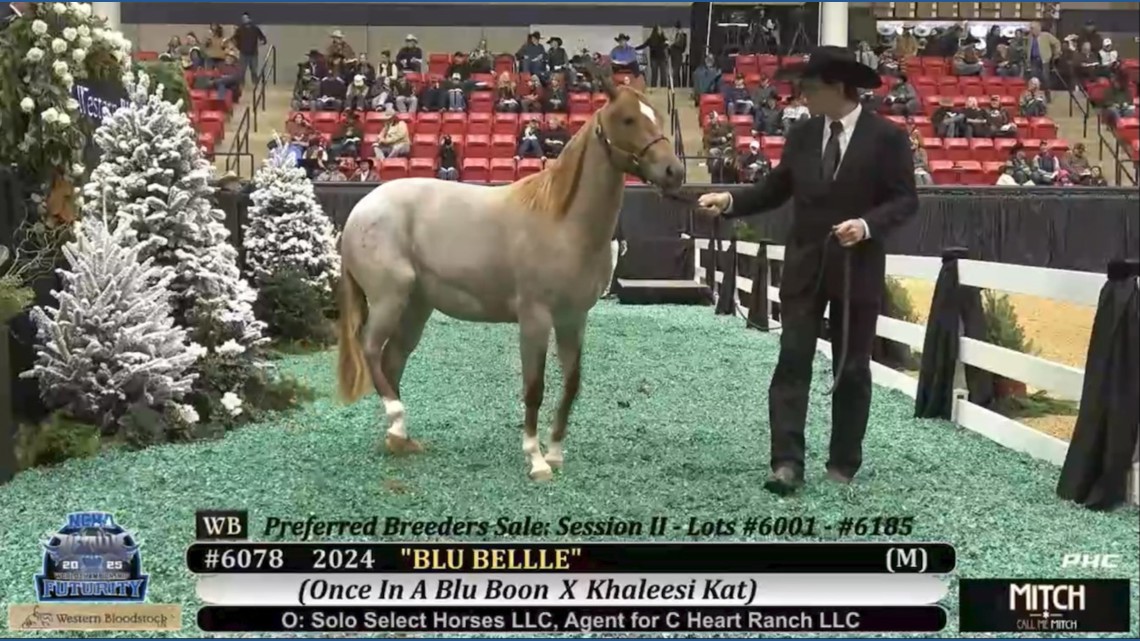
The National Cutting Horse Association in Fort Worth says its NCHA approved shows now have purses that exceed $39 million a year. And the seemingly endless chatter of an auctioneer inside W. R. Watt Arena at Will Rogers Memorial Center this week tells you the quest for that prize money, and the perfect horse, is alive and well.
The National Cutting Horse Association Futurity is considered the triple crown event for 3-year-old horses in Fort Worth. Competitions culminate this Saturday inside the John Justin Arena.
But across the street in Watt Arena, where individual horses sold at auction for more than $225,000, ranchers like Cole Tachdjian of Rockin R Ranch in Palmer were bidding on the yearlings they hope will eventually get them top prize. For him, with his wife, his two daughters, and his mom attending with him, the echoing cacophony of an auctioneer isn’t just noise. It’s family.
“Think we should buy one? Which one?” he asked his daughter, who sat in the Watt Arena stands with him.
For Cole, and for many tucked shoulder-to-shoulder in the stands, the Futurity is less about the money changing hands and more about the world they hope to preserve.
“For the most part, I think everybody in there does it as a passion for the western lifestyle and a passion to better the quarter horse breed,” he told WFAA.
The Futurity is the Super Bowl of cutting horses. Yearlings sold here won’t compete for another two years, but buyers hope they’re finding the elusive diamond in the rough.
“It is very competitive,” Tachdjian says. “Everybody here today is trying to find that next prospect that’s going to put us in the show ring on the other side of the grounds. We’re just trying to pick that right special individual horse.”
That’s where veterans like Scott Amos come in. A celebrated trainer from Colorado now working with the Tachdjian family, he is one of the few riders to surpass a million dollars in winnings and earn his spot in the NCHA Hall of Fame. Amos speaks of the sport with the awe of a man still in love with it.
“It’s almost like strapping yourself into a really fast Ferrari and stomping on the accelerator,” he says. “That’s how much of a thrill it is,” he said of his countless times on horseback in competitions. “The excitement to hold a cow away from the herd is like riding in a sports car. You got the best seat in the house.”
Cutting horses, already popular and deeply ingrained in the ranching culture of Fort Worth, have surged in visibility thanks in part to Yellowstone co-creator Taylor Sheridan, a champion of the sport who often slips into the saddle himself. His influence has brought new eyes—and new money—to the industry.
But even with the spotlight, ranchers like Tachdjian know the punchline baked into the business.
“Where is the money in it? It’s being spent!” he says with a grin. “They say, How do you become a millionaire? You start as a billionaire in the horse world. That’s the old joke.”
Still, as the auctioneer’s voice rattles the rafters and bidders raised their hands during yet another day of furious bidding, there’s nothing funny about what this event means to the people who fill these barns and arenas year after year.
A month-long celebration of grit, heritage, and the partnership between human and horse, the NCHA Futurity sits at the center of a thriving industry—and Fort Worth, for decades now, sits at the center of it all.