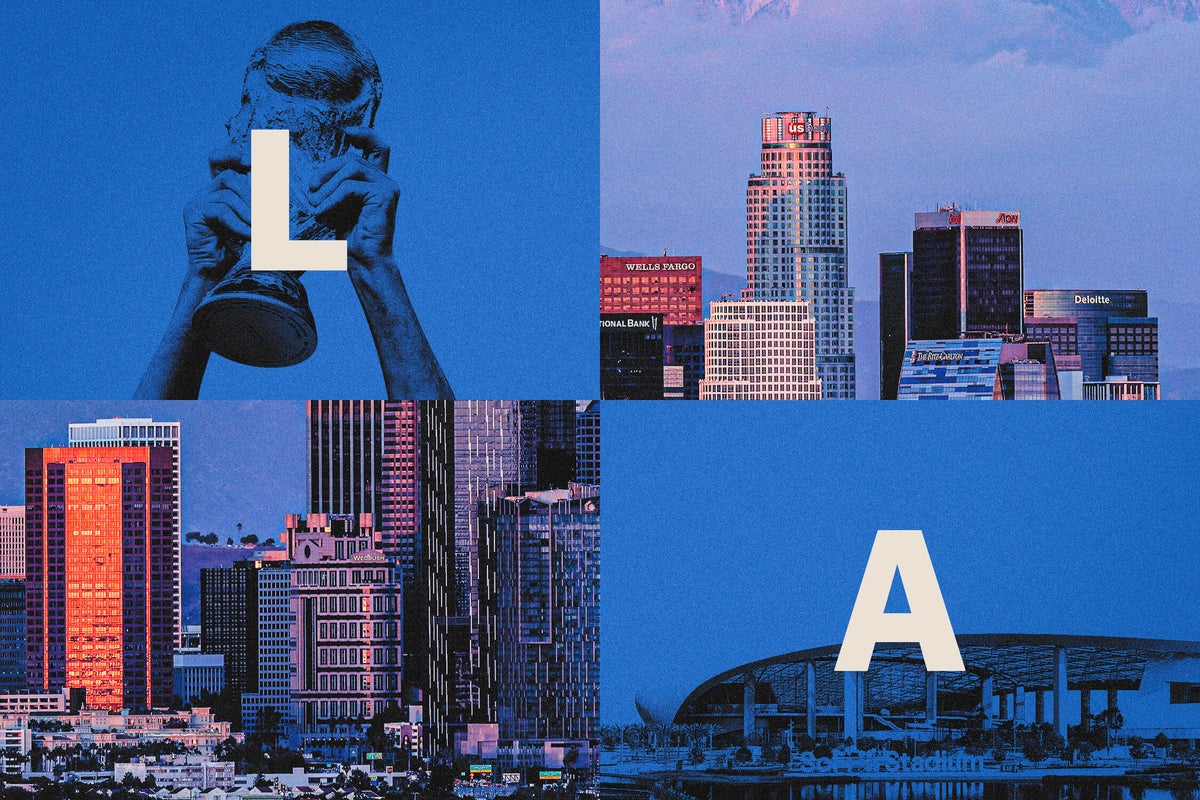
In the trailer for “Good Rivals”, the Amazon docuseries about the rivalry between the United States and Mexico men’s national soccer teams, two quotes spliced together — one from a star of each team — are used to underscore a major theme of the series.
“Playing against Mexico, it didn’t matter whether we were in Mexico City or Los Angeles…” former USMNT defender Alexi Lalas begins.
“The stadium was full and it’s mostly Mexicans,” former Mexico striker Javier ‘Chicharito’ Hernández finishes, in Spanish. “It was obvious that noise, applause and support were for us.”
That’s as good a place as any to start understanding Los Angeles and its storied soccer history. For as much as Los Angeles’ image is tied to the glitz and glamour of Hollywood, the city is home to a Hispanic population of between 1.8 and 1.9 million, who account for just under half of its nearly 4m total residents, according to U.S. census data.
As a greater metropolitan area, Los Angeles has a unique blend of dense population and rugged geography that make it difficult to traverse. The United States’ second-largest city, unlike its largest (New York) or third-largest (Chicago), does not lend itself well to mass transit around a centralized downtown hub.
Instead, it is a set of enclaves — often divided by race or income — most of which are only realistically accessible by car. Every stereotype you’ve ever heard about the awful Los Angeles traffic is 100 per cent correct. The famous opening scene of the 2015 film “La La Land” only becomes inaccurate when people start singing and getting out of their cars — and even then, only slightly.
Immigrants are an inextricable part of the region — more than 3m Los Angeles County residents were not born in the U.S., according to 2023 U.S. census data. Large swathes of that immigrant population still hold deep affinity for soccer and, especially, their national team of origin.
For thousands, that means unwavering support and the aforementioned passionate turnouts for El Tri whenever the Mexican national team makes (frequent) trips to Southern California. Virtually every other nationality — and thus, national soccer team — in the world is also represented in the region, particularly Central and South American countries.
It is not uncommon to drive through the streets of Los Angeles and see a shirt with a name like Marquez, Ronaldo or Messi on the back. Parks turned into soccer fields dotted with children learning to play the game are increasingly common in the inner city and the suburbs alike.
The region’s two MLS sides, LA Galaxy and LAFC, have passionate fanbases, trophy-filled histories and a fierce rivalry dubbed “El Trafico”. They also enjoy plenty of celebrity support (they are still right next to Hollywood, after all). Actor Will Ferrell has been a prominent part of LAFC’s ownership group since its mid-2010s founding. Actress Natalie Portman has done the same for neighboring NWSL women’s side Angel City FC since 2020.
Which is where we return to the glitz and glamour of Hollywood. Yes, Los Angeles is the entertainment capital of the world. That, plus the mild year-round weather in the area and loads of amusement options, makes it home to dozens of global celebrities — not just in entertainment, but in sports, too. And for every LeBron James and Luka Doncic on basketball’s Los Angeles Lakers or Shohei Ohtani on baseball’s Los Angeles Dodgers, there is a longstanding tradition of soccer players spending parts of their professional careers in Southern California.
David Beckham shocked the world by joining the Galaxy in 2007 as a 31-year-old, a watershed moment for MLS. Decades before him, Manchester United icon George Best and Dutch legend Johan Cruyff both spent time with the Los Angeles Aztecs of the North American Soccer League in the late 1970s. Over the past few years alone, soccer icons who have arrived in Los Angeles for a late-career spell include Zlatan Ibrahimovic and Marco Reus of the Galaxy and Gareth Bale, Giorgio Chiellini, Olivier Giroud, Hugo Lloris and Son Heung-min of LAFC.
This is not Los Angeles’ first time on an international tournament stage, either. This is the city that hosted the summer Olympics in 1984 and will do so again in 2028. The finals of the 1994 men’s World Cup, 1999 Women’s World Cup and 1984 Olympics men’s soccer tournament were all held in the Rose Bowl, located in the Los Angeles suburb of Pasadena. The Rose Bowl and the Los Angeles Memorial Coliseum in downtown L.A. both have long histories of hosting international Concacaf matches, usually featuring at least one of the USMNT or Mexico.
But for all of Los Angeles’ multicultural fabric and rich soccer history, the sport is far from a dominant cultural force. Rather, it is just one more entertainment option out of many in a massive, fragmented region that is used to the spotlight.
As is the case across the U.S., soccer only has a relatively small niche carved out in the city’s sports culture. Neither the Galaxy nor LAFC come anywhere close to bringing Angelenos together like the NBA’s Lakers, basketball’s equivalent of a gold-plated global brand like Real Madrid, or MLB’s Dodgers, which have enjoyed a Manchester City-like run of perennial title contention and trophy hauls over the past decade-plus in baseball.
Son’s introductory press conference this year is a microcosm of that. The region’s thousands of soccer fans, not to mention large swathes of its more than 300,000 Korean residents, buzzed with excitement, particularly at Son’s new close proximity to the L.A. neighborhood officially known by the self-explanatory name of Koreatown.
And then during the ceremony, Los Angeles city councilwoman Heather Hutt turned to Son — the captain of the South Korea men’s national team — in her remarks and said: “When the World Cup comes, we are expecting a win here in LA for the USA, aren’t we, everybody? We are here to support you to get that done.”
In Hutt’s defense, she was, in a way, accurately representing her constituents. For every Angeleno cringing at Hutt’s error as Son chuckled politely and put his head in his hands, there are likely several who, like Hutt, do not understand how the World Cup functions on even a basic level. Why would they, given everything else available in LA?
So, yes, Los Angeles is home to thousands of soccer fans from all corners of the world, and they will turn out in full force in summer 2026. But can the World Cup’s return fully capture the attention of this massive, diverse city and region as a whole? Time will tell.
The stadium
SoFi Stadium (Shaun Clark via Getty Images)
While the two century-old stadiums mentioned above, the Rose Bowl and L.A. Memorial Coliseum, remain functioning venues for both American and European football, all Los Angeles-based World Cup games will take place at modern SoFi Stadium in Inglewood, Calif., roughly 12 miles southwest of downtown Los Angeles.
A marvel of modern architecture featuring a translucent roof and gigantic double-sided oval scoreboard hovering above the field, SoFi Stadium is just over five years old and has already hosted a Super Bowl, in 2022. Its two primary tenants are Los Angeles’ two NFL teams, the Rams (who won that Super Bowl in their home venue) and Chargers. SoFi Stadium’s usual capacity sits at 70,000 seats with the ability to expand to 100,000 for larger events. The man behind its construction is a familiar name to Arsenal fans — Stan Kroenke, who owns the Rams as well as SoFi Stadium, in addition to the Premier League club.
While SoFi Stadium has hosted several high-profile soccer matches, including multiple Concacaf tournament finals, Copa America games in 2024 and two pre-season friendlies featuring, of course, Arsenal, its road to becoming a World Cup host venue came with twists. The initial layout of the stadium drew criticism from FIFA due to its below-regulation width and turf field — both were rectified by remodels installing removable field-level seats and adding capabilities for a grass pitch.
Kroenke and FIFA then got into a brief standoff over revenue sharing in late 2023, during which he threatened to pull SoFi Stadium as a host site. The impasse was quickly resolved, and SoFi Stadium will host the United States’ first and third group-stage matches on June 12 and June 25. In total, SoFi Stadium is set to host five matches in the group stage, two in the new round of 32 and one in the round of 16.
Getting there, however, can be a challenge. Inglewood is not a very accessible place by either car or public transportation from most other areas of greater Los Angeles, unless the region makes special accommodations to its usual public transit patterns. This is especially true for those hoping to do some pre-match sightseeing in the extremely spread-out and traffic-filled Los Angeles area.
What do the players say about the city?
Not many new arrivals to Los Angeles decide to move their families right into the heart of the city’s downtown. Robbie Keane, the former Premier League striker and Ireland captain who spent 2011-16 with the LA Galaxy, did just that.
“I like the atmosphere in downtown; there are a lot of people always walking around. It’s like a little mini-New York,” Keane told the Galaxy’s website in 2016. “I like the atmosphere because, in Europe, a lot of people don’t eat out as much as they do in LA. Every restaurant is always busy and has a great atmosphere.
“You can’t really get that in Ireland, except perhaps only on the weekend. I like that vibe.”
Other high-profile European arrivals to Los Angeles have similarly raved about the city. In an interview last year with FIFA.com, Hugo Lloris praised the culture and the weather of his new Southern California home.
“When it comes to sport, I like the approach and the culture they have, and I also saw that for myself straight away with the school my children attend,” Lloris said. “California is a fantastic place to live, too. It’s really nice to have the time to discover the Pacific coast and be there all year round.”
One of his former LAFC teammates concurred in a separate interview with FIFA.
“I fell in love with Los Angeles,” Giorgio Chiellini said. “There’s an incredible sporting culture here. Basketball, baseball, (American) football… there’s a competition for everything and this is a city that demands success.”
Where to go for breakfast
Top: Sunday Gravy, Bottom Left: In-n-Out, Bottom Right: Republique (Images supplied by venues)
Where to go for lunchWhere to go for dinnerWhere to grab a drink during the day
Top: Barney’s Beanery, Bottom: 33 Taps (Images supplied by venues)
Where to grab a drink in the eveningWhere to stay
Casa del Mar Hotel (FG/Bauer-Griffin via Getty Images)
What to do
Venice Boardwalk (Tayfun Coskun via Getty Images)
Where to watch other World Cup games
If you have the budget for it, there’s no place to catch the action quite like Cosm, a “shared reality” venue located just a short walk away from SoFi Stadium. The cutting-edge immersive technology will make you feel like you’re sitting pitch-side by virtue of a gigantic dome-shaped 12K LED screen that stretches over 87 feet (26.5 meters) in diameter, showing footage that utilizes special strategically-placed cameras. You’ll get comfortable booth seating with food and drinks delivered right to your seat inside the dome by a server. The facility also features multiple fully functional bars and a multi-level restaurant area with several large screens for a more ‘traditional’ TV viewing experience if you cannot secure access to the dome, which seats a maximum of 350 people and sells tickets for events in advance, similar to a movie theater.
Game-day hack
Parking will be a challenge in the hours leading up to kick-off, so be sure to plan out a strategy in advance. If you’re able, try to find a budget parking lot on Prairie Avenue near the adjacent Forum and walk from there to the stadium grounds. And get there early — you’ll have several shopping and entertainment options to pass the time at adjoining Hollywood Park development, including the namesake Hollywood Park Casino if you’re feeling lucky.
The best way to get around
Los Angeles has an underrated public transit system, but as we mentioned in our introduction, the decentralized geography of the region limits its usefulness. One of the most stark examples of this is the fact that the closest light rail station to SoFi Stadium is a brisk 30-minute walk away from the venue itself. If you really want to explore all Los Angeles has to offer, be prepared to rent a car or set aside a good portion of your travel budget for rideshare expenses.
What will the conditions be like?
Average June/July temperature: 70F/75F (21C/24C)
Average June/July rainfall: 3mm/2mm
Altitude: 45m
You can read more here.
A sporting fact you might not know
Few athletes in Los Angeles’ sporting history are more revered than Kobe Bryant, the late Los Angeles Lakers star whose death in a January 2020 helicopter crash scarred the city deeply. During his basketball career, Bryant was an avid supporter and evangelist of soccer at a time when the sport struggled to make inroads into the broader culture for both Los Angeles and U.S. sports. As Bryant blossomed into an international superstar, he gravitated towards supporting Barcelona due in large part to his friendship with Ronaldinho and Lionel Messi. In fact, Bryant famously attended Messi and Argentina’s win over Brazil in the semifinal round of the 2008 Beijing Olympics, where Bryant also won gold in basketball for Team USA.
You can read guides to all of the 2026 host cities here.