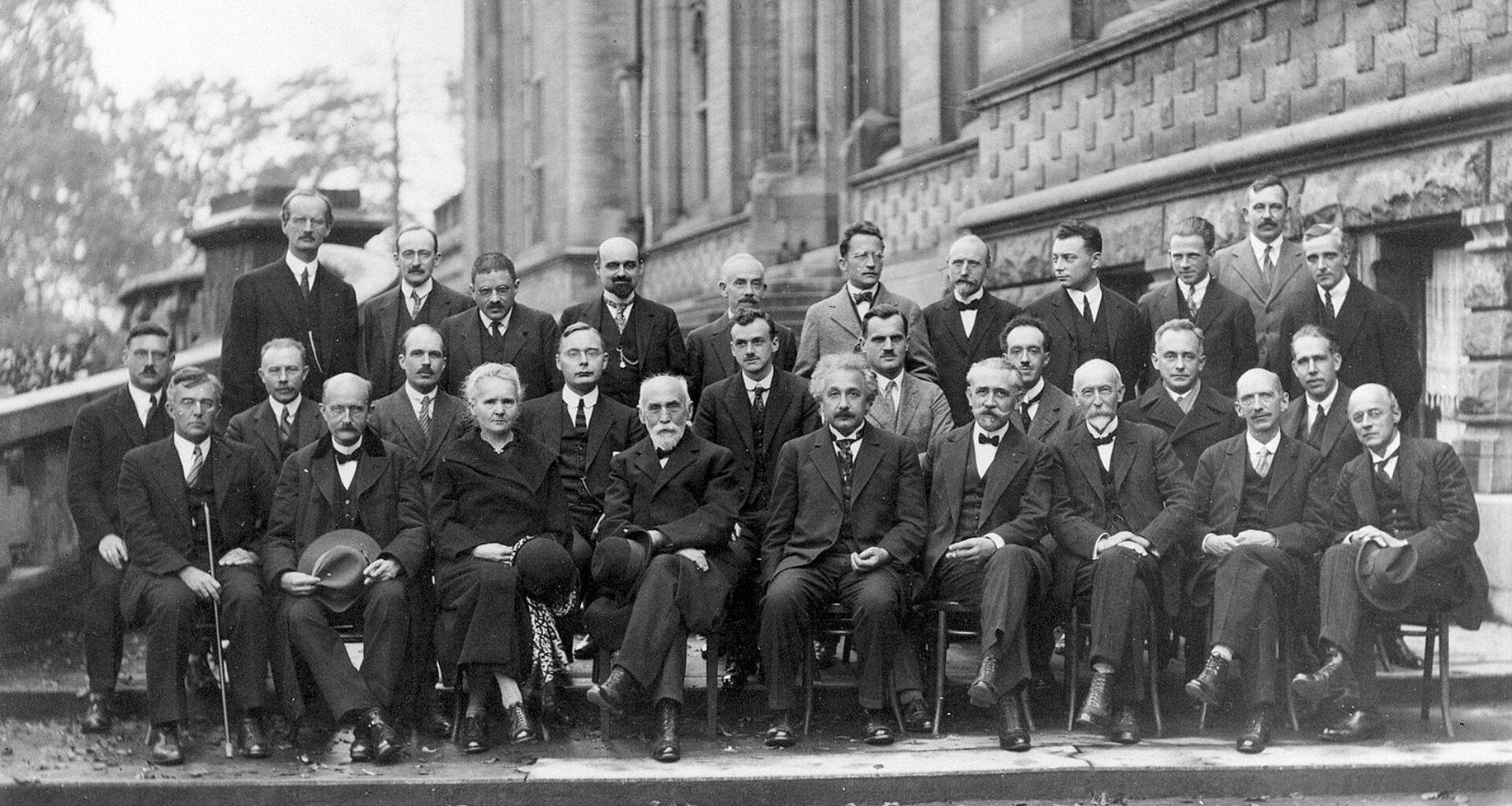
Quantum physics just delivered a full-circle moment a century in the making.
A team of researchers at University of Science and Technology of China (USTC) has reconstructed one of Albert Einstein’s most famous attempts to poke holes in quantum theory, and the results land squarely in Niels Bohr’s camp.
Using an exquisitely sensitive single-atom interferometer, researchers led by Pan Jianwei have brought Einstein’s 1927 thought experiment into the real world with unprecedented precision.
Their setup shows, once again, that the quantum world refuses to let us see everything at once.
Einstein had argued that it should be possible to determine a photon’s path without destroying its wave interference pattern.
Bohr countered that the universe simply doesn’t work that way as some of its properties are fundamentally incompatible in a single measurement. Nearly 100 years later, the Chinese team found nature siding with Bohr.
In a statement cited by South China Morning Post (SCMP), reviewers of the work called the experiment “a significant contribution to the foundations of quantum mechanics,” praising it as “beautiful” and “a textbook realisation of a century-old thought experiment.”
A century’s echo returns
The project revisits the iconic double-slit experiment, where single photons behave like both particles and waves.
Einstein’s twist was to insert a movable, ultra-light object into the setup that could register the photon’s minuscule “kick” and reveal which slit it used.
In 1927, no detector on Earth was sensitive enough to measure that recoil.
Pan’s team solved the problem by trapping a single rubidium atom in laser light and chilling it to near absolute zero. This lone atom effectively became Einstein’s movable slit.
When the atom was loosely held, it wobbled just enough to betray the photon’s trajectory. But the interference pattern vanished.
When the atom was tightly confined, the wobble disappeared, the photon’s path became unknowable, and interference returned, exactly as Bohr predicted.
“By tuning the photons’ momentum uncertainty,” an accompanying American Physical Society (APS) article explained, Pan’s team could “make the fringes more or less blurry, in line with theory.”
New doors to open
Although the result doesn’t overturn quantum mechanics (Bohr won this argument long ago), it creates one of the cleanest testbeds to probe the subtler corners of quantum theory.
The experiment’s single-atom control gives physicists a rare ability to study how quantum systems lose their coherence or become entangled with their surroundings.
According to the APS article, the setup “has the potential to explore other, less established aspects of quantum mechanics,” including how entanglement and decoherence influence each other.
Those questions matter far beyond academic debates.
Understanding how quantum states degrade could help engineer more stable qubits, build ultra-precise sensors, and refine quantum communication networks.
The results were published in Physical Review Letters.