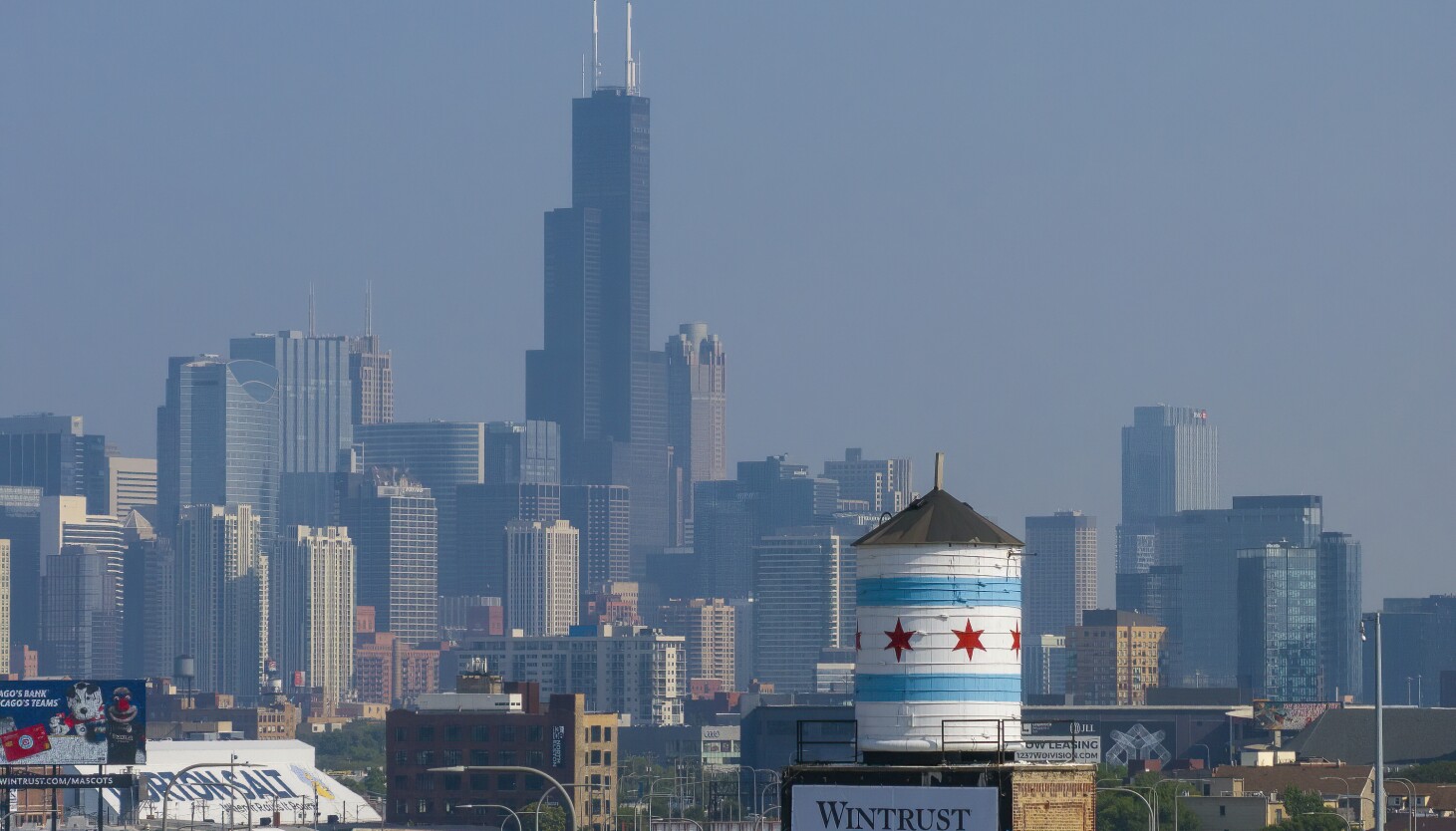
Good afternoon! It’s Friday, and my latest song obsession has kept me sane while stuck on the bus in Lake Shore Drive traffic this week. Here’s what you need to know today.
1. Chicago’s 20-year development plan for Downtown calls for more nightlife, housing and greenery
Chicago has one of the nation’s fastest-growing downtowns, and the city’s Department of Planning and Development hopes to shape its growth with the first comprehensive downtown development plan in more than 20 years.
The plan includes more than 250 goals, actions and strategic projects such as more nightlife, office-to-residential building conversions, transportation enhancements and flexible green spaces that can host year-round events.
For example, officials proposed extending the Chicago Riverwalk between Lake Street and the south branch of the Chicago River. They also want an extension between Wolf Point and the Wild Mile, as well as new water taxi stops.
As Abby Miller reports for the Chicago Sun-Times, this is the latest update to a framework the city puts together every 20 years on the future growth and development of Downtown and adjacent neighborhoods. [Chicago Sun-Times]
2. A Cook County drug court program is helping nonviolent offenders overcome substance use
Fourteen graduates got their records expunged for completing the (W)RAP program, which offers nonviolent offenders treatment and support as an alternative to incarceration, my colleague Anna Savchenko reports for WBEZ.
“Having a substance abuse disorder is not a moral failure. It’s a recognized disease,” Cook County Judge Charles Burns told the graduates, who packed the jury box as some wiped away tears.
Hara Scalin, 52, said the hardest part was the beginning, when she had to “learn how to deal with emotions and problems without the use of drugs and alcohol.” But the accountability aspect of (W)RAP, including frequent drug tests and regular court appearances, helped her heal.
The program has graduated 1,151 participants since its inception in 1998. Leaders say they look for people within the justice system facing nonviolent charges that show a clear link between a substance use disorder and their criminal history. (W)RAP relies on community partnerships to help participants get jobs and find housing. [WBEZ]
Independent restaurant owners have struggled to stay afloat in the two months since U.S. Immigration and Customs Enforcement and Border Patrol enforcement actions prompted foot traffic to dry up, WBEZ food contributor Maggie Hennessy reports.
“Some restaurants are starting to recover but aren’t at pre-raid business yet,” said Alonso Zaragoza, a community organizer and founder of Belmont Cragin United, an online resource center for residents. “Things are looking up for businesses in the area though, and hopefully they are able to get back on track.”
Zaragoza said that since he spearheaded the Taste of BC series to bolster struggling restaurants, more owners reported seeing new faces from outside the neighborhood, some of whom “are starting to come in regularly too.” BC United continues to host and platform Whistle Packing and Know Your Rights workshops around the city. [WBEZ]
4. Pope Leo helped shield clergy accused of abuse in Peru, abuse survivors allege
Survivors of clergy abuse are calling for an investigation into Pope Leo XIV during his tenure as bishop of Chiclayo in Peru, alleging he played a role in covering up how priests and clerics accused of sexual assault were allowed to continue their roles in the Catholic Church.
New recordings of church officials spurred the Survivors Network of those Abused by Priests to file an updated complaint with the Vatican, Violet Miller reports for the Chicago Sun-Times.
Recordings of a meeting from this past April between the Rev. Giampiero Gambaro with Ana María Quispe Díaz and others accusing Peruvian clerics of assault revealed the man they accused had confessed to church officials years ago, and he was granted an “honorable discharge” in September. The Chicago Sun-Times reviewed a translated version of the recordings made public by Conclave Watch. [Chicago Sun-Times]
A city panel unanimously approved the designation for 30 N. LaSalle St., the 44-story skyscraper for which the historic Chicago Stock Exchange Building was demolished — causing a civic uproar — in 1972.
As Chicago Sun-Times architecture columnist Lee Bey writes: “The idea of landmarking the 30 N. LaSalle hit a sore spot with some preservationists (and this architecture critic) because the unrelentingly drab tower was built 50 years ago to replace the far superior structure designed by Louis Sullivan and Dankmar Adler in 1894.”
The fight to save the stock exchange led to the city’s modern preservation movement. It also claimed the life of preservationist Richard Nickel, who was killed in 1972 after a portion of the old building collapsed on him as he salvaged the structure’s ornament. [Chicago Sun-Times]
Here’s what else is happening
- The Centers for Disease Control and Prevention’s vaccine advisers voted to roll back a universal recommendation to start hepatitis B immunization at birth. [NPR]
- The U.S. Supreme Court will decide whether President Donald Trump’s birthright citizenship order violates the Constitution. [AP]
- Architecture titan Frank O. Gehry died at 96. [New York Times]
- Netflix announced a deal to purchase Warner Bros. and HBO for $72 billion. [CNN]
Oh, and one more thing …
It’s beginning to look a lot like Krampus around Chicago.
There’s no known origin story that pinpoints the exact birth and time of Krampus, but he’s been a folkloric antihero for centuries in the European Alps, including Germany’s Bavaria region, Austria, Switzerland, Slovenia and northern Italy. In early December, many of those regions host annual Krampus runs, elaborate parades where costumed beasts roam the streets.
While Santa Claus’ dark counterpart was born centuries ago in Europe, Krampus’ recent explosion in the U.S. is all thanks to one Chicagoan who featured the beast in his comic zine 20 years ago, my colleague Selena Fragassi reports.
Monte Beauchamp introduced America to Krampus in a feature about century-old postcards in 2000. The issue became so popular, it led to a partnership with comics publisher Fantagraphics to produce the first U.S. book about the character, 2004’s “The Devil in Design: The Krampus Postcards.” [Chicago Sun-Times]
Tell me something good …
What memories stand out of you celebrating the holiday season in the Chicago area?
Jim writes:
“I was just telling my spouse at dinner [last night] that one of my fondest memories of the Christmas season was when a group of about 8 of us from H-F high school would go caroling, caroling caroling through the snow in Flossmoor back in the early 70s. I have to wonder if kids/adults still do that.”
Anne writes:
“A youth experiencing homelessness had told me, ‘I never get to celebrate holidays on the holiday because homeless program staff want to be in their homes on the holidays. It makes me feel very lonely and left out.’ I decided to change that up. For nearly 8 years, during the time I worked for The Night Ministry, I held a Christmas Eve party at a restaurant in Bucktown called Lazo’s Tacos. I would invite all the youth receiving Aftercare social services who had once stayed at the Open Door Homeless Youth Shelter. Sometimes there was karaoke. Other times a local Salsa band would be playing. Sometimes there would be a Santa for both the young and the old. We would celebrate the successes they had made in their lives over abundant Mexican food choices. Then I would pass out gifts that I or The Night Ministry had gotten donated. Every young person got a stocking filled with useful things like hygiene items, gloves, and hand warmers. Sometimes I was able to give everyone a new coat, or a book bag, or a gift card so they could choose their own gift rather than just get a handout. Other times it was fun stuff, like cute animal stuffies. Always I had some supplies for the parenting youth and their children. I am now retired and I look back on these as the best Christmases in my life.”
Thanks for all the responses this week! I couldn’t include them all, but it was great hearing from everyone.