
By Jennifer Asencio
| Updated 11 seconds ago

Survivor leaped onto our television screens in May 2000 and very quickly created a sensation. The show’s premise stranded a group of 16-20 people on a deserted beach, where they competed against one another for a $1 million prize. Now, the show is approaching its 50th season, which is set to begin on February 25, 2026.
While it is reasonable to expect a series that has lasted over a quarter of a century to change and evolve over time, the fact is, not all these changes have been for the better. Unfortunately, Survivor sucks now.
Survivor Used To Be About The Location
 Survivor Season 3 in Africa
When the show began, its star was neither the cast nor the game but the location. The first season was just called Survivor, but starting with the second one, Survivor: Australia, the show’s filming location was its primary identifier for all but the “special” seasons like All-Star or Heroes vs Villains.
Even the Fans vs Favorites and Blood vs Water seasons are known for locations like Micronesia and San Juan del Sur; the two Brawn vs Brains vs Beauty seasons are Cagayan (Indonesia) and Kaoh Rong (Cambodia), respectively, after the places they were filmed. Better yet, many of the competitions featured elements of the local culture, such as historical weaponry like blow guns and javelins or rewards of regional foods and interactions with locals.
Survivor Cuts A Deal With Fiji
 Survivor Season 49, in Fiji
The show eventually made a deal with the Fijian government, removing the location as a feature. For several seasons, production tried to use themes, like Millennials vs GenX and Edge of Extinction, to compensate for the same beaches always being used.
After season 40, Winners at War, it seems to have given up even that much effort. The “new era” seasons are simply the numbers 41 through 49. The contract with Fiji may have saved Survivor some money, but it took away one of the show’s best features: the intertwining of local culture and history with the game’s competitions and themes.
Changing The Nature Of The Game
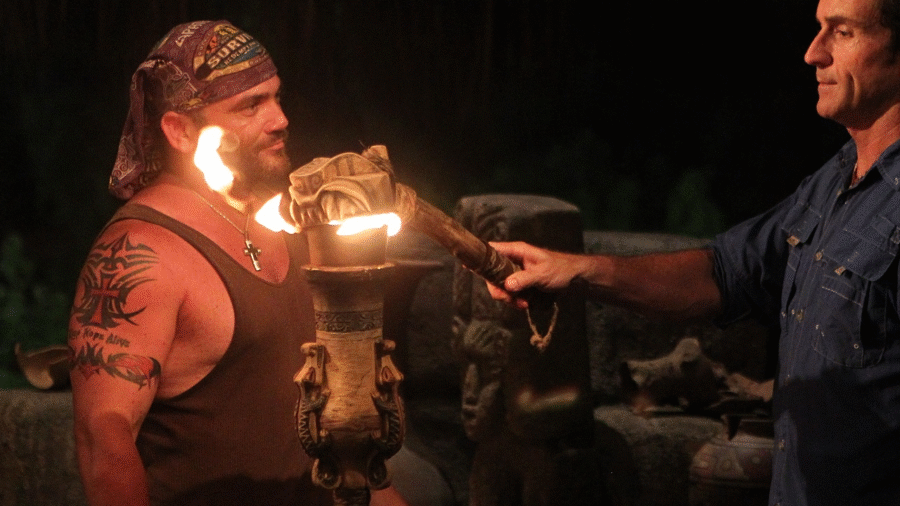 Notorious old school Survivor villain Russell Hantz
“Production,” led by host Jeff Probst, has significantly changed the game during its run. In Season 11, it introduced the Hidden Immunity Idol. After several seasons of that being the only advantage in the game, other advantages were added so frequently that an entire season (Ghost Island) centered around how these wild cards were misused in previous seasons.
All the new game elements and unexpected twists have become so excessive that fan backlash led to the cancellation of one of them, as viewers thought it was unfair to the players. In the “new era,” strategy revolves around and is often interrupted by these twists and advantages.
 Jeff Probst goes for good vibes in modern Survivor
The casting of the show has also evolved over time. The first season of Survivor featured an infamous and fiery speech at the final tribal council in which a betrayed player referred to the final two as “a snake… and a rat.” One contestant deliberately caused chaos in camp. Another lied and told his tribe that there was a death in his family. The show has featured so many villains that an entire season was structured around the theme of heroes and villains.
There could be no such season today, though, because casting doesn’t recruit villains who are quite so extreme. The contestants are so friendly with each other that the only difference between the game and Boy Scout camp is a bag of marshmallows and a rousing round of “Cumbaya.” Emphasis has been placed on kindness and camaraderie rather than competition, and every contestant has a “compelling backstory” that justifies the way they fight for the million-dollar prize.
Survivor’s Game Is Shorter Now

COVID regulations reduced the amount of time the game is played by nearly two weeks. Although those restrictions have been lifted, the shortened 26-day format costs less than the original 39-day format, so it doesn’t look like production is returning to the old way.
The game suffers because the strategy, already interrupted by too many advantages and idols, is also curtailed by the accelerated format. This means viewers see less gameplay in favor of challenges, finding advantages, and backstory, as contestants don’t have as much time to form alliances or strategize together.
Jeff Probst Has Become A Problem

Since production has done so many things to diminish the show, and Jeff Probst is one of the lead producers, it is only logical to look to his hosting as a potential problem. While Probst has admittedly gotten better at Tribal Council interviews, he has also spent so much time inserting himself into the game that he has become part of it rather than an observer and commenter.
It doesn’t help that he is getting old, and it’s clear the show is taking a physical toll on him after 25 years. However, he has also tried too hard to shape the social impact of Survivor from his position as both host and executive producer.
Can Survivor Be Saved?

Survivor will never regain the notoriety it had in its early seasons, but I don’t think the show is a lost cause. That said, I don’t have much faith that production will do some of the things it needs to do to revive the show, like return to changing locations and ending the overabundance of twists and advantages.
The reality game show still has enough viewership to justify a 50th season, regardless of whether fans complain. So, it doesn’t motivate the show to change. However, they have begun making some moves in the right direction. The infamous hourglass twist showed that the producers are willing to make some adjustments when needed, proving that Survivor is, itself, a survivor.